“The Race for Universal Monarchy: Apocalypticism and the Ottoman–Habsburg Rivalry in the Sixteenth-Century Mediterranean”
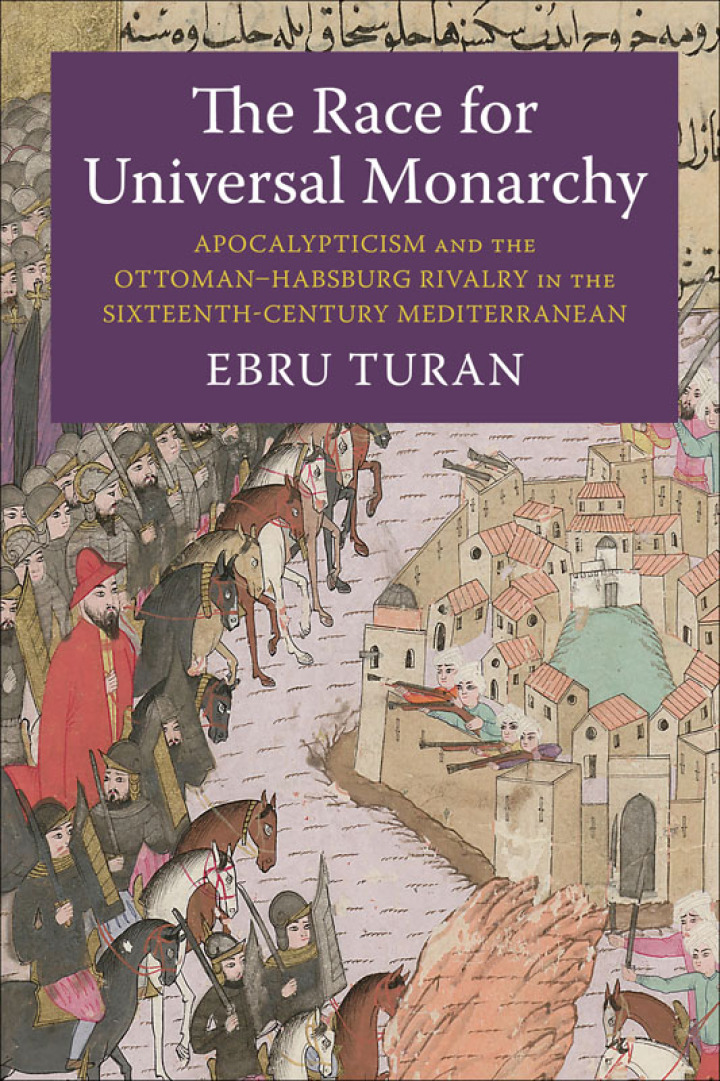
“The Persian learned men,” wrote Herodotus in his Histories, “say that the Phoenicians were the cause of the feud.” Historians have been trying ever since to understand the series of wars that set Europe and Asia against each other, going back to the Trojan War. In The Race for Universal Monarchy, Ebru Turan argues that, in the centuries-long struggle between the Habsburgs and the Ottoman Turks, each side saw the overthrow of the other as necessary to usher in the end of time and a messianic era. Readers will wonder: how much does ideology drive, as opposed to merely clothe, the moves of historical actors?
How much does ideology drive, as opposed to merely clothe, the moves of historical actors?
Others might emphasize economic drivers as playing the decisive role. When the French king Charles VIII conquered Naples in 1495, he justified this land grab as the first step in leading a crusade to recover the Holy Land for Christianity. At the same time, Naples’ fabled wealth more than justified its conquest. In the 15th and 16th centuries, a great deal of the world’s commerce passed through the Red Sea and the eastern Mediterranean, making it hard to separate ambition in this world from ambition in the next. Nor did even the most eloquent calls for crusades against the Turks always succeed. The great humanist Aeneas Silvius Piccolomini, later Pope Pius II, spent much of his life arguing for a crusade against the Turks, with great force and eloquence, but with disappointing results.
Marshalling extensive erudition in German, Latin, Italian, Ottoman and Persian, Turan makes a convincing case, however, that the ideology of universal monarchy and the notion of the end times had a powerful impact on the two most important rulers of this age: the Habsburg Charles V and the Ottoman Kanuni Süleyman “the Magnificent”.
While trying to assess the impact of ideas on society in the abstract is fraught with difficulties, it makes sense to look at the impact of ideologies on individuals, since people become the stories they tell about themselves. Charles V believed himself descended from Charlemagne, a potent symbol of Christian unity. He wanted to fulfill the grand design of his grandfather Maximilian (“the Last Knight”) to lead a crusade against the Turks. Süleyman’s father, Sultan Yavuz Selim (“the Grim”), claimed descent from Alexander the Great, a figure revered in Persianate culture as a universal sovereign. Selim’s conquest of the Muslim holy sites gave the Ottoman sultanate a eschatological dimension.
Charles V, through a series of improbable deaths, inherited a vast empire, including the thrones of Spain and Hungary. His careful diplomacy got him elected Holy Roman Emperor. Victories on the battlefield eclipsed his French, Venetian, and papal rivals. No western European since Charlemagne had wielded such temporal power.
The rise of Charles V frightened the Turks, who believed prophecies that the end times would ensue following a Christian reconquest of Constantinople and Jerusalem. Süleyman, however, had his own plans. He claimed to be the only legitimate Roman emperor, ruling from Constantine’s imperial capital, and threatened to drive the pope out of the Vatican. He hoped to unite all peoples under one rule, though not necessarily under one faith, since his empire already contained many Christians and Jews. Both Charles and Süleyman believed in their universal vocation and in their right to rule from the other’s capital—a poor formula for peaceful coexistence.
One of Turan’s key contributions is to highlight the persistence of the crusading ethos in Europe, and the corresponding fear of crusaders in the world of Islam (which does not abate when the American secretary of war sports a tattoo “Deus Vult”). When we think of the Crusades, we are inclined to restrict our imaginations to the First Crusade, which captured Jerusalem in 1099. Didn’t the age of the Crusades end with Saladin’s retaking of the holy city in 1187? Often overlooked is the series of crusades undertaken throughout the Middle Ages, including the disastrous defeats at Nicopolis and Varna. Probably because they ended in defeat, they appear to have less historical significance for the modern age. But from the Muslim point of view, these successive attempts to extirpate their faith from Europe, and possibly from Anatolia and the Levant as well, represented a constant threat.
The titanic, ongoing struggles between Christendom and Islam were not just a feature of mediaeval thinking, then, but also coloured the sense of purpose of both Charles V and Süleyman. Both sides became convinced that the other planned their annihilation. These campaigns did not arise from vainglory or greed, though such motives always play a part, but from a cold-blooded assessment of the political and military balance of power.
Readers will be reminded that in this age the divine and the prophetic appeared as real and significant as the sun rising and setting. Few doubted that the world would end in an apocalypse. They debated whether the triumphs of the cross or the crescent would trigger the last days, and, of course, which faith offered the better outcomes thereafter. Turan points out that some Sufis preferred the teachings of Jesus to those of Muhammad, while some Jews rooted for Süleyman to avenge the destruction of the Temple by the Romans and usher in the Jewish messiah. The multi-ethnic, multi-religious character of the era is underscored by the subplots concerning Alvise Gritti—a Venetian in Süleyman’s service—and Ibrahim Pasha, his favourite and a convert to Islam; their stories are told more fully in Christopher de Bellaigue’s The Lion House.
With its refreshing absence of academic jargon, The Race for Universal Monarchy provides a solid summary of this crucial era in world history, both politically and intellectually. The book could have benefited from tighter editing to avoid redundancies. Also, readers who get wrapped up in the drama as Charles and Süleyman emerge as conquerors on the world stage may be disappointed by the book’s lack of a real climax, as Turan concludes with a deep dive into the intellectual history of Ottoman messianism and leaves the conclusion of their rivalry to be told, one hopes, in another book.