“To Compare” by Xuela Zhang
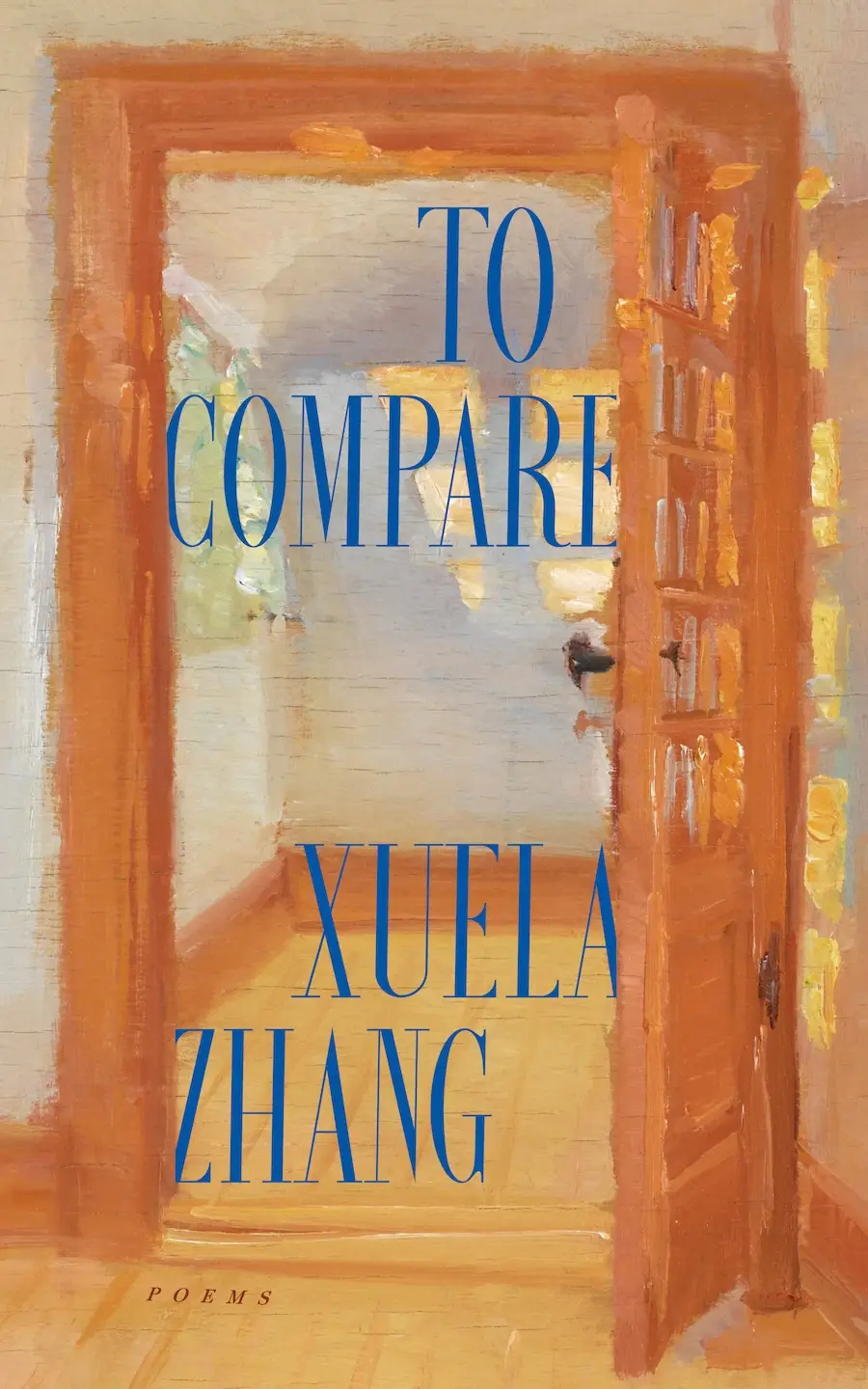
Xuela Zhang is a translator and scholar in addition to a poet; she writes in English and Chinese. In her wry, ambitious, and elegant debut collection of poetry, To Compare, she trains her exacting and precise eye on the experience of living between the US and China, translation and language, and the skewed, discriminatory power structures implicit in both. Zhang holds strong views on literary translation and how it has been practiced, an inherently ambiguous enterprise, and in To Compare, she expands, explores, and clarifies these arguments with delicacy and comprehensiveness.
Zhang also delves deeply into religion and spirituality, grief, loneliness, relationships, and the COVID-19 pandemic (there is a poem that pays homage to Li Wenliang, the famous Wuhan doctor who warned about the outbreak early on). Often featuring short, measured lines and simple, repeating phrases, the poems in this collection are accessible and invite re-reading.
The book’s seven major sections (“Quarantine”, “To Compare”, “Prelude to Translator’s Note”, “Journey to the West”, “Translator’s Note”, “To Compare”, and “Land Art”) serve as the names of their constituent pieces. (The exception is “Journey to the West”, with pieces on Monkey and Pig, two characters derived from the classical Chinese novel.) The collection takes its title from the “To Compare” poems. It highlights the work’s central tension: the futility, gaps, and ambition inherent in the switch from “the voice of someone” to the “lower, clearer voice of someone’s translator”.
Zhang often starts with a simple, self-evident statement, interrogating and complicating the premise; the poem becomes progressively abstracted and surprising. Her narrative is direct and deliberate in its rich imagery, underscoring her turns of thought.
In “To Compare”, she addresses the unnamed translator, loosely imagined as someone unfamiliar with the source text, who, in excavating meaning from it, learns more about the source language and the process of translation (“the more you learn”):
The lights sliding up
and the lights sliding down
are simply the features
of a curvy city…
into a smaller city.
The lights receding,
the lurking interior
becomes precise.
The more you learn,
the more you rely on
abstruse information.
In the analysis…
Zhang here imagines the source language as a “curvy city”. A single phrase simultaneously contains nuance and a multitude of meanings. In the translation, meaning is controlled and “precise”, unlike the “momentum” and multiplicity of the source language. Zhang goes on to enumerate how the translator’s decision reflects their perception of the source language as foreign.
Your decision
is not about words,
but the exoticized
range of choices.
Has language
passed you by
like a curvy city
or shielded
and isolated you,
an illuminated vehicle
against the flooding
tenors of light?
Zhang also questions the purpose of translation itself. She asks whether the act of translation is simultaneously inevitable and inherently violent and othering.
Elsewhere in “To Compare”, Zhang invokes the major American poet Ezra Pound’s English translations of Chinese poems. By explicitly stating that “he did not know Chinese”, she draws attention to the authority—and the implicit responsibility—of the translator.
But some say
translation is love.
Maybe, like love,
it has to be secured
in vast insecurity.
In Pound’s first
translation of Chinese
(when he did not
know Chinese),
he missed much
in the initial poem.
Later, he retranslated.
His emphasis changed
from
“Horses, his horses even, are tired. They were strong.”
to
“(no one feels half of what we know).”
Here, Pound’s original translation of a poem attributed to the great Tang poet Li Po, based on the notes of American writer Ernest Fenollosa, was rooted in literal “insecurity”—the lack of knowledge of the Chinese language and the original text. Zhang emphasizes that he “missed much” in the original poem while acknowledging the fundamental untranslatability of the source material, evident in the fact that he returned to the text, the change in his “emphasis”, and the two wildly divergent interpretations. In this poem, she draws attention to the role of Pound’s translations in the creation of modernist poetry techniques, highlighting and challenging the view that Pound’s translations constitute original poetry inspired by the Chinese texts.
In “Journey to the West”, Zhang expands the possibilities of the 16th-century Chinese novel of the same name by re-interpreting two key figures, Monkey and Pig. In the original tale, the characters travel to India from China to collect sutras and “source text”, a detail retained in To Compare. However, Zhang’s journey stretches further westwards to the US, with characters intrigued by “Donald Trump’s hand movements”. That Zhang builds upon the world of the classic signals that it is a deeply felt, inherited narrative. In retaining its key elements, she differentiates herself from translators such as Pound, who, inspired by the idea of the original, create elaborate works different from the original text.
“Interview: Monkey” is related from the perspective of the shape-shifting Monkey King, but also reflects the poet’s concerns as a Chinese woman navigating the US.
They would rather hear me speak
what they did not understand
so they could just relax, and watch me.
I smiled like a machine
and tried to manage the desirability
of my weirdness and I could,
near the end, tell
that they relaxed
and regarded me as artistic.
Broader society would rather watch her, almost as an exhibit, instead of conversing with her as an equal.
“Translator’s Note” strips the façade away. Deeply intimate, the poems explore the themes of loss, illness, and death (“There is no word for dying, the present participle, in Chinese”). For instance, in the excerpt below, the poet is not the woman who “smiled like a machine” and “managed” her “desirability”; she is frenetic and keeps “asking questions”, mimicking the rawness of illness.
Last winter, you watched the members of your family—
that is, the three of you—settle in their own ways…
My father looked at the floor
silently, up to a point.
My mother and I kept asking
the questions we thought
were worth asking…
The shift in vantage point—from the “you” to the “I”—evokes a shot filmed from different angles. Zhang studies the family at a remove before re-inserting herself into the scene, at once chaotic, poignant, and candid.
To Compare is a taut debut with poems that expand, redact, and revise the themes of translation and language. A studious inquiry into the experience of living between two countries, this collection is at once a serious and ironic meditation on grief and selfhood in a fractured world.