“Rat Race” by Mamta Kalia
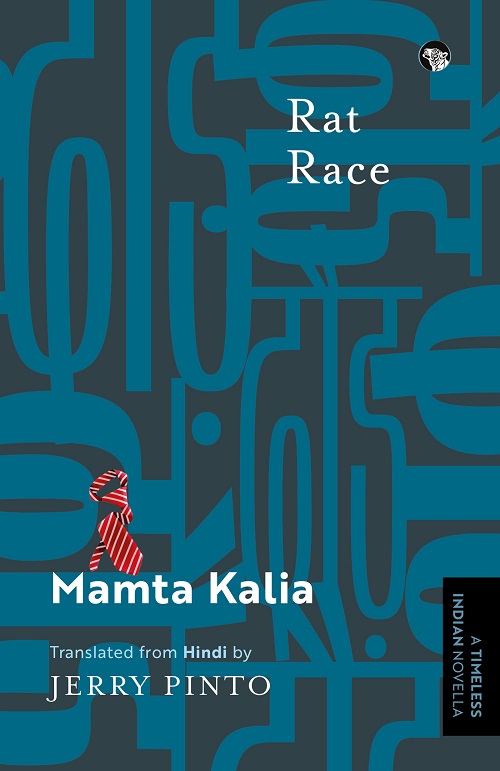
Rat Race is a slice-of-life story following characters in a modern, capitalistic India as they balance the demands of ambition and family. While originally written by Mamta Kalia in Hindi as Daud at the turn of the millennium, and possibly qualifying as a “modern classic”, Jerry Pinto’s 2026 translation still aptly encapsulates many elements of the career-minded Indian.
The story largely revolves around Pawan Pande, a 20-something professional trying to find his place in the corporate world, having graduated from the prestigious IIM Ahmedabad. He has moved away from his family, who are based in the much smaller city of Allahabad, in pursuit of an MBA. He lands a job he sees as less-than-ideal but enough to sustain him until he can jump ship to bigger things.
Kalia masterfully ties the book’s title to its opening image: a computer mouse lying inert on a desk during a power cut. Mice terrified young Pawan in Allahabad’s kitchen not long ago, and they have now been replaced by their plastic avatars.
Leaving home in search of better opportunities is a rite of passage in many Indian households. While that phenomenon and the dilemmas they create are not new, the millions of lives they have impacted make their tales worth telling, 26 years on. Throughout, Kalia makes evident the tension between professional aspirations and the risk of letting one’s personal life slip away. In the opening pages, Pawan misses his family in moments of despair, but later argues against ever moving back home, as doing so would derail his career.
Generational difference is a recurring theme. Even with the best intentions, parents and children struggle to see eye to eye.
Capitalism can often make it seem like there are only two choices: one either relentlessly pursues one’s goal or leads an unremarkable life with little sense of accomplishment. This “rat race” gets the best of most people and comes with trade-offs that society accepts as the price of success. It is this expectation that drives Pawan’s parents to encourage him to pursue an MBA in the first place.
Yet, just as he begins climbing the corporate ladder, his parents urge him to stay closer to home and to hold on to the values they imparted. Pawan feels nostalgic about home but grows disconnected from it to an ever greater degree. He belittles Allahabad as a city that never changes, and yet feels offended when his mother calls him a tourist there.
He struggles with this irony repeatedly: he wants to feel connected to his roots but doesn’t always know how. He attempts to find meaning elsewhere, including through a spiritual awakening via a Godman his colleague follows. As his father observes,
Pawan isn’t a single swallow. He is of his generation. They are the ones who will cut themselves off from their roots and reinvent what society looks like.
The 120-page novel shifts perspectives across several people in Pawan’s world, showing how different lives can look even when people make similar choices. Some of these perspectives belong to women. Abhishek Shukla, Pawan’s friend, is often at loggerheads with his wife, Rajul. With a job in advertising, Abhishek appears content in his fast-paced life—something Rajul resents, having sacrificed her own flourishing career to have a child at a time of her husband’s choosing. Her pregnancy resulted in fewer responsibilities at work, eventually costing her the job entirely. Their dynamic illustrates how people cave to societal pressure even when it runs against their own desires.
Stella D’Mello, by contrast, is Kalia’s counter-figure: a mixed-heritage businesswoman who runs her own company, refuses the kitchen, holds a black belt in taekwondo, and treats marriage as a partnership between equals rather than an absorption.
Generational difference is a recurring theme. Even with the best intentions, parents and children struggle to see eye to eye when their worlds have diverged so completely. When Pawan decides to marry Stella, who is quite different from what his parents had in mind for him, his mother, Rekha—despite her closeness to him—struggles to accept the relationship or the couple’s plan to live apart for months at a time. The tension this creates is both physical and emotional.
Rekha wondered bitterly if this was some karmic justice that was being done to her. She was not ready for a repeat of that time in her life. She did not see this as being the same thing. She had fulfilled all the obligations of a woman who had chosen to marry for love. Stella did not seem ready to do anything of the kind.
Rekha and Rakesh are not portrayed as brutes, however. They eventually accept that Pawan knows how to navigate the current world better than they do, and that they cannot expect him to clip the same wings they sent him away to grow. This realisation is reinforced when their younger son, Saghan, leaves for Taiwan and finds his way, unexpectedly, into political activism.
Jerry Pinto’s translation reads naturally without drawing attention to itself.
Kalia paints a realistic picture of the friction modern life creates between what is old and familiar and what is modern and necessary. This manifests in the evolving relationship between the characters’ personal and professional lives as each defines success and meaning for themselves. Jerry Pinto’s translation reads naturally without drawing attention to itself, complementing Kalia’s writing. He handles the range of registers in the original well, from corporate jargon to domestic arguments.
By the novel’s end, Pawan has fully bought into the chase: home is wherever he earns his salary, and spirituality is a four-day retreat designed to prepare you for Mondays. His job is his top priority, while proximity to his wife and parents is secondary.
Rat Race is an easy read that asks an important question: what does society lose when it prizes single-minded ambition above all else? The answer, Kalia suggests, accumulates quietly, in small, intangible losses that are easy to miss but also feel inevitable in the quest to achieve things.