“The Country Doctor’s Tale” by Mohamed Mansi Qandil
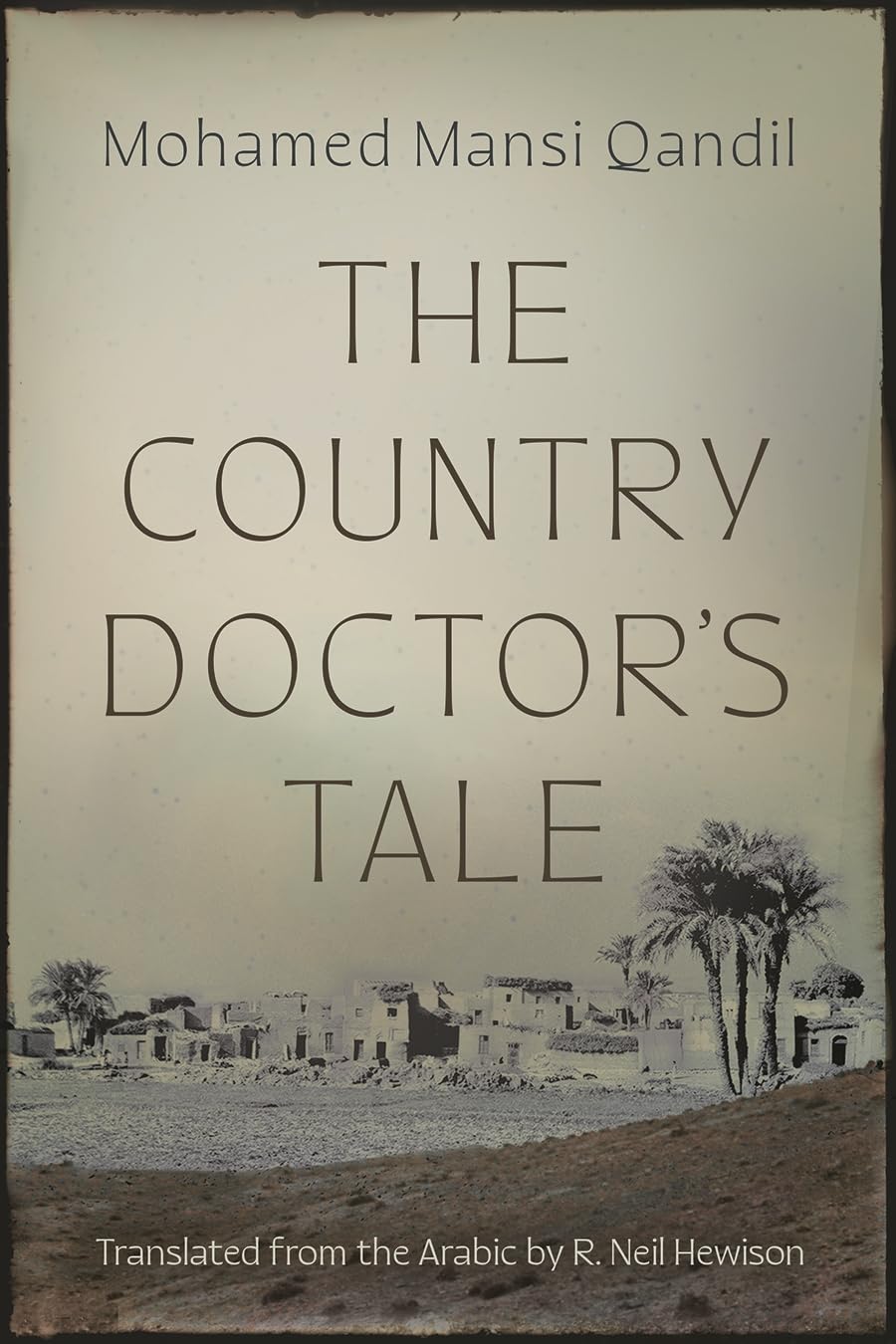
In 2006, Mohamed Mansi Qandil won one of Egypt’s most prestigious literary prizes, the Sawiris Cultural Award, with his breakthrough novel, Moon over Samarqand. In 2010 A Cloudy Day on the Western Shore was shortlisted for the International Prize for Arabic Fiction. His latest novel, The Country Doctor’s Tale, has now been made available in English, in a translation by R Neil Hewison.
Qandil initially trained as a doctor. Before he became a full-time writer, he worked in the clinic serving a village in Upper Egypt. The Country Doctor’s Tale is set during the politically turbulent years of the early 1980 —though neither politician is ever named, Anwaar Sadat was assassinated in 1981, and his death was followed by the rise of Hosni Mubarak.
The novel’s narrator, Doctor Ali, who is named only once, has lately suffered torture in a Cairo prison. On his release, he is internally exiled to a remote, impoverished village in Upper Egypt. In this unnamed village, presumably based on the one Qandil experienced first-hand, Doctor Ali finds himself attracted to a local woman, Farah, one of the clinic nurses. Farah is married to her cousin Eissa, but she reciprocates the doctor’s feelings. Though they both know that in the socially conservative village adulterers are publicly shamed and treated harshly, the couple arrange to spend a night together. Farah conceives—but comeuppance is swift.
Eissa, a day labourer, wants to quit the village and cross the border. Why? In his translator’s note Hewison explains that Eissa wants to work in Libya, where thanks to the oil boom, his earnings should be higher than any he can achieve in the village. To reach the border, Eissa must pay a people smuggler, a Bedouin sheikh, to lead him across the desert. Eissa cannot afford the fee, so he asks Doctor Ali for money, and is successful in his petition. Neither man tells Farah of their transaction. Eissa dies during the desert crossing: widowed and pregnant, Farah now guesses that Doctor Ali gave Eissa the money to pay the Bedouin sheikh; she blames her illicit lover for her husband’s death.
This bald summary of the main plot cannot however do justice to Qandil’s novel, which is satisfying on multiple levels. Hewison’s translation is fluent. As he renders it, Qandil’s prose is unfussy, but lush and sensory: it evokes to great effect both the social world and the physical world of an Upper Egyptian village. Here, Doctor Ali is standing on his balcony, before the morning mist has dispersed, watching the villagers’ early parade to the fields. The previous day, these same villagers had beaten an adulterer, but now calm has returned:
The tresses of the palms swayed softly, and the white birds shook off the dew from their wings. Sounds echoed from far away, perhaps the lowering of a cow or the faint barking of dogs. But nothing disturbed this clarity and the gentle peace that accompanied the rising of the sun. Where had the cries of savagery gone that had rung out the day before? How had they lowered their voices and their heads and changed their masks so quickly? They had stripped off the mask of naivety, then the mask of entreaty, then the mask of violence, before returning to the mask of meekness.
In hands less skilled than Qandil’s the rural doctor could become a cliché: the martyr who works twenty-hour days, and won’t accept payment; the outsider who knows and negotiates his patients’ secrets whilst treating their coughs and sprained ankles; the sophisticate who initially hates rural life before being enchanted by a local love interest. And so on and so forth.
But though Doctor Ali is indeed enchanted by a local love interest, he is no stereotype: he is an authentic and individual mix of good and bad, of firm political principles, and of conflicted attitudes to women. He is initially attracted to Farah because she reminds him of his former beloved, whom he idolised. What does he want from the clinic nurse? To replace his lost love? Sexual gratification? A child? Does he exploit her? Could he ever find lasting love with a woman so far from his equal in power, or in social standing?
He doesn’t seem terribly conflicted about sleeping with another man’s wife, nor, until disaster strikes, to worry overly much about the impact of Farah’s betrayal of Eissa on either her, or on her husband. In short, he isn’t always nice, and thus saved from becoming twee.
Meanwhile, Qandil’s patriarchal village is dominated by the mayor and the brutal head of the local police force—both cynical representatives of a repressive system. The problems Dr Ali must contend with range from domestic abuse to scorpion bites, from boils to requested abortion, all by way of bilharzia. This snail-borne scourge is supposed to be countered by a molluscicide, but the man for years assigned to apply it does not do so against snails, instead he spreads small amounts on the surfaces of water courses, and
waits until the dead or dazed fish float to the surface, then he collects these fish to sell in the market—and that’s the end of his mission.
Though Qandil favours realism, not surrealism, and his doctor is not plagued by the supernatural, his title (in English as well the Arabic Tabib Aryaf) is surely a nod to Kafka’s story titled, in English, A Country Doctor.
Not only does Qandil, like Kafka, subvert the cliché of the rural doctor, but as the misused molluscicide suggests, he is interested in absurdity. He has a very funny episode in which the clinic is used as a polling station for a presidential election, and Doctor Ali is coopted as an election official. Nobody comes to vote, so, under duress, Doctor Ali fills out the ballot papers himself: he marks some of them in opposition to the presidential candidate, only to learn this is a dangerous mistake; the candidate expects one hundred per cent support.
Overall, Qandil’s skill in world building, and as a storyteller, his compelling prose style, his characters’ complexity, and his leavening of absurdist humour render The Country Doctor’s Tale a most beguiling novel, and one which deserves to be widely read.