“The Moys of New York and Shanghai: One Family’s Extraordinary Journey Through War and Revolution”
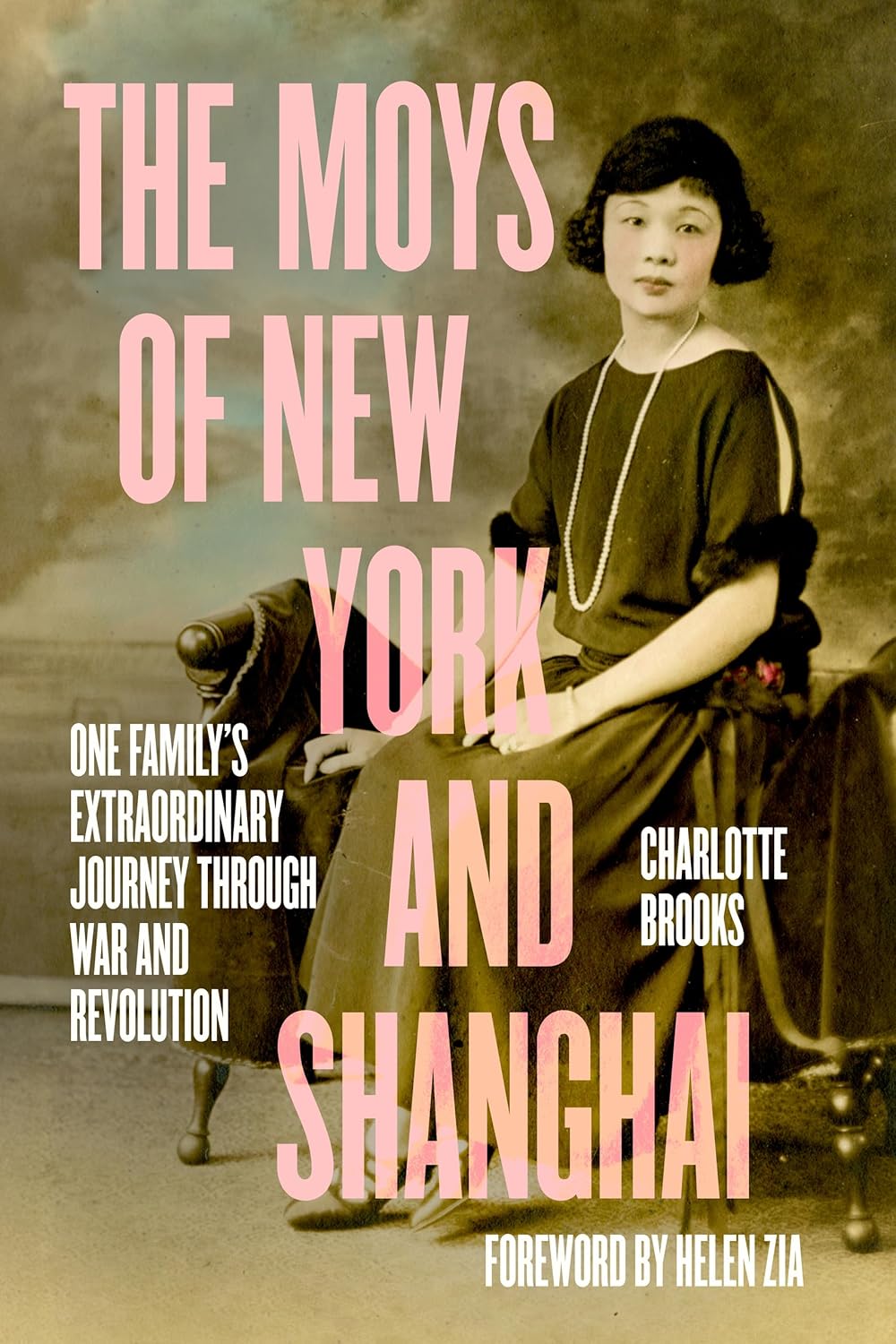
In one of the cases of history not so much repeating itself as rhyming, the current trend of Chinese Americans moving to China, either for opportunity or to avoid perceived threats, is hardly a new phenomenon. Historian Charlotte Brooks tells such a story from a century ago in her new book, The Moys of New York and Shanghai: One Family’s Extraordinary Journey Through War and Revolution.
The Moy family was headed by Sing Moy and his wife Han Ying. They were both born in Taishan in Southern China and emigrated—he first and she to follow—to the United States ironically just around the time of the passing of the 1882 Chinese Exclusion Act. They had six children who survived and most of the book follows the stories of these adult children. Ernest is the second eldest and first son; it’s his story that resonates most for he ends up involved in Chinese politics for four decades.
Ernest married Ruth, Chinese on her mother’s side and of unknown heritage on her father’s. Legend had it that Ruth’s mother was a prostitute and didn’t know which man fathered her baby. Brooks describes Ruth as a doppelganger for Eleanor Roosevelt, something born out by the photos in the book.
In the early years of their marriage, Ernest became interested in what would become the KMT when he founded a newspaper called China Monitor, printed in New York in Chinese for Chinese Americans. A couple of years later he would open the US branch of the Kuo Min News Agency.
Kuo Min acted as the mouthpiece only of the Ministry of Foreign Affairs, led by party leftist Eugene Chen. As for the “news agency” moniker, it was not particularly accurate either. Ernest’s job was not really to gather information but to transmit and monitor it. Much of this work involved lightly rewriting the KMT’s communiques for dissemination to the American press. He also kept a close eye on how journalists reported news from China, sometimes complaining to their publishers about coverage he found unfair. The final part of his job was a familiar one: giving talks about the China situation to interested American audiences.
Eugene Chen was a prominent statesman in the KMT before Chiang Kai-shek took over.
Ernest used his role as the head of the Kuo Min News Agency to wangle a trip to Shanghai, a place he–and other Chinese Americans–hoped would be freer of prejudice than 1920s America. He sailed to Shanghai in 1928 and stayed for five months.
Ernest also had the opportunity to manage the publicity of Peking opera star Mei Lanfang on his US tour in 1930, through which he would rub shoulders with Douglas Fairbanks, Mary Pickford and Irving Berlin. Yet at the same time, his wife Ruth and the tour’s manager, CC Chang, began a long-term affair. Ernest and Ruth ended up moving to Shanghai, as did Ernest’s parents and some of his siblings and their spouses, around the time of Chiang Kai-shek’s “New Life Movement”, inspired by the Christian values of his wife, Soong Mei-ling. But as Brooks writes:
… all their overseas Chinese friends claimed to support the “New Life Movement,” but no one wanted to give up American movies or chic evening gowns. And since they lived inside the foreign-controlled areas, they did not have to.
Although Ernest was devoted to the KMT, not all of his siblings held the same politics. The youngest, Herbert, worked—to the mortification of the other siblings—as a radio broadcaster for a German/ Japanese station in Shanghai.
During World War II and after, when the Chinese civil war resumed, Ernest would flutter between Shanghai, Hong Kong, New York, and Taiwan. He would work for Claire Chennault of the Flying Tigers and later CAT.
After the war, the former Flying Tigers commander ran China Air Transport, a United Nations Relief and Rehabilitation Administration-connected air service. In 1948, Chennault and a partner purchased much of the company outright, with the KMT government owning the rest. The old general had seen Ernest’s administrative abilities during the war and now asked him to join the newly renamed Civil Air Transport (CAT).
CAT was notorious for running covert missions for the United States during the Cold War, but that didn’t bother Ernest. He was staunchly anti-Communist, but by the mid-1950s, he would become disillusioned with the party when he learned about the KMT’s massacres in Taiwan. He would not recover from this disappointment.
Each of the Moy siblings could merit a separate stand-alone biography with the prominent role each played in New York, Shanghai or Hong Kong, but as a whole they show the unique position their generation played in Chinese-American history, a rather unique history that would not be seen again. Brooks sums this up perfectly at the end of her book: