“Questions 27 & 28” by Karen Tei Yamashita
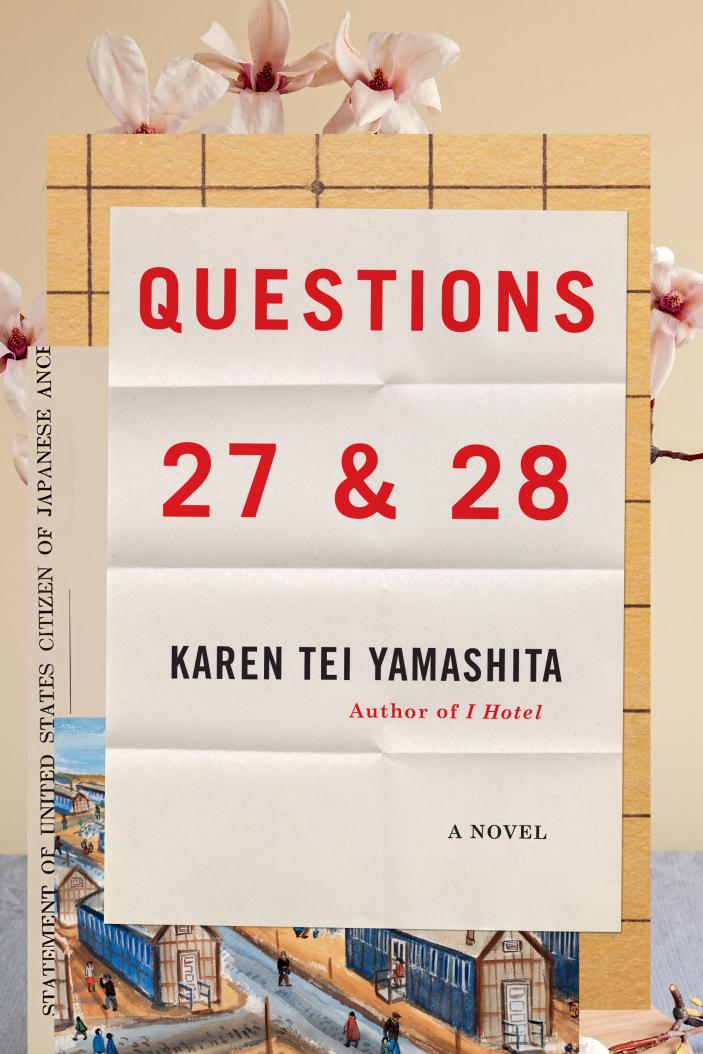
Of the many questions Japanese American internees were asked before they would be released from the World War 2 camps were Questions 27 and 28. Question 27 asked if men were willing to serve in the US military and Question 28 asked internees to renounce their loyalty to Emperor Hirohito.
The interrogation of minority groups being asked to prove their loyalty always says more about the government than the minority. In the United States, the most egregious of these loyalty tests was the interment of Japanese Americans during World War 2, which included issei, nisei, and sansei, or the first, second, and third generation. The internment camps and the people who were forced to live in crowded barracks in desolate areas on the west coast for the duration of the war have been described before, but few books have also painted a broad picture of Japanese American contributions in the United States and abroad both before and after the war.
Karen Tei Yamashita’s new novel, Question 27 & 28, takes a thorough look at Japanese American history, centered around these two particularly infamous questions. Yamashita never writes the questions, but rather frames her narrative around their implications, not just during the war, but also before and after.
In an untraditional narrative structure, Yamashita composes a couple dozen character profiles, as if each person were featured in a file stored in an archival box. Some of the characters were famous people, namely Yone and Isamu Noguchi. Yone was not interned during the war and spent those years in Japan, but his story follows his early career in the United States when he finds a mentor in the San Francisco Bay Area.
Then, all at once, life takes a turn. Hike to the Oakland Heights where Joaquin Miller lives. Miller, the hermit who lives on dews, God’s gardener, raising roses and carnations. He’s a rugged white-bearded mountain man in top boots, cloaked in bearskin, a cap of ribbons. A red crepe sash about his wait, he’s named himself Joaquin after the Mexican revolutionary Murrieta.
In Yamashita’s telling, Noguchi may not have become a renowned poet and art critic were it not for his work in the United States. Noguchi’s son, Isamu, also takes up another file in Yamashita’s novel. Unlike his father, Isamu Noguchi spent most of the war in an internment camp, but on a volunteer basis. Isamu felt he should be interned if his fellow Japanese Americans were, so he entered the Poston Internment Camp in Arizona with the understanding that he would start an arts community there.
He brought his work with him. Those were his conditions: bring in his tools, machinery, supplies, set up a workshop studio. Of course, he wasn’t asking for special treatment; he’d live just like everyone else. Fair enough. Eventually he’d build what he required, get the others involved, inspire and train, create a working community. It was like starting anew. The desert terrain was a blank slate. Anything was imaginable, but you had to have imagination.
But Isamu’s plans didn’t pan out the way he imagined and the US government viewed these activities as
subversive. Isamu was scrutinized even more than the other detainees.
Other recognizable names include Fred Korematsu, whose name has been engraved into US history via the eponymous 1944 Supreme Court case. When the US government started interning Japanese Americans after Pearl Harbor, Korematsu refused to be interned. He was arrested and his case eventually came before the Supreme Court, which ruled in 6-3 favor for the United States government and against Korematsu. This case, since overturned, is a popular one in constitutional law courses.
Daniel Inouye served in the US Senate for 50 years, but before that he enlisted in the US Army after Pearl Harbor to show his loyalty to his country. Yamashita features him in a page-long exposé in which part of his right arm was blown off. When he took his vows to become a US Senator, he was asked to raise his right hand. But he no longer had a right hand, so raised his left.
Yamashita includes a dozen and a half other examples of Japanese Americans—both real and fictional—who contributed to the United States in a variety of fields. One of the most chilling parts takes place when the camps close. The internees are released back into society, the camps are dismantled, and the fields of the desert appear as if nothing amiss had ever happened. Yamashita’s book serves as a comprehensive memorial to one of the darkest eras in modern US history.