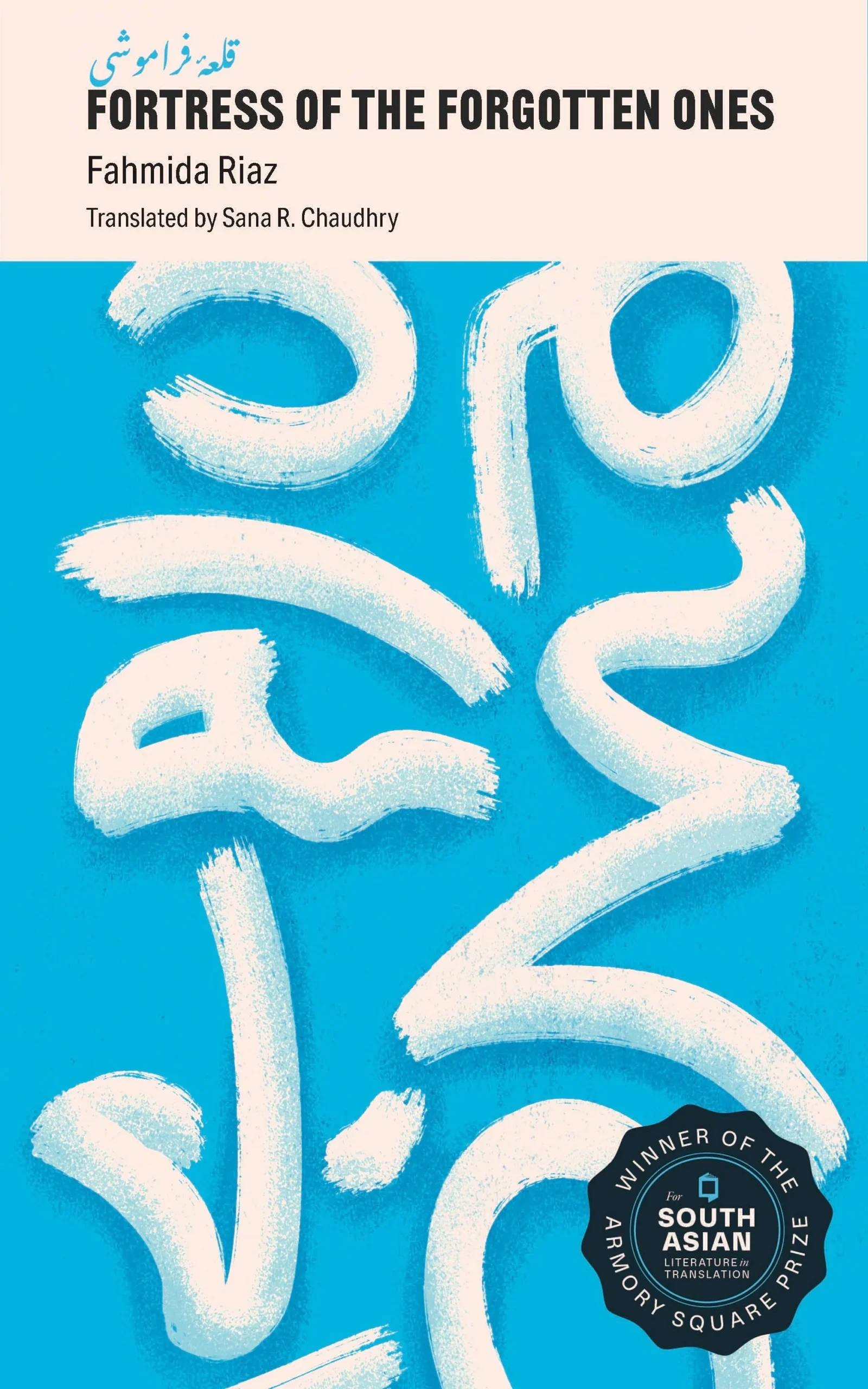
“Fortress of the Forgotten Ones” by Fahmida Riaz
Karl Marx famously argued that “the history of all hitherto existing society is the history of class struggles.” Fahmida Riaz’s Fortress of the Forgotten Ones, a historical novel set in 5th-century Ctesiphon, capital of the Persian Sasanian empire at its zenith, shows that this struggle existed long before its appearance in The Communist Manifesto.
The novel follows Mazdak—often regarded as the “first socialist revolutionary”—a devout Zoroastrian priest who, during a devastating famine, watches the common people starve while the elite nobles and Zoroastrian mobeds hoard immense wealth. Horrified by this inequality, Mazdak experiences a divine revelation and preaches a radical message of socialist revolution, declaring that the Almighty “has filled the earth with the means of life, so that all creation may share them equally, and none may take more than another.” He insists that “wealth be taken from the rich and given to the poor” to restore the equality intended by God.
Forging an alliance with the young King Qobad and military commander Seyavash, Mazdak commands the starving masses to seize the nobles’ granaries, abolishes oppressive taxes for the working class, and institutes sweeping egalitarian reforms, declaring that “like water, fire, and pastures, so too must wealth be held in common.”
Outraged by the loss of their wealth and power, the greedy aristocrats dethrone King Qobad and exile him to the “Fortress of the Forgotten Ones”, a political prison used to “detain those political prisoners who were meant to be erased from public memory.”
Although Qobad’s devoted Queen Naindokht helps him escape to the Khanate of the White Huns where he raises a new army to reclaim his crown, the king’s victory is short-lived; he soon falls gravely ill and dies. The throne passes to his ruthless son, Khosrow Nosherwan, who despises the egalitarian movement and moves immediately to crush it. After executing Seyavash and massacring the Mazdakites, Khosrow personally beheads the Prophet and orders the nobles to “erase Mazdak’s name from the history of this kingdom,” demanding that “no tongue dare utter his name.”
It is fortunate that [Riaz’s] work is now available to English-speaking readers
Riaz, a renowned Pakistani author writing in Urdu, originally published the novel in 2017 as Qila-e- Faramoshi. This recent English translation by Sana R Chaudhry brings Riaz’s final work to a global audience following her death in 2018. Throughout her life, she was a well-known poet and activist whose outspoken views often cost her living years of exile. It is not surprising that Riaz wrote this story, as it focuses on themes she was passionate about: state power, the silencing of those who disagree, and the empty teachings of powerful religious leaders. It is fortunate that her work is now available to English- speaking readers.
Riaz takes the history seriously. Llewellyn-Jones’s Ancient Persia and the Book of Esther identifies the Achaemenid palace in modern Khuzestan—the same province where Riaz anchors her titular fortress, while readers will find the White Huns in Adrian Goldsworthy’s Rome and Persia: The Seven Hundred Year Rivalry. Meanwhile a brief flash-forward to the modern era reveals that the attempt to suppress this revolutionary vision ultimately failed, as Mazdak’s legacy of class struggle survived into the future.
Fortress of the Forgotten Ones is, in a word, ambitious and more than a historical novel; it is an act of historical reclamation that reframes the Sasanian Empire through the lens of class struggle. Riaz did years of deep historical research and used it to create a world that feels real and alive. She spent two to two and a half years studying ancient texts like the Shahnameh, the Avesta, and Arthur Christensen’s work on Sasanian culture. Rather than filling the book with academic notes, she modified this knowledge directly into the story. For example, she vividly describes the court of King Qobad, where people are seated strictly by their social rank (from the high-born wispuhran to the dehqanan) showing how well she understood the history and then used her imagination to bring it to life. The book has been awarded as The Armory Square Prize for South Asian Literature in Translation (2024) and the jury chair Jason Grunebaum praised it for its “meticulous language that creates a polyphonic space for the recovery of a people and their memory.”
The translated novel succeeds in building the narrative out of history, achieving a sweeping geopolitical scope by incorporating the Sasanian court, the Roman Empire, Jewish communities, and Arab Bedouins. The novel is further distinguished by its rich “anthropological tidbits” regarding ancient Zoroastrian and Mazdaic customs, so rich, indeed that, in its ambitious attempt to pack so much historical data into a relatively short book, the pacing occasionally feels hurried and leaves certain character arcs unresolved. Nevertheless, with Chaudhry’s excellent translation, Riaz ensures that Mazdak is forgotten no longer, allowing her work to be read alongside other modern classics of translated fiction.