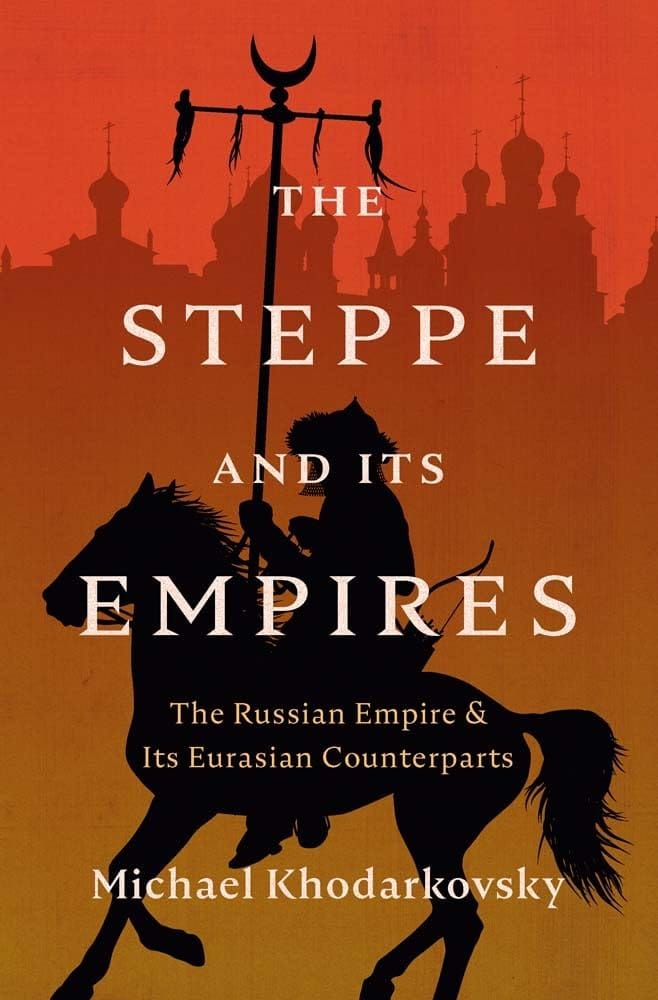
“The Steppe and Its Empire” by Michael Khodarkovsky
When Ivan the Terrible received the English ambassador Jerome Edward Horsey in 1580, he showed him the Kremlin’s treasury room, full of gifts and tribute from sultans, beys and khans: scimitars, saddles, bridles and quivers, all covered in jewels and nielloed steel. Horsey could imagine he had been transported to Cathay, Tabriz, or Lahore. Viewing these same treasures today, we can readily agree with Michael Khodarovsky’s thesis, that Moscow was a successor state to the Mongol empire, and inherited much steppe DNA, in common with Qing China, the Mughal Empire, Safavid Iran and Ottoman Turkey. These empires shared practices of imperial expansion, elite recruitment, application of law, individual freedom or sanctity of treaties. As with many comparative surveys, the core thesis yields stimulating insights, though one can debate some of the assertions.
It should not come as a surprise that 16th-century Moscow resembled the other land-based empires. They all relied on horse power to connect across the vast distances, and to defend territories with no natural frontiers. Their rulers all maintained large cavalry forces—larger than anything imaginable in western Europe. Qing China fielded 600,000 troopers; Mughal India 700,000. Moscow supplemented its 50,000 cavalry with levies of semi-independent Cossacks; Safavid Iran likewise combined 200,000 fulltime troopers with Turkmen tribesmen. The seat of empire was the saddle.
These horses came at a huge cost. The state had to provide land for raising horses, either as individual grants or tribal ones. Since pasture lands did not have clearly defined boundaries, like the empires themselves, and unlike western European estates, landownership could not become hereditary. The humblest herder could rise to the top, like Tamerlane, or Nader Shah of Iran. Many Tatars assimilated into the Russian ruling class.
The fluidity of the ruling class prevented corporatist resistance to the top. None of the elites in these empires saw their privileges crystallised in a document like the Magna Carta, which protected initially barons, later, freemen, and then everyone in England. ‘Rex is Lex’, in Khodarkovsky’s formulation. And without protections, the distinction between subject and slave remained a nuance. Until Catherine the Great’s reign, Russia’s elites had no more rights than the slave soldiers of the sultan or the shah.
These empires resembled each other in their external dealings as well as in their internal structures, When they expanded, perhaps inevitably, into the adjacent, boundless steppe, they confronted peoples whom they considered intrinsically inferior to their own, literate, urban societies. They made little distinction between their subject, allied, or even unsubmissive peoples. Foreign affairs and internal affairs overlapped. Khodarkovsky further points out that Ivan the Terrible, Süleyman the Magnificent, Akbar the Mughal and the Manchu emperors all considered themselves in different ways to be universal monarchs. How much of this was due to ideology and culture, and how much to the vastness of their frontiers, is debatable.
Undoubtedly, then, Russia’s history echoes that of these other empires founded in the aftershocks of the Mongols. But how much does this affect Russia today? After all, Peter the Great and Catherine the Great, the latter a German princess, boldly reshaped the Russian state to align with western European norms of statecraft. Recruitment from the west, including Scots, Poles, Germans and Swedes, resulted in military and civil officials often speaking French in order to understand one another. 19th-century Russian nationalism focussed on rescuing fellow Orthodox Slavs from Ottoman Turkish rule—Russia’s steppe identity never came into the picture during the imperial era. Now, notes Khodarkovsky darkly, many aspects of Russian President Vladimir Putin’s official ideology explicitly invoke the steppe legacy. His reluctance to recognise established borders, his flexible application of law, and his subordination of elites to the ends of the state would all meet with Ivan the Terrible’s approval. Paradoxically, Marxism, imported from the west, destroyed many elements of Peter’s and Catherine’s westernisation, allowing an earlier ethos to reemerge, as the Aleksandr Blok wrote in his premonitory, 1908 poem, “The Field of Kulikovo.”
Comparing the Russian empire to its Eurasian peers provides useful insights, but too often in Khodarkovsky’s high-level retelling of these parallel lives, the facts get distorted in order to fit the author’s intention. The Ottomans did not originate on the steppe, unless you skip 250 years back to the Saljuk invasion of Anatolia. They did make use of cavalry, but their empire relied primarily on infantry in the hilly Balkans, and on naval power in the Mediterranean. He makes similar mischaracterisations about the Safavids and the Mughals. Another quibble is being told twice, on page 45 and 51, that Mehmed III murdered his 19 brothers. Academic press editing needs to improve.
This should not distract the reader from benefiting from the many insights into Russia’s imperial project in Asia. As befitting its two-headed eagle, Russia was a European great power playing the diplomatic game with Talleyrand, Disraeli and Bismark, while in the east it deployed the wiles and violence of Genghis Khan against the Kazakhs and Kalmyks. This two-faceness is perhaps the source of the enigma that Russia presents. We should take its steppe heritage seriously. About this, Khodarkovsky is dead right.