“Shanghai” by Michael Dillon
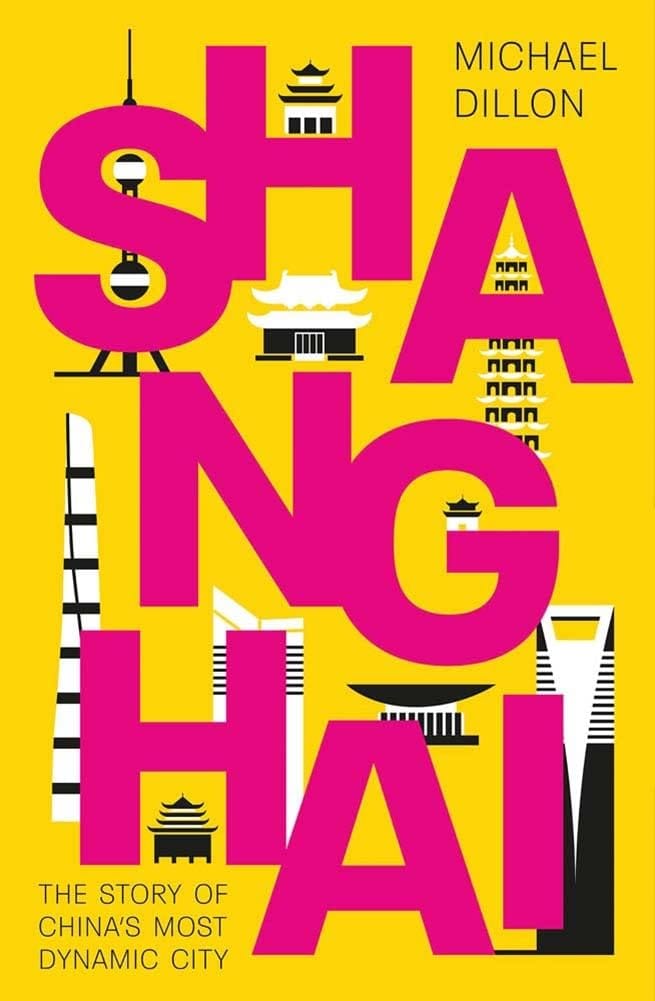
Both the subtitle of historian Michael Dillon’s new book Shanghai: The Story of China’s Most Dynamic City and its jaunty pink and yellow cover, punctuated with stylised drawings of the city’s landmarks, suggest this might be a fairly breezy version of the Shanghai story. Certainly, the city seems to encourage such accounts, which often foreground treaty-port tales of cocktails, jazz and expatriate excess. Dillon, who is an academic historian currently based at King’s College London, confounds this expectation, however. Though it does not eschew the city’s pre-colonial history and its development after the Treaty of Nanjing in 1842, the book’s focus, and main contribution, is primarily the post-1949 role the city played in CCP history.
This is a productive approach, because Shanghai’s importance to modern China has never been merely economic or cultural. Over the past century, the city has also acquired a reputation as a centre of political radicalism: it was the birthplace of the Chinese Communist Party in 1921, the site of a powerful labour movement and, later, an alternative political base from which Mao Zedong could circumvent the more austere and bureaucratic institutions of the capital. Mao repeatedly exploited Shanghai’s newspapers, cultural organisations, political networks and the industrial workforce in pursuit of struggles taking place within the national leadership. The city was especially important to the origins and development of the Cultural Revolution, to which Dillon devotes four dense chapters.
Dillon begins by tracing the city’s antecedents back to the Songze archaeological site, some six millennia old, before following its emergence as a commercial settlement under the Song and Yuan dynasties. By the Ming period, Shanghai was already an important port, protected by walls erected in 1553 against raids from pirates and other waterborne threats. Its position within the waterways of the lower Yangtze delta made it particularly well suited to trade: the Huangpu River divides Puxi—the area west of the river containing the old Chinese city and the later foreign settlements—from Pudong, now the site of China’s most recognisable skyline. Shanghai was therefore already an established economic centre by the time the Treaty of Nanjing was signed in 1842 at the conclusion of the First Opium War. That treaty, which was followed by the Treaty of the Bogue and the Treaty of Wanghia—early examples of the agreements later denounced in China as the “unequal treaties”—required the Qing government to pay an indemnity, cede Hong Kong to Britain and open five ports to foreign trade.
There have been many accounts of the development of the British and American settlements in Shanghai (which later became the International Settlement) but Dillon’s book is particularly strong on the history of the French Concession. Dillon presents the French Concession’s establishment as a protracted process rooted in France’s determination not to fall behind its British and American imperial competitors: the Treaty of Whampoa, negotiated by Théodose de Lagrené and the Qing official Qiying on 24 October 1844, granted French subjects the right to rent or acquire property and construct churches, schools and cemeteries in the treaty ports, providing the legal basis for a distinct French zone that was formally conceded by the Shanghai authorities in 1849 and remained administratively separate from the British and American settlements. The overall foreign population rose from approximately 500 in 1860 to 2,000 in 1865, 10,000 in 1905, and about twice that figure a decade later.
Shanghai’s divided geography becomes increasingly consequential over the decades which saw the end of the Qing dynasty in 1911, and the beginning of the republican era. The city was a cosmopolitan centre, drawing people from across the world – by 1932, the city had approximately 70,000 foreign residents. The clichés of Shanghai—the booze-soaked Paris of the East, with jazz spilling from every hotel and bar—date from this era, and became clichés because they capture a partial truth. Yet, this was also an era of enormous political upheaval in China, played out vividly and violently on the streets of Shanghai. The growth of textile mills, docks and transport networks created an increasingly organised industrial workforce in the city. Labour conflict converged with anti-imperial nationalism in the May Thirtieth Movement of 1925, precipitated when British-commanded police in the International Settlement fired on Chinese demonstrators on 30 May. The killings triggered strikes and protests and strengthened the influence of the CCP and the Communist-led Shanghai General Labour Union. Shanghai consequently became the crucial urban battleground within the temporary alliance between the CCP and the Guomindang, leading to what has become known as the Shanghai massacre of April 1927 in which Chiang Kai-shek’s Guomindang troops and Green and Red Gang allies attacked Communist-led unions and workers’ organisations across Shanghai, shooting resisters. The coup shattered the fragile Guomindang–Communist alliance and initiated the wider “White Terror,” in which thousands of Communists and suspected leftists were arrested and killed.
This past is, in this volume, prologue to the victory of the CCP in 1949. Dillon’s interest is quite clearly concentrated on the city’s development after the communist victory. In particular, he understandably focuses much of the book on the city’s role in the Cultural Revolution. Shanghai was central to the story of this violent and confusing decade, and any summary here is unlikely to do the complexities of the history justice.
In the aftermath of Mao’s death and the end of the Cultural Revolution in 1976, China began a period of what would become known as “reform and opening”. Partly as a result of its history as a treaty port, and partly because its economic importance meant it was off limits in the initial phase of experimentation, Shanghai was not an early beneficiary of the economic policies of the new leadership in the 1980s. By the beginning of the following decade, Deng Xiaoping had come to believe that the national leadership had waited too long to develop the city. During the post-Tiananmen years, he repeatedly described Shanghai as China’s “trump card” and urged senior leaders, including the former Shanghai mayor Jiang Zemin, to accelerate its redevelopment. Deng’s Southern Tour of 1992 would give the final impetus needed to encourage Shanghai’s rejuvenation, and the subsequent development of Pudong became the most visible expression of Deng’s strategy. It also restored Shanghai to the position it had occupied before 1949: not simply as China’s largest commercial city, but as the point at which the country was most directly connected to international capital, technology and culture.
Dillon’s book is an excellent primer on Shanghai’s history, particularly in relation to elite politics in the post-1949 era. If it sometimes lacks an evocative sense of place, readers can be reassured that entire bookshelves could already be filled with volumes which achieve that aim. His accomplishment is to recover Shanghai as a site of political power: a city repeatedly used to challenge Beijing, to test new forms of mobilisation and radicalism, and ultimately as the physical embodiment of China’s economic transformation over the last thirty years.