“The Luminous Fairies and Mothra” by Takehiko Fukunaga, Yoshie Hotta & Shin’ichiro Nakamura
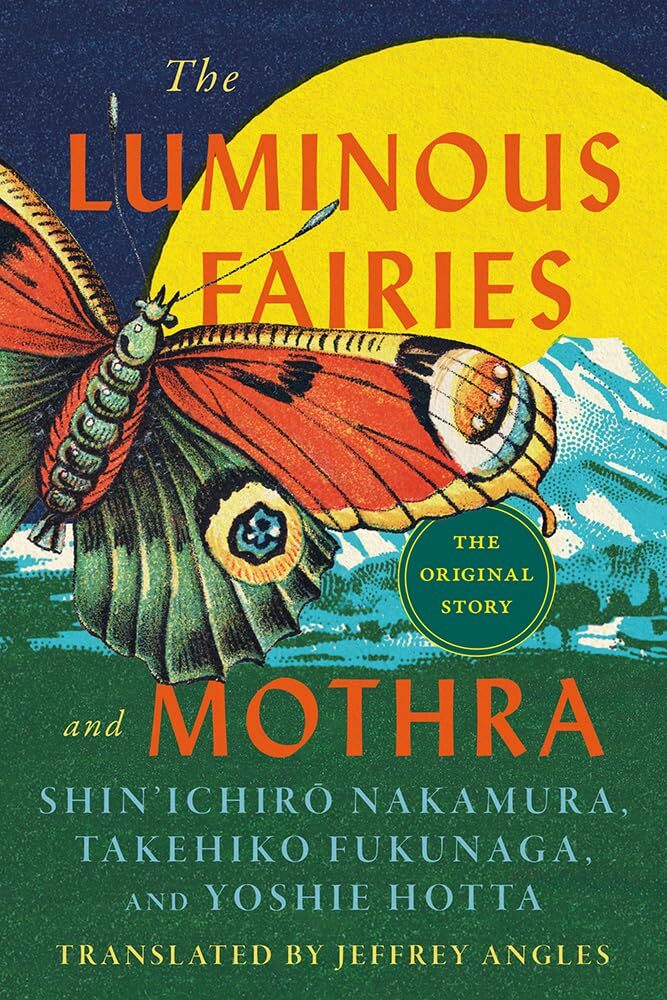
In 2023, University of Minnesota Press released a translation of Godzilla and Godzilla Raids Again. The two novellas (published as one volume with a thorough explanatory afterword by translator Jeffrey Angles) add the often-forgotten backstory to one of the world’s most iconic monster movies, often credited solely to the imaginations of director Ishiro Honda and special effects visionary Eiji Tsubaraya. In reality, science fiction author Shigeru Kayama wrote the scenario for the film, meaning he created the movie’s “entire foundation… the plot, characters, themes, and structure”. The publisher returns to the tale of another movie monster with The Luminous Fairies and Mothra, again translated by Angles.
The novella was co-written by Shinichiro Nakamura, Takehiko Fukunaga, and Yoshie Hotta and served as the basis for the 1961 cult classic film.
The Luminous Fairies and Mothra takes place in a world dominated by a superpower, Rosillica—a Japanese-language portmanteau of Russia and America. Like Godzilla, it opens with the investigation of a shipwreck. Four survivors of the Gen’yo-maru somehow escaped radiation poisoning on Infant Island, where Rosilica had been testing its new arsenal of hydrogen bombs.
Now, a joint Rosilican-Japanese investigative team is returning to the island to discover how the shipwrecked sailors survived. The Japanese heroes include Shinichi Chujo, a linguist; Professor Harada, a specialist in nuclear science; and Dr. Raff, a physicist. Their Rosilican rival is the sinister capitalist, Nelson.
When the party arrives on Infant Island, they discover indigenous people (who are, predictably, problematically othered) and dangerous plants, but also tiny shobijin (“little beauties”, which Angles renders “fairies”). These four tiny women are just 60 centimeters tall and communicate by singing. The men from the expedition agree to keep the fairies’ existence secret. Even plucky reporter Zenichiro Fukuda agrees that’s the only way to keep them safe.
When Nelson returns to Infant Island and kidnaps the fairies to become part of an entertainment spectacle, he invites retaliation from the Island’s guardian deity, Mothra. First encountered in egg form, Mothra hatches, travels to Honshu as a larva, erects a cocoon on one of Japan’s most iconic landmarks, and emerges as a giant moth to attack both Tokyo and a fictional version of New York City.
Each third of the novel has its own distinctive style and tone, an idiosyncrasy Angles has chosen to retain.
While the novel itself has its charms, it also suffers from an oddly disjointed quality. It was, after all, written in three sections by three writers. None was a seasoned science fiction veteran like Godzilla author Shigeru Kayama.
Toho Studios originally approached Shinichiro Nakamura, an author of high literature with film experience; he wrote the screenplay for Yukio Mishima’s The Sound of Waves. Nakamura’s enthusiasm for the project stands out—the first section of The Luminous Fairies, attributed to Nakamura, is clearly the novella’s best—yet he invited two friends to contribute as well. Literary fiction author Takahiko Fukunaga wrote the middle section; Fukunaga is best known in English for his 1954 novel Flowers of Grass, the tale of a bisexual young man dying in a tuberculosis sanitorium. Akutagawa Prize Winner and post-colonial organizer Yoshie Hotta wrote the novella’s final third.
Each third of the novel has its own distinctive style and tone, an idiosyncrasy Angles has chosen to retain. Each is written with a different level of narrative and descriptive detail. There is no real attempt to reconcile these differences.
Unlike Godzilla, Mothra lost much of the storytellers’ nuanced allegory in its translation from novel to film.
As with his translation of Godzilla, it is perhaps Angles’s afterword that makes the translation of The Luminous Fairies most worth picking up. It includes not only a textual history, but also information about the classic kaiju film; the prominent Toho Studios, producer of both Godzilla and Mothra; and the historical context of both the novella and movie. The context is vital for a fuller understanding of the authors’ intentions—unlike Godzilla, Mothra lost much of the storytellers’ nuanced allegory in its translation from novel to film.
In its original, novella form, Mothra is an allegory of Japan’s dramatic Summer of Rage, specifically the Anti-Security Treaty Protest (ANPO) that rocked the country in 1960. The third section of the novella, written by Yoshie Hotta, abbreviates the story of the ANPO protests and relates them directly to the events of The Luminous Fairies.
Not long before, Japan had established a military alliance with Rosilica. Negotiations over the alliance provoked numerous protests both inside and around the Japanese Diet Building, but even so, the Japanese government pressed ahead and ratified the alliance without getting a sufficient level of approval from citizens.
In the novella, Mothra, still in the larval form, even builds her pupa atop the National Diet Building; filmmakers elected to have Mothra perch on Tokyo tower instead.
Angles’s afterword adds significant interest to the volume, but ultimately accounts for more of The Luminous Fairies and Mothra’s page count than the novella itself; some of the content is likely to be of interest to only the most devoted of Mothra fans. Nevertheless, the novella itself is a fun read for aficionados of Japanese literature and movie buffs alike. The volume as a whole provides a fascinating read to anyone interested in Japanese popular culture.