“The Raven of Ruwi” by Hamoud Saud
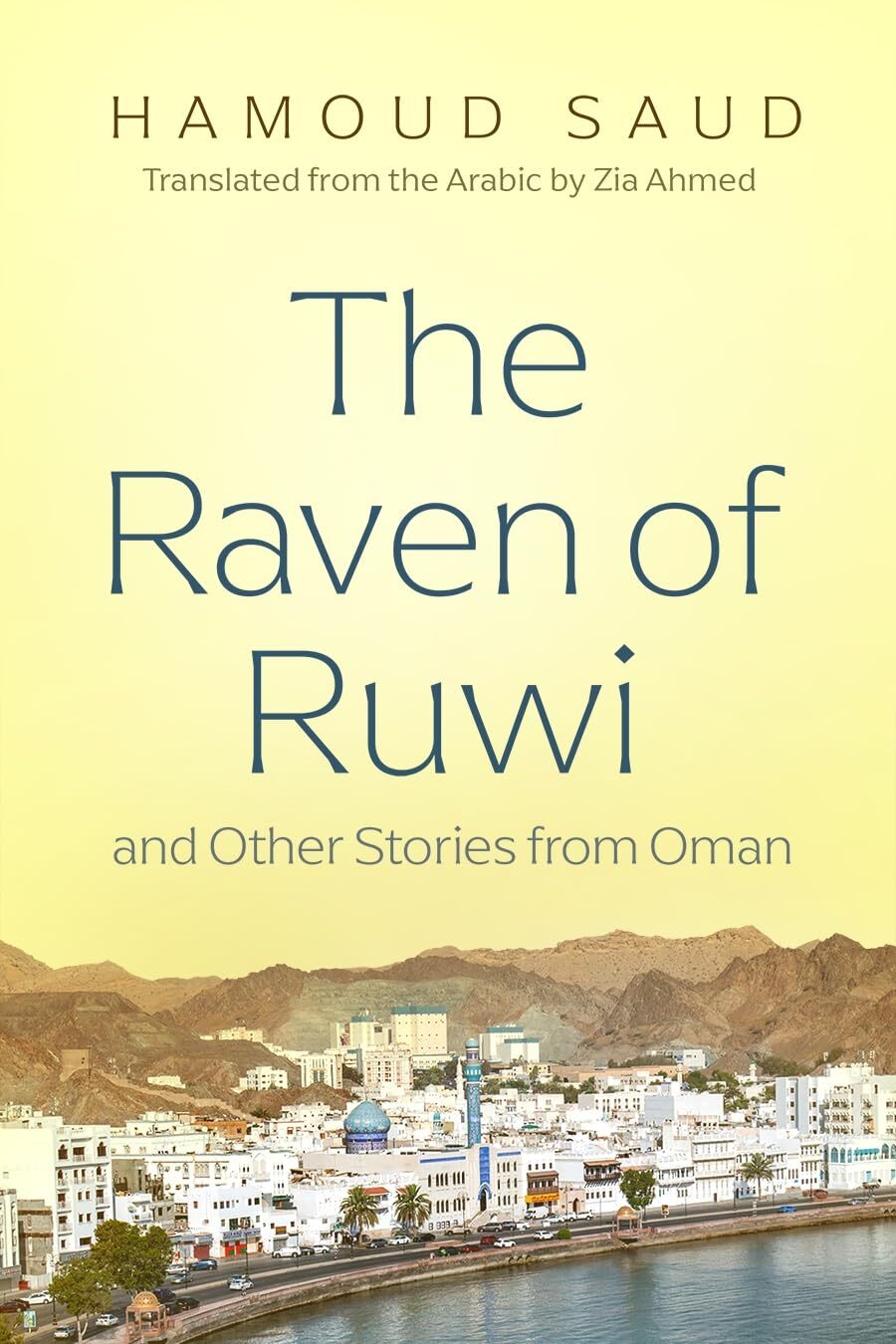
The Omani literary scene is currently flourishing, led by authors such as Jokha Alharthi, whose Celestial Bodies won the International Booker in 2019: she provides a foreword to this collection by Hamoud Saud, another prominent Omani writer. He writes in Arabic, and he has already been translated into Azerbaijani, Japanese, and Spanish. In his translator’s introduction, Zia Ahmed describes Saud as: “a teller—qās in Arabic—of short stories, memoirish vignettes, prose poems, and other strange sketches that defy easy categorization.” Defiance of categorization certainly marks the strange sketches gathered in The Raven of Ruwi. The final three, Trees of Ash, Music, and The Blood of Solitude, are meditations on trees, music, and writing and solitude respectively. The earlier ten pieces are experimental short stories with a metafictional interest in narration, and a poet’s concern for language and imagery. Riders are accompanied by the sound of the desert “its eternal silence.” A woman looks at the remains of a rose hennaed on her hand and remembers: “the roses in her garden, on her bedroom curtains, and on the anniversary of their first night together.”
All the meditations, and stories/prose poems are set in Muscat, which we are told, means “place of falling”. As part of an extended, and poetic elaboration of the ways in which Muscat is a place of falling, Saud writers: “Indeed, things fall in this city every morning: dreams fall, words fall from newspapers, delusional people fall into traps of light, nostalgia falls upon its ancient paths and in the voices of peddlers in the Neighbourhood of the Blind…”Muscat, this place of falling, its geography, history, and built and natural environments, is as dominant a presence in Saud’s writing as any of his characters. Plot often follows the developments and setbacks affecting the city and the impacts they have on its residents’ lives.Modernisation provides Saud with one of his major themes.
Over the past fifty odd years Oman has undergone swift modernisation, thanks to the discovery and exploitation of oil. This modernisation provides Saud with one of his major themes. In Marginalizing the Narrative, Narrating the Marginal he refers to the houses Omanis now occupy as “cement boxes”:
How quickly human beings crowd into these boxes created by a cruel and deformed modernity! We’ve forgotten the mud houses of our villages and neglected our memories.
In The Guardian of Muscat, a falaj—a traditional system of irrigation canals—dries up, “consumed by modernity and police stations.” In Post Office of the Dead, a forest of concrete is created by “a distorted modernity, with milling workers oppressed by a scorching summer and the hunger of exile.” In Who Stole Muscat’s Noses?, we find both “dreams crushed by illusions of modernity” and “a carnival of distorted modernity.”The disorienting nature of the stories and pieces gathered in The Raven of Ruwi surely mirrors the disorientation caused by quick modernisation, making the book’s structure a key component of its investigation into, or criticism, of modernity’s effects.Suad’s discomfort with modernity is matched by his respectful and melancholic interest in nostalgia. In Post Office of the Dead, we’re told that “There’s no meaning in words that emerge from nightmares, nor in the emotions of a woman who’s never plumbed the depths of nostalgia,” suggesting, perhaps, that a life without nostalgia is barely a life:He remembered the scent of lemons from faraway villages. Now, he saw nothing but asphalt and lights, a life without life, a bridge suspended under the sky.
Translator Ahmed notes that “Nostalgia, for lost childhood and a simpler past, is a defining aspect of the Omani psyche.” This is no doubt true, but Saud’s view of the past is not merely nostalgic. He is naturally harsh about Oman’s former colonisers, particularly in the nightmarish Pirates of Wadi Adai where we meet colonial Englishmen, Portuguese and “the turbaned ones”. Of these, the English “latch on to Oman’s jugular and drink its blood.” In this collection, however, there is no comparable engagement with, say, Oman’s involvement in slaving and slavery.Saud’s layered examination of his home city is an excellent antidote to Western parochialism.
Saud frequently references other writers and their work. In The White Goat’s Head, it’s Murakami’s Kafka On the Shore. Meanwhile, Post Office of the Dead refers to both Kafka himself, that master of absurdity—his style provides the model for a letter about the post office of the dead—and to Dostoevsky. “What if, breaking all barriers between time and space, imagination and reality, a letter from Fyodor Dostoevsky arrived at Al Amerat’s post office?” Patrick Süskind. “the German author of Perfume” also gets a mention. Readers may feel the references to famous authors are overdone.
Saud’s collection stresses the cosmopolitanism of Oman. He describes the lives of people of diverse origins, languages, races and religions, all of whom call Muscat home. The title story, The Raven of Ruwi, which opens the collection, is set in the eponymous Muscat district of Ruwi, where live many Indians—the Banyans, who, as a note to another story explains, are Hindu merchants who have been settled in Oman for centuries. Other nationalities mentioned as resident include Egyptians, Pakistanis, Balochis, Omanis of Palestinian origin and Iranians/Persians.Saud is committed to making marginalized voices central, so he offers an unlikely collection of protagonists and narrators: a raven, a sad donkey, a white goat’s head, madmen, and especially ghosts and the dead. The Guardian of Muscat concerns a gatekeeper who has been dead for forty years, and who imagines he is still the keeper of Muscat’s gate: “Time didn’t allow the dead guardian to feel the ecstasy of power, the power of doors open and closed, of the fear he’d once exercised over those who passed through his gate.”Muscat is of course not marginal to Muscat, but it is likely to be so for many readers in London or New York. Saud’s layered examination of his home city is an excellent antidote to Western parochialism, and, too, a rich, nuanced, and lyrical investigation of Omani identity, of memory, of the challenges of modernising, and of the melancholy of yearning for the past.