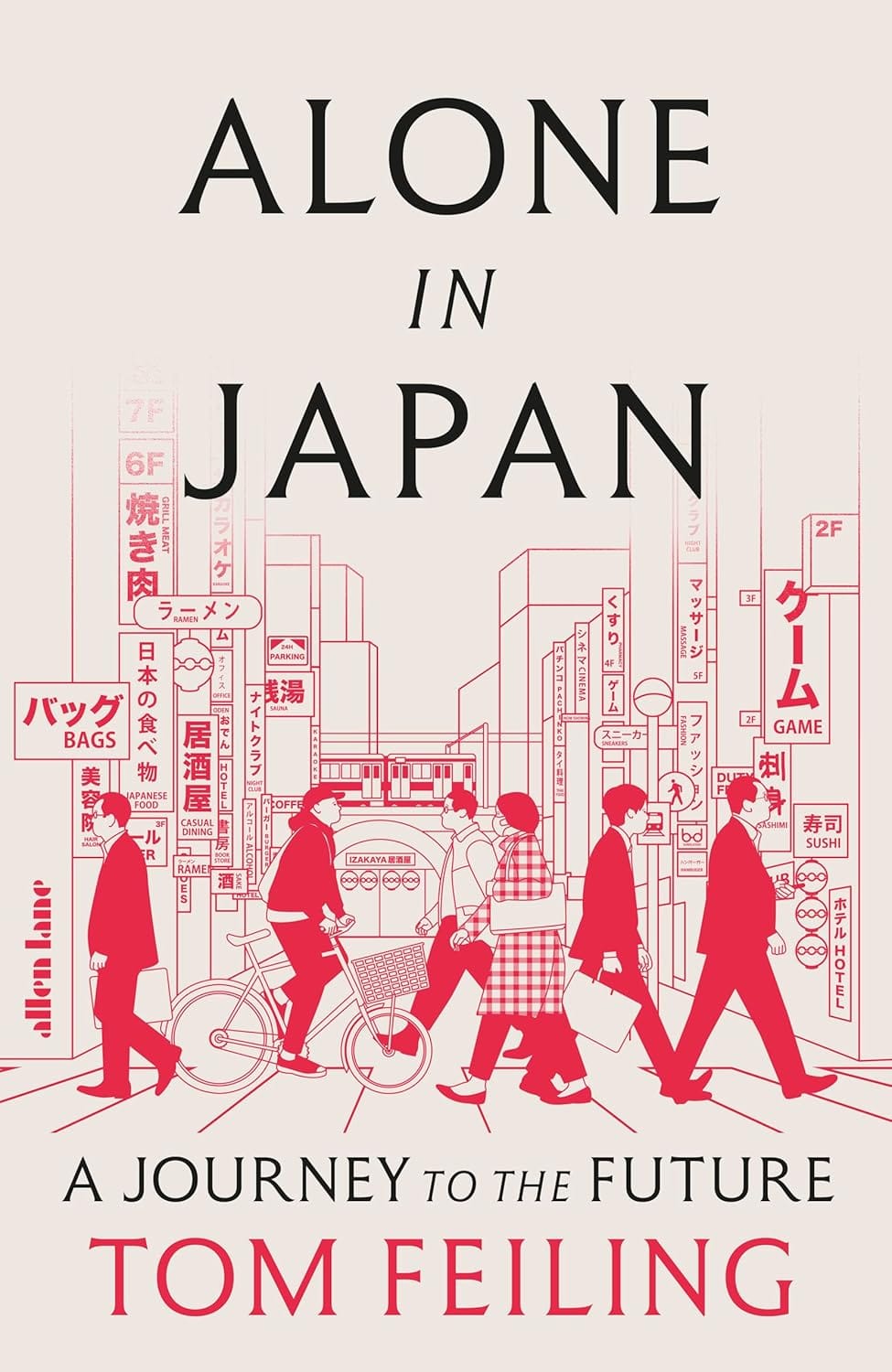
“Alone in Japan” by Tom Feiling
When Japan was first opened to widespread Western contact in the late 19th century, visitors saw it as a glimpse into the past. In its arts and crafts, they perceived an unconscious artistic genius lost to those who lived in industrial societies. At some point in the late 20th century, travellers started to see not the past but the future in Japan. The astonishing development of Japan’s cities and infrastructure was seen in a more ambivalent light: high-speed trains and efficient industrial production might be celebrated, but many aspects of the way that the Japanese lived were more troubling.
Now, in the 21st century, Japan still represents a vision of the future, albeit in a different and—for most commentators—more uniformly concerning way. Japan stands at the head of a global demographic trend: fertility rates falling far below replacement level, increasing numbers of the super-old, and ratios of workers to retirees that are throwing into doubt the sustainability of welfare programmes. Tom Feiling explores this important subject in his new book Alone In Japan: A Journey To The Future.
The first part of the book is an exploration of causes, mixing statistical research and analysis with personal experience and interviews. There is an interpretive contradiction here: if Japan really is a glimpse into a global future, it is because the causes of population aging and decline—increasing social isolation and an inverse relationship between women’s salaries and the number of children they have for example—are shared in varying degrees across the developed nations, rather than being unique to Japan. If so, as does seem to be the case, then culturally specific factors such as Edo period sexual politics, low levels of parental affection, or an (alleged) squeamishness about sex, are at best a local twist on more general underlying forces. Moreover, they potentially reveal unacknowledged assumptions about what is normal and abnormal embedded in a Western (or even more specific) paradigm.
However, exploring the consequences of the population crisis promises to be more revealing. One of the most striking things about the aging Japanese population is its distribution: a few cities, Tokyo in particular, are still growing, while rural areas are in freefall. Feiling devotes the second part of the book to a series of trips out of the capital to see depopulation on the ground, travelling on his own and with organised groups, examining existing farms and projects to encourage city dwellers to return to the countryside. Especially given the historic stress on one’s hometown—furusato—the sheer scale of Japan’s rural depopulation is striking. Whole villages are abandoned to wild boar and black bear, while even in surviving towns, abandoned houses (akiya) are an increasing sight.
In charting Japan’s changing hinterland, he is heir to a rich tradition of Western travel writing, such as Alan Booth or Donald Richie, much of which has struck a similar tone of melancholy. Where these previous writers were reflecting a perception that Japanese traditions were being lost to modernity, now the threat seems to be that Japan itself might cease to exist.
There are however other trends which complicate the story of which Feiling is either dismissive or uninterested. The shift to a smaller, urban base is driving a phase of investment and development—both of housing and commercial space which is striking in the major city centres. The country has also internationalised visibly over the last 20 years. This is not just an urban phenomenon—even in rural Shikoku which I visited this spring there was a notable cohort of Southeast Asian workers. More recently, there has been a boom in tourism from across the world that is starting to spread beyond the “golden triangle” of Tokyo, Kyoto and Osaka.
None of these phenomena really counter the demographic data, and some such as immigration and tourism are sensitive political issues. Moreover, while I would be less skeptical about the potential of projects to promote rural regeneration and cultural preservation than Feiling seems to be, there is a danger that the desire of foreign visitors to encounter the “real Japan” sees rural areas become more of a theme park than a living community. Nevertheless, Japan is changing in ways other than its aging—whether it is charting a path that other nations should follow, or learn to avoid, only time will tell.