“The Man Who Stole the Gods” by Matthew Campbell
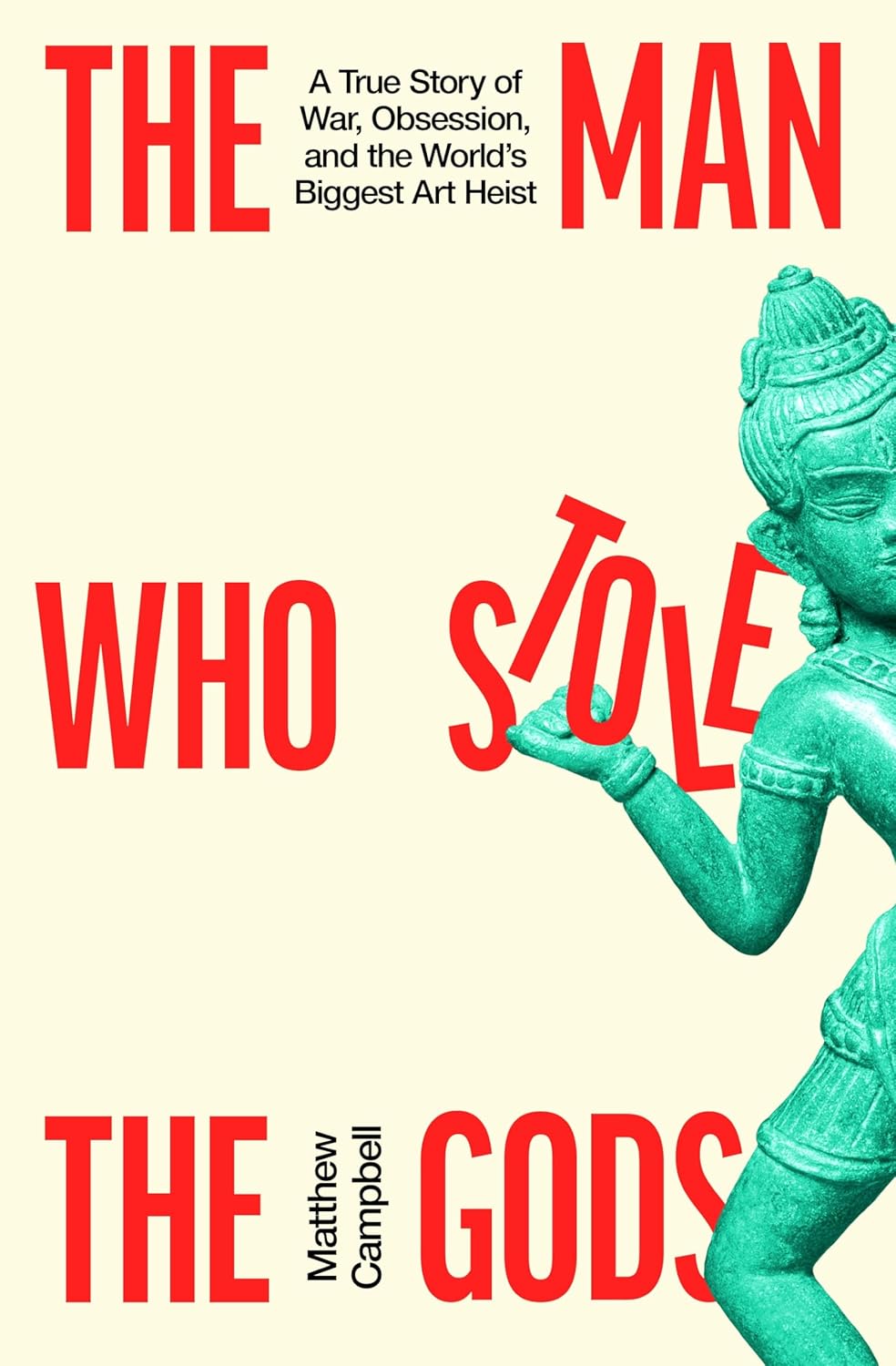
A New York Times headline from late February read “Cambodia Celebrates the Return of Looted Artifacts From a Tainted Dealer”. It wasn’t front-page news, and readers may have missed the connection to previous scandals involving such storied institutions as New York’s Metropolitan Museum, the Smithsonian, the Denver Art Museum, Sotheby’s and Spinks, all of whom received or dealt in other looted Khmer statues and antiquities.
In The Man Who Stole the Gods, Matthew Campbell tells this sordid tale from the beginning to (given publishing schedules) not-quite-end as a cross between a well-reported exposé and—with short chapters alternating between Bangkok, Cambodia and New York, between temples, luxury apartments and US Justice Department interview rooms—a page-turning true-crime procedural. There are shady art dealers, greedy museum curators, Khmer Rouge guerillas, American tycoons turned art collectors, indefatigable Feds, honest lawyers, Thai body-builders: everything needed for a multi-episode TV docudrama.
The “man” of the title is Douglas Latchford, a perhaps unlikely villain: a Bombay-born British businessman who washed up in a late 1950s Bangkok overseen by Jim Thompson (he of the eponymous silk firm, but also a spy and collector of art and antiquities). Latchford was not without business nous of his own, but his passion soon became Khmer sculpture, taking his lead from Thomson, himself a collector—and trader: “Much of what Thompson obtained, he was willing to part with for the right price.”
As often happens, what was originally a hobby becomes a business—one for which the chaos of the Cambodian civil war offered unparalleled opportunities—and the logic of expansion and self-justification is self-fulfilling. To help establish his bona fides as a connoisseur and art historian, Latchford even published books in which stolen artworks took pride of place. By the end, the business is close to looting-to-order, statues ripped off pedestals, reliefs torn from walls.
This is 19th-century rapaciousness; one wants to be shocked that it was still going on well into the 21st, but we’ve seen this movie before, with some of the same protagonists. The infamous Euphronios Krater makes a cameo: it wasn’t just looted Khmer art that the Metropolitan and its peers have had on display and had to return.
Campbell excels at building a narrative. Some of this is structural: interlocking brief chapters from different points of view and in different settings. But the prose itself is punchy and, where it needs to be, evocative:
The sun climbed steadily up from the tropical horizon, bathing the sandstone below in a brilliant golden hue. In a pair of reflecting pools, five conical towers mirrored themselves precisely, gilded by the advancing dawn.
The forensics—matching statues with their in situ bases, tracking the artworks, demonstrating false provenances—are covered clearly and in detail. Some of this is quite ridiculous, with at one point Latchford
providing an unsigned letter bearing the name of a British businessman, Ian Donaldson. “I herewith declare,” it read, that the piece “was purchased by me in Hong Kong where I was posted from 1964–1966 and has been in my collection since then.” … Donaldson, however, had died in 2001 and was presumably unavailable to provide his signature. Nonetheless, when it came to another piece, one sold to a museum in Singapore, Latchford provided … a similar statement from Donaldson—this time stating that he’d been “posted” in Vietnam, not Hong Kong, during the same two-year period.
No one had any real interest in checking.
Campbell is particularly good at characterisation. Some of the characters write themselves, of course: Lathford, the expat seeking both the good life and social approbation; Bradley Gordon, an conscientious and driven American lawyer representing Cambodia; Emma Bunker, the elderly art historian who latched on the Latchford and laundered his credentials; Jessica Feinstein, the tireless and focused prosecutor brought in to close the case. But most memorable is perhaps Toek Tik, the teenage Khmer Rouge soldier who later turned to looting to survive. He was very good at it, but later came to regret what he had done and assisted the efforts to have the pieces returned. “I want the gods to come home,” he is quoted as saying. He dies of cancer as the book is ending.
The Man Who Stole the Gods covers the better part of three-quarters of a century, a period over which the conventional wisdom regarding the ethics of collecting and trading have tightened. One has to be careful in applying the standards of today to the Southeast Asia of the 1950s and 60s; or rather it serves little purpose to be judgemental when the participants are now deceased.
That being said, museums (at least those in the cultural capitals of the West) are having a bad time, with increasing calls for returning pieces whence they came. There are some apologists who argue that many pieces were acquired “legitimately”; this becomes increasingly hard to sustain when the pattern of procuring recently-looted pieces continues to the present day. The Man Who Stole the Gods calls into question the museums’ mission-statements and their protestations of innocence regarding works not just recently acquired but those that entered their collection a century or more ago.
The “stole” in the title notwithstanding, this isn’t just about theft or doubtful provenance. The legal cases around contested painting can be just as insalubrious, but a painting can undergo restitution. A relief torn from a temple with a hacksaw however suffers irreparable damage. Latchford didn’t just steal the gods; he had them kneecapped. For all his professed love and respect for the art, he didn’t seem to care, nor did the people—most of whom should have known better—who abetted and lauded him.