“The Book of Damascus: A City in Short Fiction”
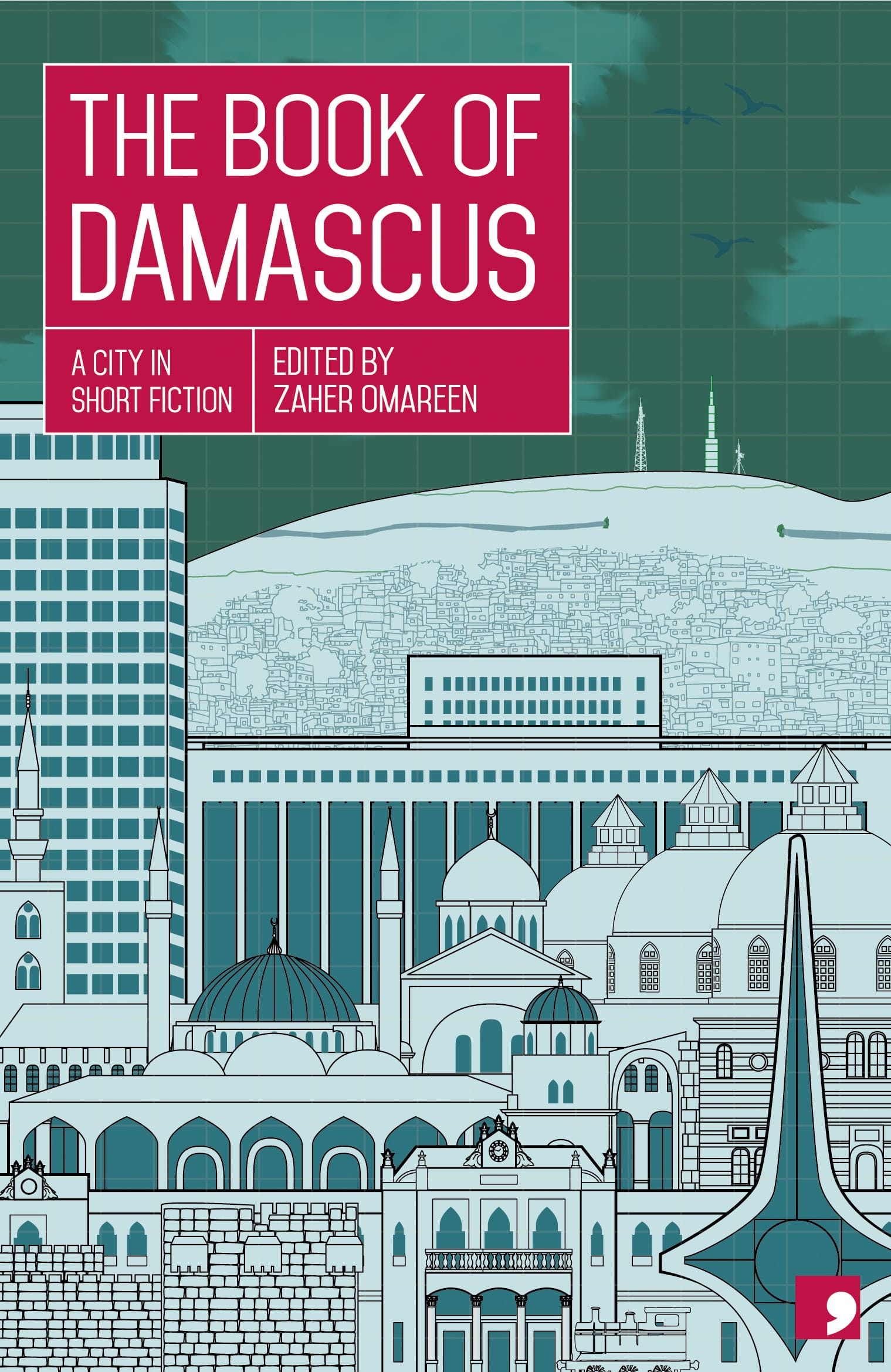
The Book of Damascus, an anthology of ten short stories and one non-fiction piece, gives English-speaking readers a chance to see the world through the eyes of Damascenes.
The non-fiction piece, I Write to You from Damascus, by Khaled Khalifa serves as a preface. Khalifa, the internationally-renowned author of novels such as In Praise of Hatred and No One Prayed Over Their Graves, died before he could write a short story for the anthology: I Write to You from Damascus, originally a magazine column, was included to honour him. It addresses: Damascenes’ hopes, and dashed hopes, of family reunions following prisoner releases; never-ending queues; electricity cuts; residents’ dreams of escaping their city.
In his introduction, the editor, Zaher Omareen, explains that, like I Write to You from Damascus, all the anthologised short stories were written before the fall of the Assad regime. Have subsequent events rendered them less capable of revealing Damascus? Do they now map a city that no longer exists? Omareen argues that no, the fall of the regime merely constitutes a new frame through which to read the stories.
In Omareen’s own contribution, What Only the Chickens and the Donkey Know About Abdulwahab, the eponymous Abdulwahab’s burning desires for food, sex, and aspirin lead him into a collision with an enraged donkey. He sustains only a minor injury, but the aspirin tablets
had finally worked their magic on him; Abdulwahab’s blood kept flowing out, hot and unstoppable. That morning, near al-Marjah Square, or more precisely next to the low steps that led pedestrians to the concrete monstrosity that was the Yalbogha al-Nasiri building, Abdulwahab passed away: alone, but laughing and full of food and joy, as if he’d never felt this way before.
Many contributors similarly use satire and absurdism to explore the trauma of living under a regime of such violence and repression that tragedy became an inevitable part of daily life (and death). In the First Hour of Traffic by Omar al-Jbaai the bicycling Mr Kaleh (Mr Faded) doesn’t come home one evening, and nor does Asmar (a note explains Asmar means a person with brown skin), who is beaten to death by Hethae (shoe). If Hethae has also beaten Mr Kaleh to death (with a shoe), then his wife is given various other improbable explanations for his disappearance, including that “A citizen can die at any moment from purely natural causes.” The Blacklist, by Haseeb Al-Zainy, is set in a Kafkaesque world of low-level bureaucracy. It follows a junior government official in the aftermath of a security service purge. Colleagues whose names are inscribed on grudge-based blacklists are condemned to vanish. With understandable paranoia, the official becomes convinced that his own name is on a blacklist. What is he to do? He decides that to save himself, he must murder his boss.
Butterflies in the Sky of Damascus, by Salwa Zakzak, features another example of horrific, random death. It opens:
In the Damascus sky, colourful, vibrant butterflies flutter, and despite everything – as the proverb says – you cannot cover the sun with a sieve.
“You cannot cover the sun with a sieve” means that reality cannot be hidden or denied. Here the undeniable reality is the death of a little girl, Aya, and the deaths of six of her friends, all of them scavenging the rubbish of Damascus. The children
lost their lives, after being accidentally buried in a large landfill adjacent to the Bab Tuma neighbourhood. They believed they would find something there that might change both their and their families’ lives. They were taken by ambulance, under official escort and with a media convoy, to Al-Mowasat Hospital, the largest in Damascus.
Tomorrow, Damascus will awaken just as it has done for the past ten years, slowly and in despair, like someone waking from a long nightmare or a disturbing dream. And with little concern, it will carry on, as if nothing has happened.
In Damascus under Assad, sudden death by foul causes, disappearance and capricious assignment of guilt sat side by side with practical difficulties. In discussing electricity outages, Khalifa observes “the sight of a city plunged into darkness encapsulates the true meaning of despair.” Other authors, too, exploit the facts and figurative meanings of electricity cuts, outages and rationing. The Curse of Eid Eve by Fares Al-Zahaby, begins:
If you looked at Damascus from above at night, it would have looked, during that period, like a chessboard of black and white squares: some squares without electricity, others well-lit.
In A Storyteller for Our Times by Rawaa Sonbol the laundry can only be done between two and two thirty in the afternoon, when the electricity is on, an interesting detail in a sobering story about the dangers of storytelling, and the ease of sliding from storytelling to telling tales (informing) under an oppressive regime.
Though the collected stories address challenging themes, they can be playful. The Seven-Gated Girl-Lady by Rasha Abbas takes the reader on a tour of Damascus, which here becomes a dreamscape, via its seven Roman-era gates, each of which was dedicated to a celestial body, and which are here transformed into magical gates.
Throughout the anthology, delight in language abounds. Bitter Hymns by Odai al-Zoubi incorporates: a haiku by Kawahigashi Hekigodo; a tanka by Yosano Akiko; a jueju by Wang Wei; a riddle poem by the celebrated and influential modern Syrian poet Riyad Al-Saleh Hussein; Over there, in the half-darkness of the cathedral, by Alexander Blok.
Abu Hajal and the Magic Lamp by Aboud Saeed refers not to poetry, but to One Thousand and One Nights. Abu Hajal
spends his time searching for Aladdin’s Lamp, the treasures of Harun al-Rashid and other buried antiques, dreaming of striking lucky, like he’s at a casino in Vegas.
And from dreams of Las Vegas, he touches down in Damascus! Specifically, Damascus Central Prison, also known as Adra Prison.
Abu Hajal’s imprisonment leads to his brother, Khalil, “an ironsmith by day, a poet by night” becoming embroiled in a romantic plot, or rather an unromantic plot, with a twist worthy of Guy de Maupassant.
The final story, Marvellous Music Memory by Alaa Rashidi, explores the intertwining of music, art and memory. After being injured in a bombing, a composer loses his grip on reality and can no longer tell if his compositions ever existed beyond his imagination:
when the war started and I was displaced, I lost all my recordings. Now I’m left with only my music memory to search through, hoping that it still holds that piece. But it seems I can’t find it. There’s a gap where it could have been, in my memory strip, caused by the damage done to my bone marrow by the shrapnel. Or maybe I never wrote the song in the first place. Oh, the consequences of war!
Of the ten short stories, only three are by women. All the translations are by Majd Abu Shawish. He captures a change in register between stories, avoiding the potential pitfall of a single-translator anthology of every author sounding the same. All his translations read smoothly, without flattening out the strangeness of some of the stories.
Overall, this is a wonderful introduction to contemporary writing from Damascus; it will leave the reader with much to pity and much to think about. In his introduction, Omareen claims that only in Damascus
can you witness more than one era in a single moment: what was, what is, and what could have been, had this country only escaped its oppressors and its illusions.
Now it has escaped its Assad oppressors, let’s hope what could have been, comes to be.