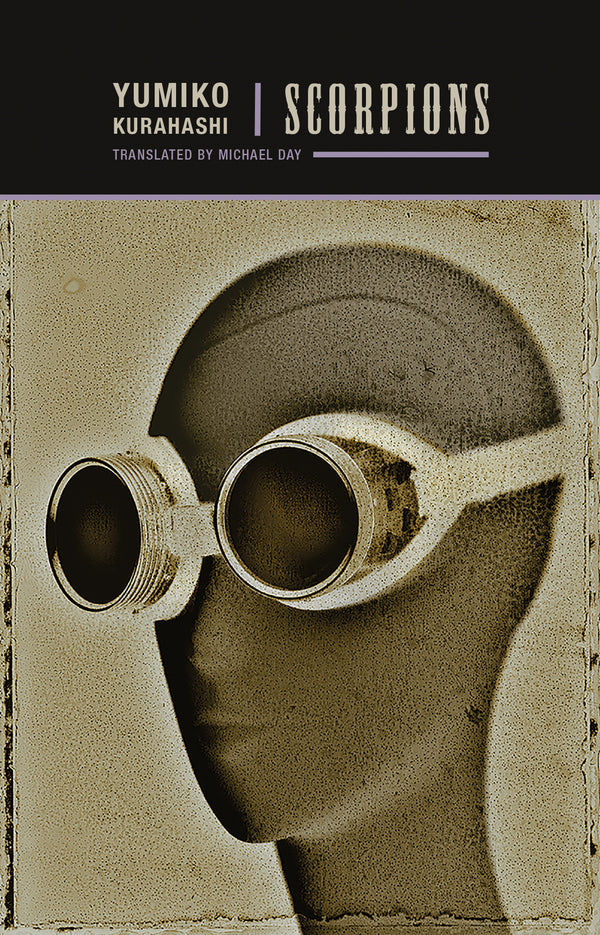
“Scorpions” by Yumiko Kurahashi
Yumiko Kurahashi (1935-2005) is celebrated as a pivotal female writer in Japan’s growing post-war break with literary tradition. Informed by European writers and philosophers of the 1950s and 1960s, “third wave” writers in post-war Japan—Kobo Abe, Kenzaburo Oe, Minako Oba, Meiko Kanai and dozens of others labeled experimentalists, avant-garde, and absurdists—were interested in the metaphysical, the existential, and the intertextual, rather than depicting the real world. Kurahashi’s work embodies all of these.
Kurahashi’s literary output is substantial and spans forty years. Unfortunately, only two works have appeared to date in English, The Woman with the Flying Head, a collection of short stories from the early 1960s to the 1980s, and The Adventures of Sumiyakist Q (1969), a novel. A few short stories have also appeared in English in journals, magazines, and anthologies. Scorpions is an early work, originally published in a literary journal in 1963, and later issued as a book.
Kurahashi’s incredibly rich work engages both Japanese and European literatures and how they negotiate philosophical, religious and sociopolitical systems.
Scorpions purports to be a story about matricide. L and K, twin sister and brother, have murdered their mother. The novella is a transcript of the interview with L in a psychological evaluation for the court. L tells her story, uninterrupted and fully aware of what is going on.
For the sake of your psychological evaluation for the court, I will [tell what happened]. Since you’re planning on labeling me schizophrenic and getting me released to a hospital – isn’t that right? Or is your aim to identify within me a uniquely modern anguish, pluck it out with tweezers, and display it to the world with an accusatory smirk? You are the perfect image of a humanist, you know, with your slicked-back hair and those glasses.
L then begins with a description of their mother, Madame (aka OLD BAG), who is enormous, slathering, and suffering mental problems. Throughout the novella, L describes her mother’s bestial nature and how L and her brother tortured and abused her. Madame recognizes what is happening, but doesn’t appear to care. If anything, she is in a state of religious ecstasy supported by her own mortification of her flesh.
S, a family friend of L and K’s parents, quickly enters, offers L a job, and eventually takes his son, L, K and K’s fiancee on a vacation north to the Sea of Okhotsk. At the end of the novella (after the deaths of the others), L and K return to discover their mother lolling about in her own excrement. After hosing her down and washing her with “bathroom cleaning products,” K asks “What do we do now?”
“I’m thinking hanging,” I said. K’s response, eyes sparkling: “Delightful.” For a moment, we looked each other over, and I was able to confirm clearly that the desire that sparkled in K’s eyes was the same as mine: we both yearned to kill for pleasure. It occurred to me that it would be most appropriate for the OLD BAG to meet her end swinging in the air, neck snapped by her own weight. For her part, she did not seem to object.
Michael Day has done a remarkable job capturing all of this nuance in his English translation.
The sexual tension between L and K, however, drives the story. It is signaled shortly after S has offered L the job and is set to take her out to dinner with the hopes of making her the “other woman”. While she waits for him, she takes his car for a joy ride, and provides a poignant summary of many of the novella’s issues.
I love cars so much it sends shivers down my spine. Plying the surging crowds with the windows rolled up tightly. People streaming by on all sides, I loved that I could belt out gospel songs, shriek like a rape victim, and giddily give voice to my most licentious desires, which I had been saving for just such a moment. K, how I long to uncover my NAKEDNESS to thee.
The culminating carnal act immediately following the hanging has been building from the beginning, from flirtations, unexpressed exhortations of desire, touch and fondling, tickling, masturbation and oral sex, to the final words of the novella: “Between continuing bursts of laughter, we made complete, perfect love.”
Much as L loves “plying the surging crowds with the windows rolled up tightly”, Scorpions has Kurahashi’s characters stepping outside the social context. L’s recounting of the events shows no remorse. For an amoralist, how could it? Her confession adds incest and laughter to her crimes, and rape to her twin brother’s, but she is also refusing to admit that they are truly sinful.
Kurahashi’s incredibly rich work engages both Japanese and European literatures and how they negotiate philosophical, religious and sociopolitical systems. Her fictions are tightly woven, intertwining multiple themes, sometimes within a given paragraph. Moreover, she plays with Kafka, Camus, Sartre and others, as well as with language, indirect quotes, innuendo, implications, irony and other language games (to invoke Wittgenstein). Michael Day has done a remarkable job capturing all of this nuance in his English translation.