“Chapal Rani, the Last Queen of Bengal” by Sandip Roy
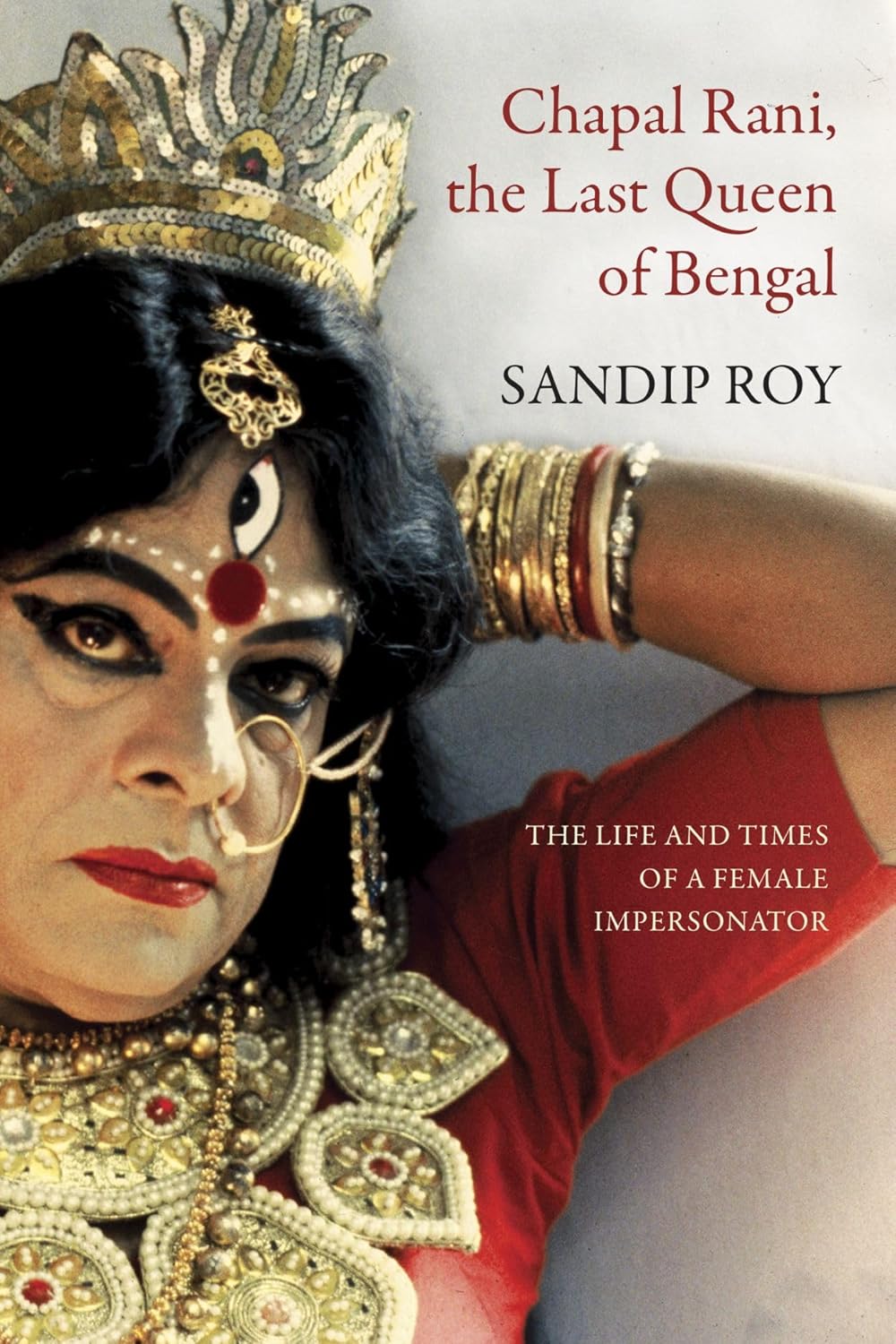
A young, aspiring actor joins an itinerant theatre troupe to perform on makeshift stages in remote villages, traveling from place to place by truck, or in the absence of paved roads, by bullock cart. Readers will recall scenes from The Adventures of Goopy and Bagha by Satrajit Ray, or Shakespearewallah, by James Ivory. There is no stage set, only the glaring petromax lanterns. The green room, where actors prepare, is a rice paddy. But the audience, squatting on a tarpaulin, applauds the dazzling costumes: saris from Benares, turbans of gold, fish-scale armor, and zardozi (gold) brocades. Sita, Krishna, Aurangzeb and Chand Bibi come alive on the stage. The acting captivates the audience, who hang on every word, every gesture and glance, especially those of the young actor. A star is born. But Chapal is only on a temporary contract for 100 rupees a month, so when mess time arrives, he is not allowed to eat of a copper plate, considered to have ayurvedic benefits, but a cheap enamel one. The path to the top is long and hard.
Chapal Rani’s story is a classic tale of show business, from humble, inauspicious beginnings, to stardom and then neglect. What’s unique here is that the actor made his name playing women on stage, hence the stage name, “Rani”, the queen.
Jatra invites comparison with the theatre of Shakespeare.
Sandip Roy has spent years interviewing the actor and his contemporaries, visiting the now unfashionable neighborhoods of Calcutta, and studying the once popular theatre genre practiced by Chapal Rani, called jatra.
Jatra invites comparison with the theatre of Shakespeare, with its sophisticated plots and elevated language. Sultans, nawabs, maharajas and pandits argue matters of state. Gods perform transformations. An orchestra underscores dramatic moments with crashing cymbals or enchanting flutes. Demands on the actors are extreme. In one performance, Chapal Rani’s fellow player got so carried away with his acting that he stabbed the star with a real knife, causing copious blood to flow. Jatra used to delight even the simplest village audience. Now all this has vanished, replaced by video clips viewed on tiny screens from Reliance Jio.
Chapal Rani enjoyed playing beautiful women. He liked the attention he received, the simulacre of glamour, and the challenge. He did not dress as a woman off stage. The greatest insult you could throw at him was to call him a hijra, a caste of traditional entertainers considered a third sex, often with genital modification. He deeply identified with being a woman onstage, in an extreme version of method acting—so much so that he wanted to put on makeup in the woman’s dressing room. While Sandip Roy makes it clear that Chapal Rani preferred male companions, his private life did not determine his choice of acting roles, but rather that’s where he saw the opportunity to shine. Lead male roles required of him a physique and a voice that he never developed. His sentimental life remained discreet. Talking about religion, he said, “Hindu or Muslim, we are all humans.” He felt the same way about sexual orientation. It was no one’s business.
The actor’s career stopped abruptly when he was 35 years old. He had exploited his sweet singing voice, his slim build, and good looks to perform female roles for 20 years. The Jatra used boys to play women, again, much like in Shakespeare’s times, because women were reluctant to travel to the remote countryside in the company of male actors, and they did not enjoy much consideration from the villagers either. However, by the seventies, a combination of onsetting middle-age and a change in taste by the audience brought Chapal Rani low. “We want a real woman,” they screamed, chasing the one-time star off the set in the middle of the performance.
Books about showbusiness are often predictable. This one is magical.
25 years later, elderly, balding, abandoned by his fans, penniless, living on the kindness of others, Chapal Rani finally received an invitation to perform his art in Canada. A new generation of theatre lovers sought to reconnect with the fabled past. The actor received a new lease on life, accolades, interviews, and finally, even movies to capture his art for posterity. The story has a semi-happy end, but as Chapal Rani says in the face of the saddest events, “do not cry. This was fated to be.”
This first person-narrative, “as told to Sandip Roy”, contains endless, entertaining, piquant and revealing anecdotes and digressions about Calcutta’s life, high and low, holding up a mirror to India since independence. Sandip Roy interjects fictional chapters, imagined incidents with ghosts or interviews with people long deceased. The unusual approach to writing biography works. Books about showbusiness are often predictable. This one is magical.
