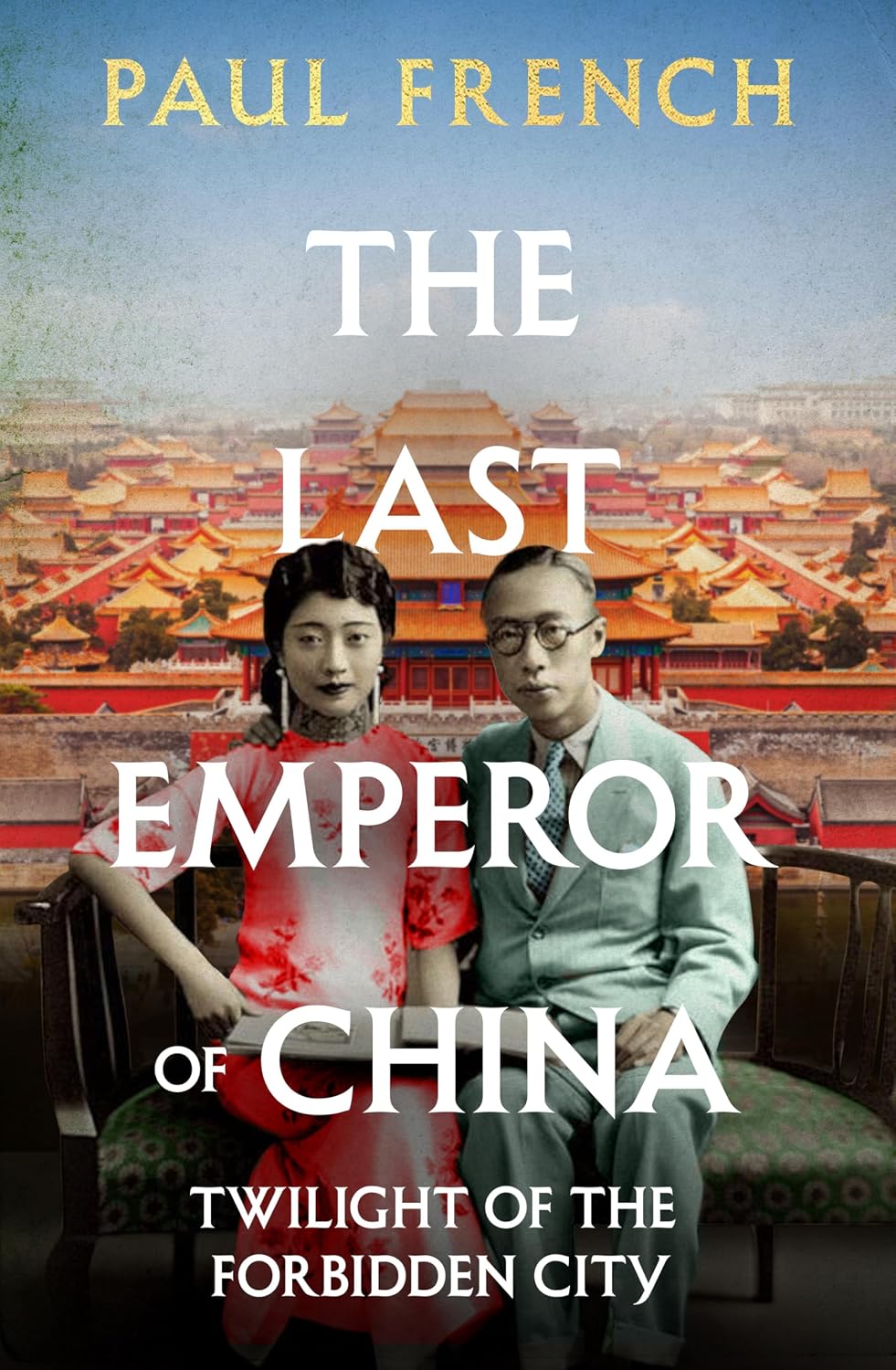
“The Last Emperor of China” by Paul French
For most readers and filmgoers, the emotional architecture of the final Qing court was built not by historians but by Bernardo Bertolucci’s 1987 visually intoxicating film The Last Emperor. It fixed certain ideas about the enigmatic emperor Puyi in the public imagination: a spectral figure wandering through a museum of vanished power, emotionally stunted, politically helpless, fundamentally isolated. Paul French’s book does not so much overturn that vision as quietly prise open hidden doors and secret corridors within it.
French seeks something more intimate and more elusive—the emotional texture of the final years inside the Forbidden City before exile, humiliation, and Japanese manipulation consumed the imperial household. His central question: has the accepted portrait of Puyi and his world been too cold, too clinical, too eager to turn everyone into symbols?
The answer, according to French, is yes.
French understands that the Forbidden City was not merely a location but more a psychological climate. He lingers over its geometry and rituals, its endless halls and nested enclosures. The place emerges not as a functioning home but “essentially a grand theatrical stage set rather than any sort of practical home.” The inner court feels like a forbidden city within the Forbidden City itself, populated by eunuchs, dowagers, retainers, and fading ceremonies that survived long after imperial authority had evaporated beyond the walls.
French conveys the bizarre limbo into which the abdicated emperor was placed after 1912. Outside the gates, China convulsed through republicanism, warlordism, and anti-foreign upheaval. Inside, court rituals continued as though history had merely paused for a cup of Oolong. Puyi remained cocooned in “the Great Within”, trapped by the very Articles of Favourable Treatment that supposedly protected him. The tension between enclosure and yearning runs through the entire book: Puyi staring from rooftops toward the city beyond the walls, dreaming of attending Oxford, craving ordinary life—yet simultaneously imprisoned by duty, symbolism, and the livelihoods of the vast entourage dependent on him.
One of the book’s most interesting achievements is its insistence—drawing heavily on newly explored diaries and correspondence, particularly those of the American tutoress Isabel Ingram—that Puyi and his consort Wanrong possessed a genuine emotional bond, albeit one expressed through elite Manchu conventions rather than Western romantic performance. French attacks both the old Communist depiction of Puyi as neutered and impotent and the Western tendency to mistake reserve for absence of feeling. The result is unexpectedly touching. There are scenes of photography sessions, picnics, dogs, cream cakes from German bakeries, tennis games, dancing, movies, gramophones, and motorcycles. French quotes Puyi’s brother recalling that “there was a lot of laughter, she and Puyi seemed to get on well, they were like kids together.”
Equally fascinating is French’s handling of Isabel Ingram herself. Barely visible in most previous tellings, she becomes here a lively observer whose journals bring out the real texture and humanity of palace life. Through her eyes the Forbidden City becomes a space filled with gossip, humour, frustration, and emotional entanglements—generous glimpses behind the velvet curtains. Her relationship with the Scottish tutor Reginald Johnston, long portrayed as the emperor’s solitary foreign confidant, gives the book an almost Merchant-Ivory melancholy: Johnston’s letters to Ingram reveal warmth, longing, and a far more emotionally vulnerable figure than the canon allows.
French’s great strength as a writer is the ability to convey complex historical events without sacrificing readability. The scholarship is substantial, sometimes heavily footnoted, yet the narrative seldom loses momentum. Room names such as the Palace of Gathered Evidence or Pavilion of Delightful Melodies shimmer throughout the text like fragments of an older cosmology. Even the absurdities resonate—the imperial household apparently maintained an entire Department of Toilet Paper.
Yet beyond the eccentricity and faded splendour lies a steadily darkening political reality. When the warlord Feng Yuxiang expelled the imperial household in 1924, the emotional rupture was catastrophic. Isabel Ingram wrote: “That day was the end of my beautiful China…” For Puyi, exile seems to have fused humiliation with grievance. French persuasively suggests that his later cooperation with Japan partly reflected a desire for revenge upon the republic that had stripped him of identity, purpose, and legitimacy. Manchukuo offered the fantasy of recovered emperorship—but the tragedy lies in how quickly Puyi realised the trap. He had exchanged one gilded cage for another, ending up “a puppet emperor in a puppet state recognised by virtually no one internationally.”
The final irony is brutal: a man once worshipped, now wearing a grey worker’s jacket, ends up queuing to buy a ticket to visit the Forbidden City, just like any other tourist. It is a fittingly autumnal close to a book that recovers, with considerable skill and sympathy, the human texture of a world entirely vanished.
This is a book for readers drawn to the intimate textures of history, those who find the human detail more revealing than grand sweeps of political chronology. It will appeal particularly to anyone with an interest in late-imperial China, the strange twilight world of treaty-port Asia, or the dynamics of colonial encounters. Readers who came to Puyi through Bertolucci will find their understanding quietly deepened, and perceptions substantially shifted.