Old post
This post was published before January 2026. Some links, images or other content may no longer display or work as originally intended.
“Andhar Bil” by Kalyani Thakur Charal
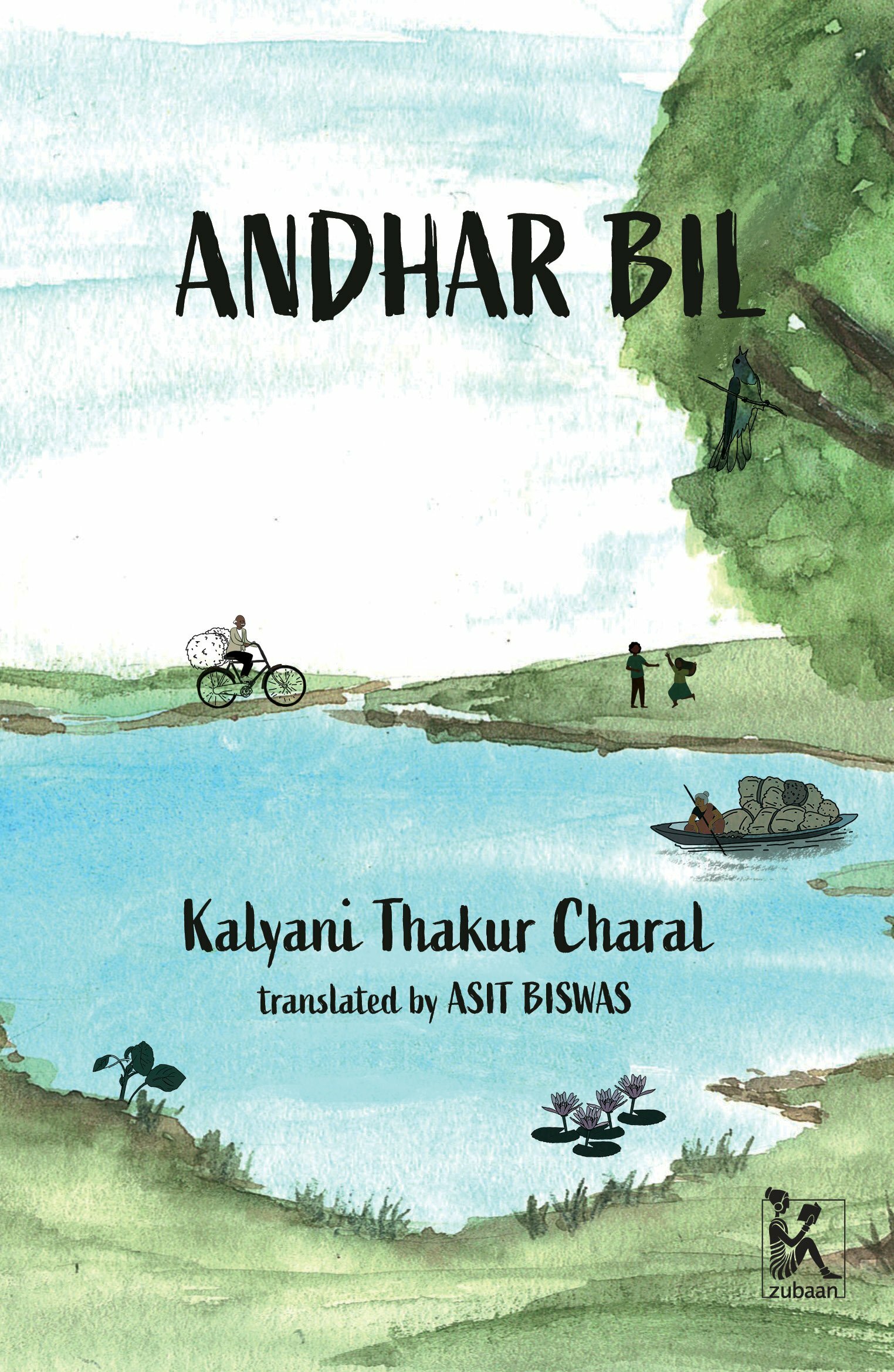
“The story here,” Indian Dalit author Kalyani Thakur Charal writes in the introduction to Andhar Bil, “centres round my village, my childhood, my beloved Andhar Bil which has a close, intimate relationship not only with me but also with numerous boys and girls of my village.” Drawing on her lived experience of loss, uprooting, and resettlement in the aftermath of the Bangladesh Liberation War of 1971, the novella emerges from Charal’s intimate attachment to place and memory.
Set in rural Eastern India, the novella traces the slow rebuilding of everyday life among Dalit refugees who cross over from what is now Bangladesh and settle around the bil, a body of water that anchors labour, ritual, and belonging. Charal does not deploy history through spectacle or overt political declaration. Instead, she assembles fragments of the ordinary—work, movement, recollection—to show how large historical ruptures sediment into daily life. Translated from the Bengali with restraint and care by Asit Biswas, whose own childhood familiarity with similar wetland landscapes and refugee communities informs his engagement with the text, Andhar Bil allows forced movement and resettlement to register quietly, through texture, rhythm, and lived detail rather than explanatory excess.
The refugees arrive by train at Gede, a border town on the India–Bangladesh border, carrying jute bags and tin trunks. Some bring their pet cats, small tokens of domestic attachment; others carry arum roots carefully wrapped in cloth—portable means of subsistence that signal an effort to replant everyday life in unfamiliar terrain. Charal’s attention to such seemingly trivial objects records the material residue of migration and resettlement. The land they encounter is raw and unfamiliar, and comparisons with their former home in Bangladesh emerge immediately. Someone reflects, “No matter what you say, there is a difference of heaven and hell between that country and this one. Can the water of the Madhumati and that of Andhar Bil be the same?” The question frames the novella’s central inquiry into belonging.
Biswas’s translation allows this landscape to speak quietly, without explanatory excess.
Around the bil, life settles into rhythm. Communal kitchens give way to individual households; men cut paddy in chest-deep water; children chase ducks, calling out choi choi; women stitch kanthas late into the night through shared systems of gata. Boat races and village fairs return. Nostalgia does not halt daily life, but it accompanies it. As villagers compare food, clothing, and even the air of the two countries, memories of “the country left behind always win the best position.” What has been lost remains irretrievable, yet it continues to shape longing and memory.
“The only consolation is that there is a bil at the stretch of a hand for everyone.” The bil is not a mere backdrop but a living presence. While rivers wash away sins, Charal writes, “the bil merges all sins unto herself… She is witness to everything in the village.” Still, opaque, and receptive, the bil absorbs arrival and illness, harvest and hunger, joy and betrayal. As years pass and the bil dries up except during the rains, the community experiences this ecological thinning as another layer of loss—one that echoes earlier histories of uprooting and foreshadows future precarity.
Woven into this collective life is the journey of Kamalini, a girl growing up in the newly settled village of Bilparah. Kamalini learns to swim in mossy ponds, sells vegetables, husks paddy, tries to tame a buffalo, and rows a boat into flooded fields to meet her father. She takes pride in her strength, even considering herself “a bit masculine”, and feels “a kind of self-satisfaction” in being able to do work usually associated with boys. Her father applauds her daring, while her mother’s fear and anxiety follow close behind. Kamalini is not framed as a rebel, but as a child discovering her capacities before the world teaches her how and where to limit them.
Women’s labour sustains the community.
Patriarchy structures village life, yet so do small acts of negotiation. One of the novella’s most vivid episodes describes the formation of a women’s group. They beat the donka, sing jagron songs through the night, and dance during the Baruni festival in white saris with red borders. Religious injunctions warn that women who beat the donka will cause the rice vessel to explode. Kamalini’s response is direct and unadorned. She “thinks the religious texts tell lies.”
Women’s labour sustains the community. They haul water from the bil, cook for many, stitch quilts by moonlight, preserve rituals, and mediate disputes. At the same time, they are confined by naming: widows known only as “X’s widow,” mothers defined through their children. Kamalini’s quiet question—“Can a ‘widow’ be an identity?”—remains unanswered. These scenes show how caste and gender operate in everyday life, shaping how women are recognised, addressed, and spoken about.
References to Dandakaranya—where only Dalit refugees were systematically resettled in inhospitable forest camps—circulate through village conversation as cautionary tales. “You’ve left one country and come to another, and again to leave this place!” someone remarks, noting that “the only thing that grows there is corn, nothing else.” Such moments reveal how post-Partition rehabilitation policies were hierarchised: upper-caste refugees often remain closer to cultivable land and infrastructure, while Dalits are pushed toward ecological and economic margins. Within the village itself, caste stigma persists in the form of mockery and suspicion. Children from Bilparah are taunted—“Bilparah men are long without meals / Rice not much, but fish to them appeals”—and theft is quickly attributed to Dalit boys. These slurs translate material dependence on the surrounding environment into moral inferiority.
As refugee schools emerge, the community’s dreams tentatively expand. Children learn arithmetic; girls and boys attend class together. Education offers new possibilities, even as hardship remains. Kamalini eventually boards a train to Kolkata for further schooling, initiating another migration—this time chosen rather than forced. Yet the departure does not promise simple escape. Charal ends with an image of interior geography: Kamalini will live amid concrete, yet within her “will grow trees like gaon as in the Sundarbans,” and she will continue to search for the Andhar Bil of her childhood. Home becomes something carried, questioned, and continually reimagined.
The English retains the text’s rootedness without flattening its textures.
Biswas’s translation deserves special praise. Cultural terms remain intact, the cadence unhurried, the emotional register restrained. The English retains the text’s rootedness without flattening its textures.
Andhar Bil is not driven by plot or spectacle. Its power lies in accumulation—in moments, routines, and pauses. Like the bil at its centre, the book is still profound, absorbing what people leave unspoken. It reminds us that history is lived not in declarations, but in harvesting, cooking, rowing, singing, stitching, and remembering.