“The Lady Who Carried the Monk Across the River: A Parable for Ordinary People” by Pavan K Varma
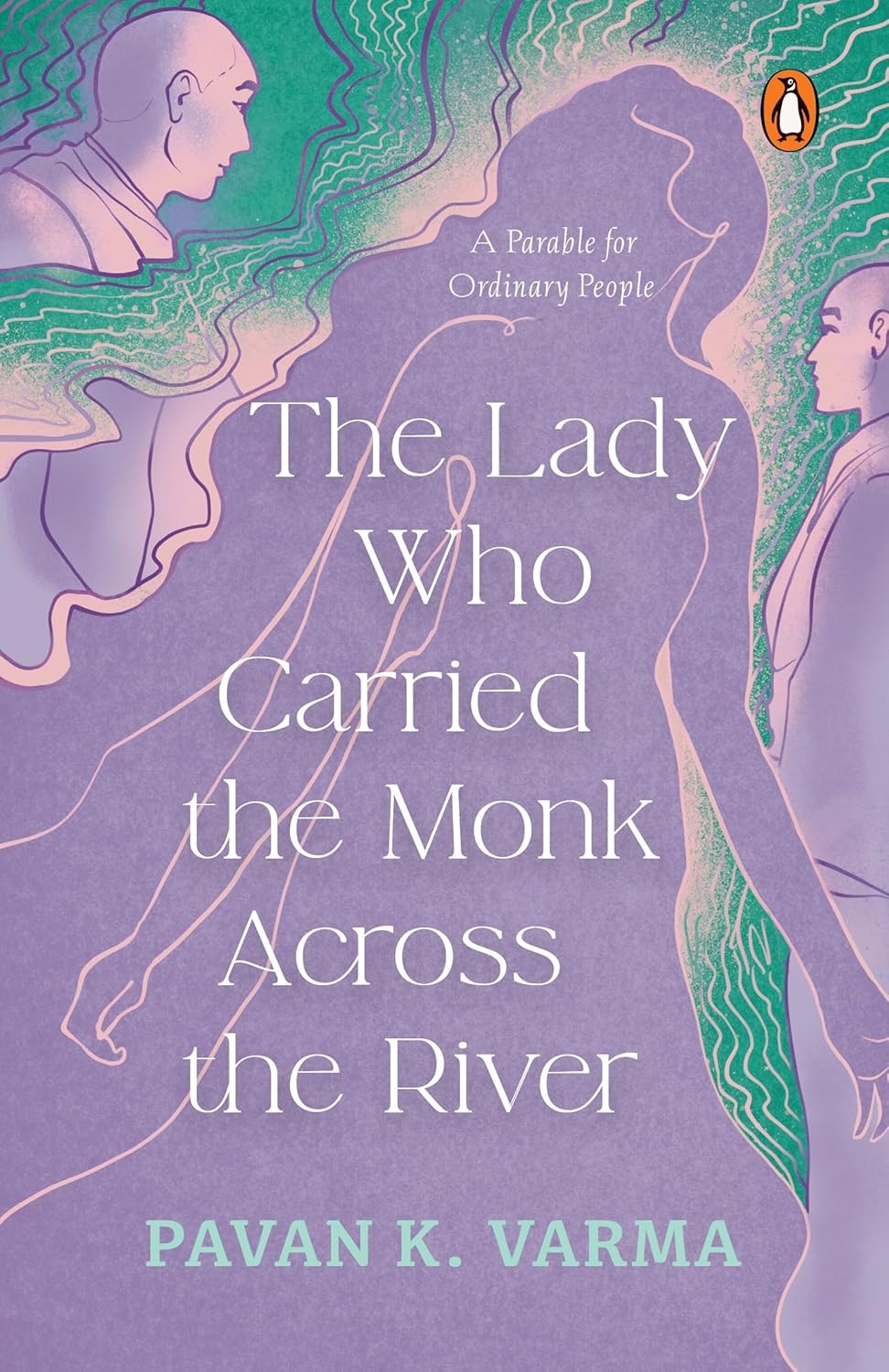
While philosophy has often figured in literature, the Indian philosophical universe of dharma, karma, yoga, consciousness, body, mind, desire, and so on has rarely been the foundation of Indian English fiction. In The Lady Who Carried the Monk Across the River: A Parable for Ordinary People, Pavan K Varma (who also happens be a former diplomat and government minister) steps into this intersection of fiction and philosophy to retell the well known Zen parable about a monk carrying a woman across a river. Varma’s version flips the ending for a different take on monkhood, celibacy, spirituality, and desire.
Varma sets his story in a contemporary village and town in the foothills of the Himalayas. Two monks—Gyandeva and the “hero” Kevala—living in an ashram cross a river everyday to meet their learned teacher—one well versed in Hindu philosophy—who lives in a village nearby. One fine day, the monks see a woman who is too scared to step into the river. Kevala picks her up and puts her down on the other side while the onlooker, his friend Gyan, cries out in horror at the gesture. Kevala turns it back on Gyan exactly like the monk in the Zen story: he has dropped the woman at the bank while his friend is still carrying her in his thoughts.
Rather than ending there, as the original more or less does, the story takes another turn. Gyan complains to the teacher Guru Brahaspati who, while disapproving, sees a teaching opportunity and decided upon an intellectual duel, a recreation of a famous 8th-century debate between Adi Shankaracharya and Mandana Mishra on what is superior: the path of consecrated ritual or the path of knowledge. That debate was won by Shankaracharya who espoused the cause of knowledge.
Kevala knows he is no Shankaracharya obeys his teacher’s command to enter into a shastrartha, a civilised argument about the interpretation of scripture, to clarify his own thinking to himself. He thinks of it as dialogue rather than debate about desire and morality and their relationship with life.
The five day long dialogue touches upon the nature of desire, the body, peace, consciousness, and spirituality; that is the real point of the parable, not who “wins”. For instance, while they believe that there is such a thing as truth and perception and inference as ways of arriving at truth, Kevala brings in quantum physics:
A wave could be a particle, a particle a wave… The quantum world demolishes the notions of conventional reality… So, what is the validity of any reasoning that is determined by our limited rational apparatus?
Most questions make the Guru wonder what they have to do with the woman and Kevala’s act of carrying her. As Kevala puts it in one of the dialogues:
But, master, if Brahman parades all things, animate and inanimate, why should I not experience the same joy from lived experience? … Would it not be much better if I also aspired to find joy in all phenomena, even if some of them are transient, and even if some of them may also be a source of pain? What needs to change is my attitude to external phenomena, the ability to accept joy and sorrow with equanimity, like the Bhagavad Gita teaches us.
Each day nudges Guru, Kevala, and Gyan closer to examining their own lives and acts, both past and present. Both Guru Brahaspati and Gyan have either been hiding from what they really want or feeling a sense of shame about desire. They realise their decision to renounce the world has got more to do with not being their own person than with goals of spirituality.
The slim novel is a quick read, not written with the burden of understanding or challenging the burden of Indian philosophy but it does seem to have a well intentioned didactic agenda: what is Indian thought? Is it as simplistic as the spirituality-as-renunciation? And more importantly, can one approach diversity in opinions as dialogue rather than as debate? The story should be read as a modern, inquiry-based approach to belief systems. Varma does not seek to shock the reader but leaves the reader with the feeling that worldviews should not feel exclusive; engaging with one should not mean deserting everything else.