“Fortress Besieged” by Qian Zhongshu
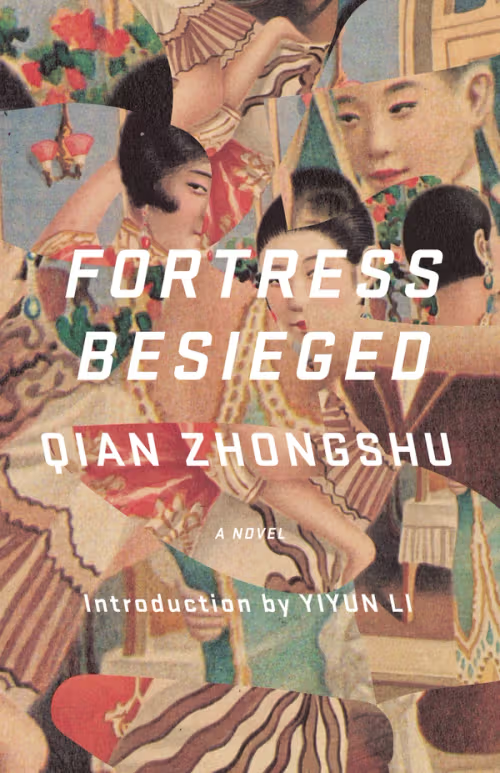
Born one year before the Republic of China, Qian Zhongshu was to become one of its most revered fictional chroniclers. The cast of Fortress Besieged—the only novel he ever completed—characters were to become stand-ins for a generation of the Republic’s fumbling (pseudo-)intellectuals.
The novel follows one Fang Hung-chien, starting with his 1937 return from Europe with a fake degree then through botched romances in Shanghai and a failed career at a new university in China’s interior, and at last into a collapsing marriage in Hong Kong then Shanghai once more. In the background, the Second Sino-Japanese war is taking hold. Fang and friends do not participate, though the politics of collaboration versus resistance eventually encroach on the plot, despite the relative safety of Shanghai’s neutral foreign concessions.
This new release of the novel is a republication of its only English translation, by Jeanne Kelly and Nathan K Mao, published in 1979. This original included a brief translators’ preface handling acknowledgements, an afterword by the latter translator providing commentary, and the author’s own preface from the original Chinese 1947 publication, where Qian shared characteristically wry thoughts on the practice of literary dedications. A 2003 edition saw the addition of a foreword by sinologist Johnathan Spence, which details the novel’s historical context then compares its plot to the author’s life. Bundled in with all the above is a fresh introduction by Yiyun Li, who offers a more personal and pointed interpretation than any of her forerunners.
Yiyun Li… offers a more personal and pointed interpretation than any of her forerunners
She explains that she first read Fortress Besieged amid a massive revival triggered by a 1990 television adaptation, emphasising that China’s communist revolution and subsequent Cultural Revolution had put non-regime literature on hold. Whether unwittingly or not, Li parallels the novel’s literati by leaning heavily into citing canonic Western writers—but her references are illuminating, not comedically muddled like those of Qian’s characters. In another parallel with the text in question, she adopts a rather misanthropic approach, arguing that while Fortress Besieged can force readers to “confront their own casual bigotry” and “calculated cruelty”, many will see a satire only of their “frenemies” or outmoded historical attitudes—and never their own ugliness. In considering jokes and remarks in the novel that today read as politically incorrect (usually it’s national and racial stereotypes), Li says that those who would condemn the entire novel for this must prefer propaganda to literature.
Nathan K Mao’s afterword makes for a workmanlike counterpoint to Li’s introduction. After breaking down the novel’s structure, Mao discusses themes and topics one by one. These include humour, characterisation, and romance. He also considers attitudes in Republican China toward studying overseas—a topic still relevant to well-off youth of the People’s Republic. His final analysis is of Fang as the archetypal Republican intellectual, and he is quite sympathetic, helping the reader to consider Fang as beleaguered and limited—a poor player, but one who has been dealt a bad hand.
Between Mao and Li’s contributions the key insight is that reading Fortress Besieged is a reading experience driven by observing and reacting to its characters and their behaviour. One can feel disgusted by or sorry for Fang Hung-chien when he—for example—romances two women at once out of indecision, then finally lets one down only to see her turn the other against him. One can laugh or groan at the band of intellectuals Fang meets who trade their meagre intellectual worth on connections and references to Western names (eg, responses to fan mail by Betrand Russell), or one can soak in the historical context that Qian is distilling to critique. This was a time when China’s young progressive elite saw the adoption of Western thought as their means to pull their nation from millennia of feudalism, now redundant, to a better future among a society of nations then entirely dominated by the West. Qian’s depiction uncovers the gormless, selfish side of the coin.
Other writers of the time confronted the collisions and contradictions of superstition/tradition versus modernity/double-consciousness in their own way. In Fortress Besieged, it is biting satire and wry humour that distinguishes Qian, taken to the point that he skewers every character so deeply that the reader finds no-one left standing. There is no moral centre. While Fang Hung-chien is essentially a lazy cheating posturer, others are worse. Many mistreat Fang, and he mistreats others—we can feel sorry for them all, even though almost nobody ever takes responsibility or accepts blame, right down to the inn landlord who assures Fang and company that the worms in their dish are “meat sprouts”. As for patriotism and signing up to resist the Japanese aggressors under the aegis of the Nationalist or Communist parties—such actions are nonexistent, and to be found in other novels such as Han Suyin’s Destination Chungking.
Qian’s novel demonstrates an understanding of just how pathetic and petty people can be, and precisely how our weak, lapsing, or absent principles can see us fail to rise to the moments in front of us, despite all our cleverness. His characters have much of his wit and insight, but squander it into the air. In her introduction, Yiyun Li compares them to the Twitter pundits in our era of highly advanced sarcasm alongside stagnation, discord, and decline. It can be funny. It can also be excruciating. (See also Twitter’s tragicomic conversion to “X”.)
In the novel’s final act, chortles become scarce as the relationship between Fang and his bride Sun turns from an unwise but sweet beginning to a living hell engendered by pride and impatience. Both partners would rather measure their wounds rather than nurse those of the other. Fang ends the chronicle of his prolonged adolescence alone, save for a ticking clock and the knowledge that he must start again, again.
At the time of this new edition, young would-be intellectuals are facing a future shaped by new wars and diminishing prospects where personal branding and self-mythologising number among the last stepping stones not built on inherited wealth or in-demand STEM skills. Barriers to producing fraudulent academic certificates have risen, but many people with humanities degrees, in China and everywhere, still wish to be people. Even in good times, they will seek shortcuts. Posturing. Flattering. Deflecting. All to mitigate desperation and humiliation, and still with the likely outcome of landing flat then vanishing into obscurity. Those who can face this should consider picking up Fortress Besieged.