Olivia and Sophia by Rosie Milne
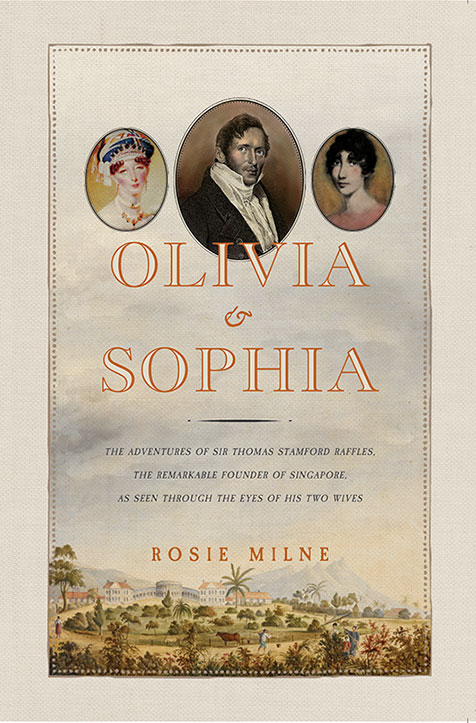
Olivia and Sophia is inspired by the life of Singapore’s colonial founding father, a somewhat fictionalized account as opposed to a faithful recounting of sequential historical events. Novelist Rosie Milne admits that she takes a slice of poetic license with some facts, invents scenes, conflates individual characters into a single person and changes the order of events. This work of historical fiction tells the essence of a story through short diary entries, a not unusual literary device.
Milne gives equal voice to both Raffles’s wives. His first spouse, Olivia, was of partial Circassian descent. When she meets Raffles she is ten years older than him, having been unwed and pregnant at age 15, and a widow in debt. On paper, their marriage was socially risky for Raffles but in reality it seems to have been a loving union.
In this book, she claims to be writing a journal for herself to read in old age. (In reality, Olivia did not keep a diary.) Her flirty personality and close friendship with other men made her easy fodder for stuffy scandal merchants. She is open about her relationships but adamant they are purely platonic, most notably with William Ramsey, effectively Raffles’s sponsor, Colonel Gillespie, and Scottish poet and polyglot John Leyden.
Leyden is a massive feature in Olivia’s life and her admiration comes across very clearly. Other than Leyden and Raffles, ill health and worry dominate Olivia’s writing. From the beginning, she worries about funding their trip to establish Raffles as new assistant secretary of the colonial outpost of Penang. Her trepidation of moving to the East is conveyed well, as are the horrors of being on a ship for months on end; and there are particularly evocative descriptions of their first landing and seeing the “jangal”.
Her analysis of Raffles is sound: “Tom is a nervous sailor”, and it is “fame he longs for.” He is socially irreverent, very ambitious and has an abhorrence of slavery. So far, so historical.
But Olivia’s self-analysis and views on others, as constructed by Milne, are frequently more interesting and enjoyable to read. Her diary feels more like her adventure rather than her husband’s (as indicated in the book’s subtitle) and this is no bad thing. She is critical of the snobbery of the upper class colonialists and brutally honest on a number of subjects: Lord Dundas’s sister is “too ugly to find a husband in England” hence her presence in the East, and the primary driver of most colonial adventurers is to “shake the money tree.” She is very clear that most men are in love with her and defends and befriends nonyas, the local mistresses of European men. In short she is a bit of a social rebel.
Yet suffering infuses Olivia’s life, from the climate in Asia—“ I am dissolving in the heat”—to her husband’s frequent ill health to the death of her daughter Harriet in England, and she is traumatised by Leyden’s death in Batavia. The fragility of life in the early 19th century is laid bare.
But intermittent happiness does not evade her. She enjoys the high life at balls in Penang and on trips to the colonial HQ of Calcutta and expresses joy after the successful British invasion of Java.
There are also nicely drawn scenes where Raffles and the co-founder of Singapore, William Farqhuar sit on a porch in Penang, sucking on their pipes, decrying the East India Company directors for the decision to raze Melacca in 1807 and waxing on their mutual love of zoology and botany.
And there are comedic moments, such as the chaos that results from having pet orangutans living on their premises and the pleasure of smoking the local ganja during their time in Melacca. Some of this is black humor. In 1812, suffering from a liver abscess, she retires to bed with a bottle of cherry brandy!
But misery is never far away. One sad entry is written from “Deathland”, telling us that: “horror looms yet I live a little longer...” In her last days, Olivia doubts her Christian faith and evinces a deep fear of eternal nothingness. At age 43, she eventually succumbed to dysentery and after 9 years marriage to Raffles she was interred in Batavia beside her other great love, John Leyden.
Raffles’s second wife Sophia is in no doubt about the existence of God or the truth of the Christian religion. Her diary entries are often prefaced by philosophical biblical quotes. Sometimes using the actual words from her real memoir, the tone of this part of the book changes starkly—from plaintive and melancholic to hopeful and business-like.
Sophia did indeed keep a diary— a memoir of Raffles himself. Her diary in Olivia and Sophia is more about her husband than herself, more political than personal. She considers herself more “redoubtable, resourceful and resilient” than Olivia, who is menacingly described as “the ghost who rubs between us.”
Sophia gives birth to a daughter, Charlotte, along the way to Bencoolen in Sumatra, present-day Indonesia. She is unimpressed with dilapidated colonial outpost that Raffles has been sent to sort out: “everywhere here is in a moderate state of desolation.”
This is a more erudite memoir. There are none of the “aint’s” that pepper Olivia’s diary. Sophia is prissier and more political than Olivia and clearly disapproves of the latter’s ganja puffing. Yet, like Olivia, she is still compassionate towards the plight of undernourished “natives” and is vehement in her love and respect for Raffles.
Milne conveys Sophia’s excitement on becoming Lady Raffles when her husband is knighted, which gives her more reason to maintain European decorum and standards of behavior, despite the oppressive environment in Asia.
As with Olivia, death haunts Raffles and his wife. Their friend Dr Arnold dies, as do others close to the couple. But it is the loss of four of their children in quick succession that is infinitely more heart-breaking. And yet, as with Olivia, there is some comic relief. They have tiger cubs and other animals frolicking around the house and she observes that “I have heard it said that to the natives we Europeans look much the same.”
Geopolitical developments are closely woven into Sophia’s diary entries. Raffles identifies Singapore, a tiny island that at the time was covered in jungle and a landing point for pirates, as the trading port to rival Dutch interests. She is witness to the wild celebrations on taking control of Singapore, following her husband’s judicious manipulation of the feuds between local Sultans.
Following portentous comments about Raffles’s bad headaches, by 1824 they are thankful to be heading home. Sophia returns a transformed woman, even tougher and more worldly than before. But their triumphant return is marred by financial troubles and demands for Raffles to pay compensation to the East India Company.
The last few years are covered briefly and Raffles’s ultimate demise has Sophia declare her intention to secure his legacy and historical reputation—a reference to her Memoir of the Life and Public Services of Sir Thomas Stamford Raffles.
This book that will attract the general historical fiction reader, in particular those interested in British colonial history and history from a female perspective. However, the interesting alternative perspective offered by Olivia and Sophia should not deter lovers of pure history from picking it up.