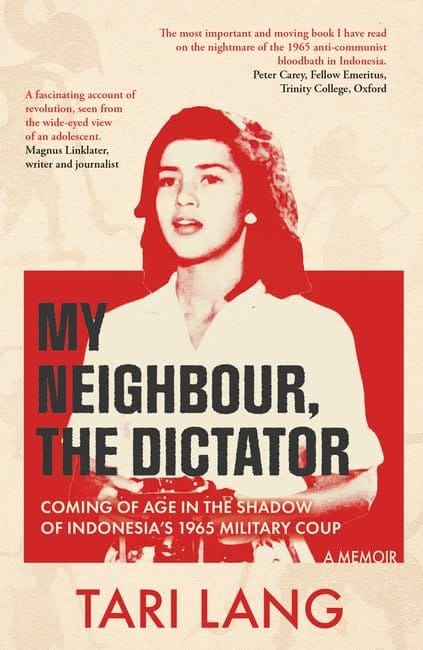
“My Neighbour, The Dictator” by Tari Lang
The years immediately following Indonesian independence were optimistic ones. The early 1950s are remembered as the “parliamentary period” of pluralism, when communists, socialists, nationalists, Islamists and the military vied for positions in the government. But debate between these parties was fierce from the beginning and quickly became vicious. After national elections in September 1955, a tense standoff emerged between the communists and the army. President Sukarno soon called an end to democracy in Indonesia and the country entered the 1960s primed for further instability.
Tari Lang was born in 1951 in Prague, where her British Jewish mother worked for the Secretariat of the International Union of Students and her Javanese Muslim father was studying at Charles University. The young family soon moved to Jakarta after which Lang’s brother, Anto, was born. Then on 1 October 1965, when Lang was just fifteen years old, the army seized control of the country after a failed power-grab by a small group of progressive officers, which caused the death of six high-ranking generals. The army leadership blamed the actions on the communists and proceeded to kill approximately half a million real and alleged party members, and detained another million without trial. My Neighbour, The Dictator is Lang’s personal account of the tumultuous years before and after these fateful events.
As the book title suggests, Lang had something of a front row seat to all of this. Her family lived in the affluent suburb Menteng, just a few leafy streets from army leader Suharto and senior general Nasution. Her school friends included the daughters of communist leaders Aidit and Lukman. Her father was deputy minister in the trade and maritime affairs department, while her mother was an economics researcher in the foreign ministry and occasionally drafted speeches for Sukarno.
Life changed quickly for Lang after the army seized power. Because of her parents’ progressive political associations, they were repeatedly arrested and adolescent Lang was left to look after herself and her younger brother. In a remarkable display of resourcefulness and bravery, Lang even worked to turn a house formerly owned by a Chinese family into a hideout for radicals on the run. Chinese Indonesians were regularly targeted by the army for their presumed affiliation with communism. Lang was arrested for her actions and spent two terrifying days in prison.
Lang’s recollections from after 1 October are a portrait of a society where secrets, cruelty and imprisonment have become normalised. For the historian they are an account of how militarism can capture the state and brutally suppress opposition. For the lay reader they are an extraordinary story of resistance in the face of hopelessness and fear.
Since publication, Lang has insisted My Neighbour is first and foremost a memoir, not a history book. While an entire tradition of progressive political activism was coming to an end, Lang was beginning life as a young woman, with all the anxieties and revelations which come with that. The book’s best moments are its touching reflections on coming of age and family, as well as its amusing anecdotes of modern urban life, teenage romance and fun with friends.
For example, before the events of October 1965, Lang and her family had a comfortable life, but under a “strict regime of nothing frivolous”. Her mother in particular was austere, secular and, having renounced her British citizenship for Indonesia, utterly focused on her career in politics. Lang did not so much resist this lifestyle, but rather something else alongside it. She attended political youth meetings but also sought out traditionally feminine activities and possessions that her mother eschewed: necklaces, dressmaking and lipstick. She found joy and meaning in music, theatre, poetry—and religion, too.
The military government… could not break the basic bonds that tie humans to one and other. The story in My Neighbour is testament to this
Yet if there is one theme that runs throughout the entire memoir, it must be the importance of community. My Neighbour features a wide cast of characters—friends, neighbours, organisation members, religious leaders, cultural figures—all connected in a thick social web around Lang and her family. She relies on these people throughout the difficult years, and they ensure her safety more than once. Others often rely on her in turn. The military government may have violently destroyed a vibrant and influential part of Indonesian political life, but it could not break the basic bonds that tie humans to one and other. The story in My Neighbour is testament to this and the values that make those connections possible: resistance, mutual reciprocity, solidarity and kindness.