“This is Where the Serpent Lives” by Daniyal Mueenuddin
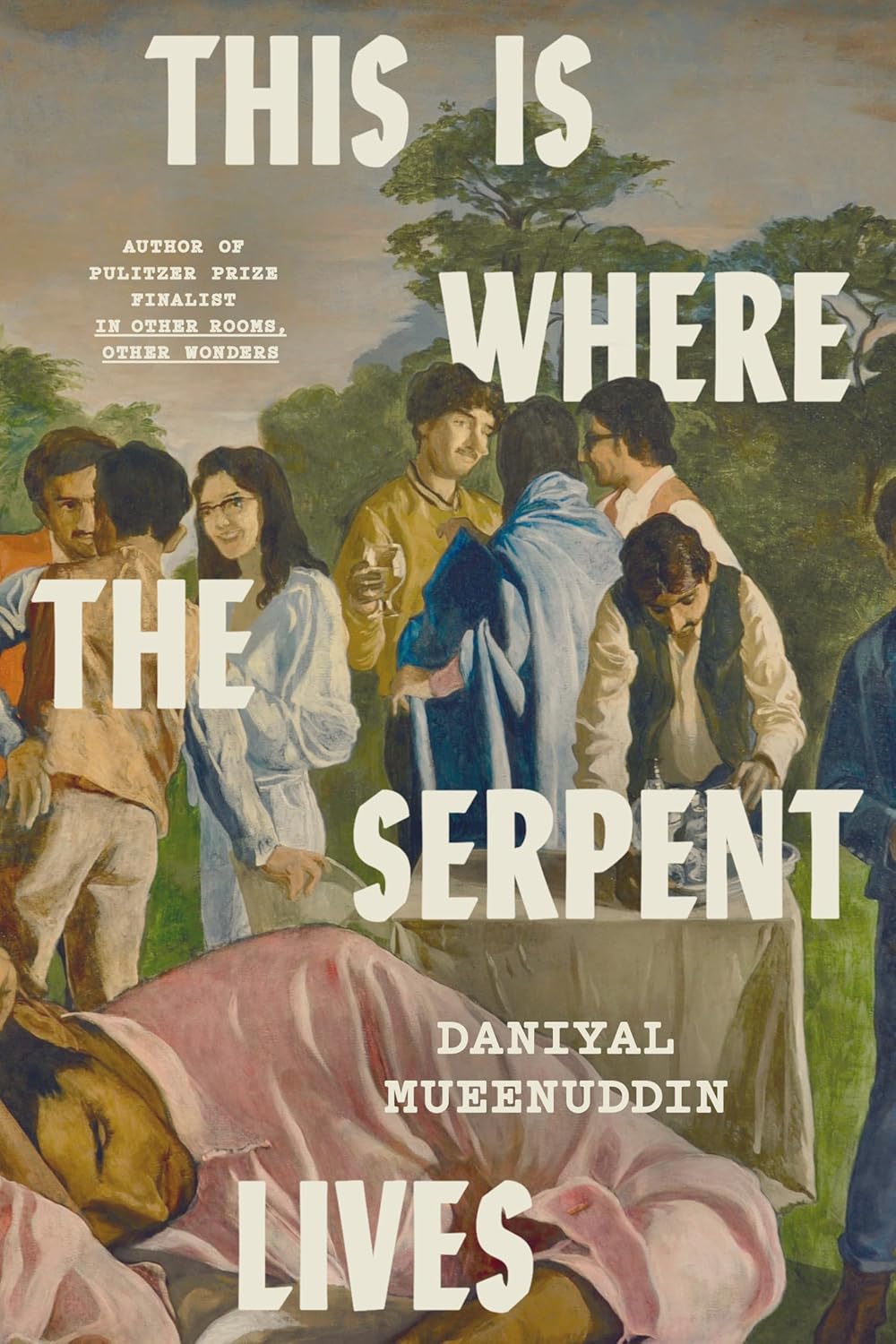
In This is Where the Serpent Lives, Daniyal Mueenuddin unpacks the nuances of the Pakistani landowning class through rich, in-depth characterisation filled with complex interpersonal dynamics that shed light on the realities of class, discrimination and social mobility.
Divided into four sections, each with a different narrator, the novel explores the interconnected lives of characters living in rural northern Pakistan. A boy named Yazid is found abandoned in a Rawalpindi bazaar, and works his way from working at a tea stall to becoming a driver for the wealthy Atar family. In the next section, Rustom, a landowner newly arrived from America struggles to manage his family’s estate while dealing with thugs encroaching on his farmland. Rustom’s cousin Hisham Atar, meanwhile, looks back on his childhood as the heir to a landowning family, his relationship with his estranged brother, and his marriage to the worldly, clever Shahnaz. In the final section, Saqib, a servant in the Atar household, rises to the rank of farm manager, making himself indispensable to his employers while scheming to swindle them.
Because of this structure, Mueenuddin’s latest work feels less like a novel and more like three self-contained short stories and a novella which happen to share some of the same characters. The result can feel slightly disconnected and chaotic, but Mueenuddin also forces us to look for the places where the narratives overlap, and where common themes and patterns reveal themselves. It’s an ambitious book, requiring close and attentive reading.
Making it even more demanding, the novel features a sprawling cast made up of complex relationships, requiring a character list in its opening pages. Nevertheless, Mueenuddin manages to make each character appear unique, authentic and rich in detail. More crucially, he uses the diverse mix of characters to comment on the complex class dynamics at play within the feudal system. Of the four narrators, Rustom and Hisham are upper-class land-owners, while Yazid and Saqib are working-class labourers. A wider cast presents perspectives of individuals from all levels of the class system: those who benefit from it, those who suffer because of it, and those who learn to use it to their advantage.
Notably, there are no women narrators, and the female characters are sidelined into the roles of wives and lovers, consistent with the male-dominated system in which the story operates. Despite that, the women are some of the more fascinating characters in the novel, with many, particularly Hisham’s cunning wife Shahnaz and Saqib’s ambitious wife Gazala, playing an important role in driving the events of the plot, showcasing their agency even within the limits the system (and the story) allows them.
Of the four sections the novel is broken into, Saqib’s narrative is the longest as well as the last, suggesting that if the story has a protagonist, it’s him. The preceding pages lay the foundations and build up the context for his story, and the novel’s dramatic, tragic conclusion. Mueenuddin makes the readers wait for the pay-off, because Saqib’s story is the answer to the question the novel poses about how far someone can climb the social ladder within this class hierarchy. Yazid and Saqib are both characters who rise above their humble beginnings, but Yazid recognises the limitations of how far he can aspire to climb, whereas Saqib strives to go higher than what the social contract allows. This is best demonstrated in a conversation between the pair at a restaurant, where Yazid points to a serving boy and comments:
“‘Look at life. I used to be that, and now I drive around in a Mercedes four-door saloon.’
‘But you don’t own it.’
‘I don’t need to.’”
Yazid is content to wear and operate the symbols of status even if he doesn’t own them, whereas Saqib is preoccupied with the concept of ownership: the ultimate symbol of power in a system where land is the most valuable currency. Yazid, whose story opens the novel, and Saqib, whose story closes it out, act as narrative foils who demonstrate the illusion of social mobility within the class system.
In his representation of rural Pakistan, Mueenuddin paints a picture of a world that operates by its own rules, customs, and laws, set apart from the rest of Pakistan. Rustom is forced to rely on the shaky loyalty of thugs in order to protect himself from the thugs who have been encroaching on his land. In moments of hilarity and horror, Mueenuddin draws our attention to the absurdities of this world. He creates a strong sense of place, not by relying on heavily detailed descriptions of the landscape, villages, and houses, but what they represent, and the emotions they evoke. As Saqib cleans the Atars’ empty house, “the poignant, melancholy rooms lay drained of motive in the masters’ absence.” There is a tone of satire, but also great empathy in his descriptions of the spaces in which these characters operate.
The novel gives the impression that Mueenuddin is only highlighting a small fragment of a wider story and a glimpse of the novel’s vast, rich, and complicated world. Many minor characters appear only briefly and then vanish, and some of the interwoven storylines are left unconcluded. The narrator’s perspectives are deliberately limited by their own biases and preoccupations. What emerges is a setting that’s often barbaric and sometimes baffling, adding to the novel’s sense of rustic charm and raw authenticity.