“She Walks at Night” by Seishi Yokomizo
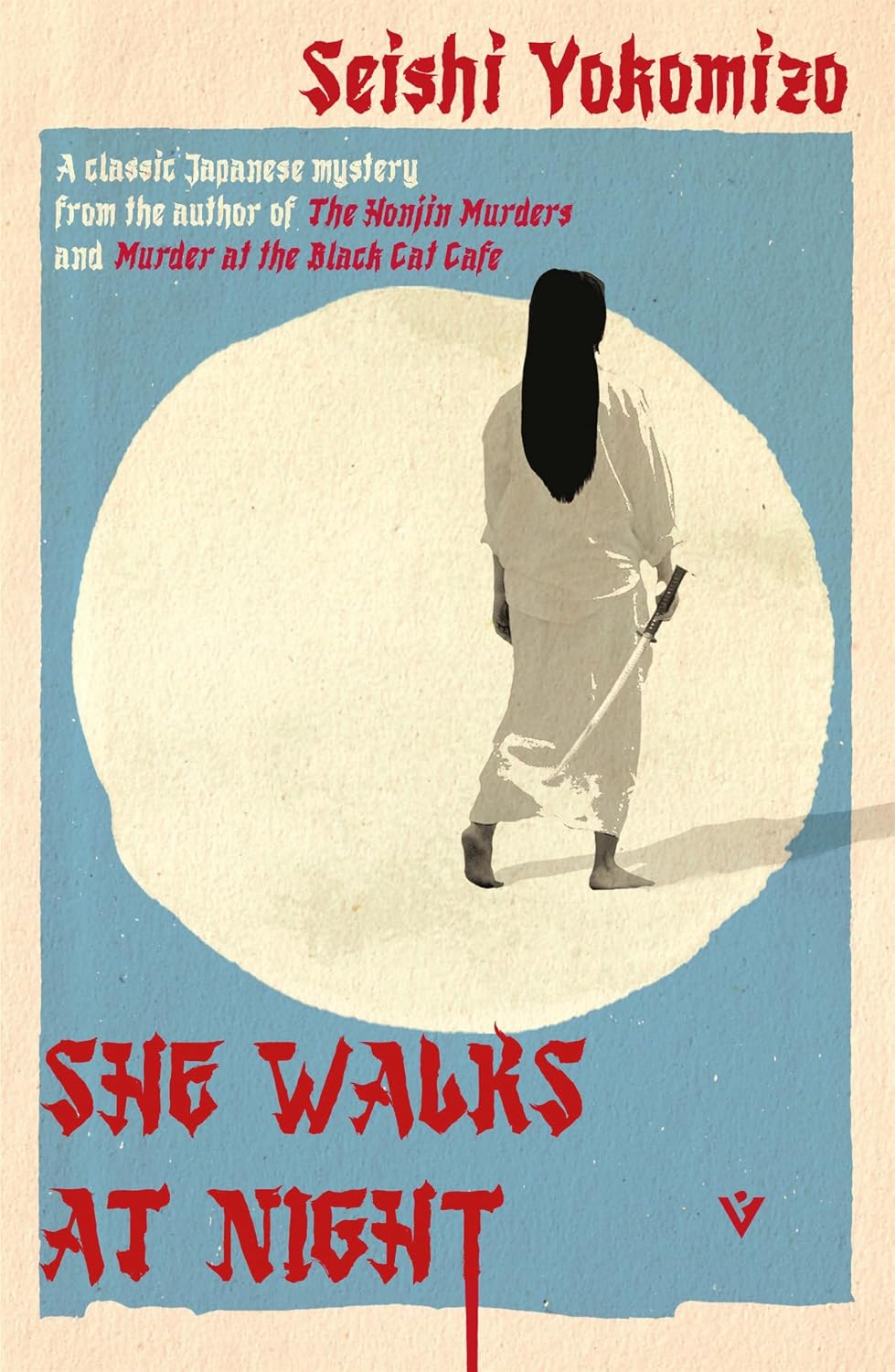
She Walks at Night is the eighth Seishi Yokomizo mystery to be published in English since 2019 and features a cast familiar to previous readers of this popular series, which began with The Honjin Murders, published in Japan in 1946. The story brings back the eccentric private detective Kosuke Kindaichi and Inspector Isokawa, his longstanding, trusted companion in Okayama Prefecture, while introducing us to the haughty Furugami family and their retainers, the Sengokus. Gleeful and decadent, it was first serialised in a magazine in Japan in the 1940s. The novel is brought to life in English by Jesse Kirkwood’s rhythmic, atmospheric translation, which retains the careful, methodical, yet gothic sensibilities of Yokomizo’s writing.
She Walks at Night is narrated by Torata Yashiro, a writer of (“middling”) detective fiction, and opens with Yashiro’s frenemy and classmate, Naoki Sengoku, enlisting him to look into a series of baffling occurrences within the family. As Naoki’s begrudging confidant, Yashiro agrees; he quickly discovers that in life, unlike in fiction, there is no easy resolution to murder. In his acidic narrative voice, he mulls Naoki’s invitation:
A struggling novelist needs his patron. Instead, swallowing my resentment, I set about flattering him as much as possible. In fact, Naoki seemed to hold me in utter contempt…
Like the wealthy, feudal families of Yokomizo’s earlier Kindaichi mysteries, The Honjin Murders, The Devil’s Flute Murders, and The Inugami Curse, the Furugamis and Sengokus are a motley lot. The head of the Furugami clan, Viscount Oribe, is deceased, and Tetsunoshin Sengoku, Naoki’s father, has assumed de facto leadership of the household. It includes Lady Oryu, the late Viscount’s widow, with whom Tetsunoshin is in a relationship; the beautiful and temperamental Yachiyo; and Morie—the Viscount’s son, who has a curved spine. (Here, the English reader should be aware that the text retains some terms that are now considered derogatory). Although Yachiyo is the Viscount’s daughter on paper, her true parentage remains unclear, and despite the threat of incest, Morie is deeply in love with her.
However, his efforts are thwarted by the artist Hachiya, Yachiyo’s fiancé, a fashionable, opportunistic character who has found fame and success in postwar Tokyo. The drama opens when Yachiyo receives a series of anonymous, threatening letters from someone who warns her not to walk at night, an apparent reference to her somnambulism, of which anyone outside the family is unlikely to know. She Walks at Night is psychologically rich, expanding upon each character’s motivations and secrets.
A departure from his famous locked-room honkaku mysteries, the murders in this novel occur in open, freely-accessible spaces. The focus of the investigation frequently moves away from the technicalities of how the murder took place to why it happened, allowing for a deeper glimpse into each suspect’s fears, desires, and dissatisfactions. Such a pivot forces the detective—and the reader, by extension—to deconstruct the suspects’ motives for each death, reinforcing the psychological focus of the novel. As in a game, Yokomizo sets up parallels between sets of characters through the manner in which different corpses are found, and later, between Yashiro and Kindaichi.
While surveying each suspect, Yokomizo, through Hachiya, recreates the fashions, arts, and glamor of a society in flux. He documents and gently satirizes the affectations of a society recovering from war, seen below in Yashiro’s sardonic characterization of the artist:
He was a rising star of the art world who had established his reputation as a painter after the war. He styled himself a modernist, claiming that merely replicating one’s subject, no matter how skillfully, amounted to nothing more than an imitation of nature… In short, Hachiya was a very conceited man… Rendered in a style that you might, if you were feeling generous, call early Symbolist, and teeming with bizarre details, they left me entirely in the dark as to what the artist was actually trying to convey. They featured motifs such as women cradling skulls, or snakes coiled around beautiful youths, to which Hachiya would assign grandiose titles like The Suffering of Life or The Mystery of Woman.
In another scene, Naoki describes a nightclub called Cabaret Hana, frequented by the wealthy in Ginza:
A lot of them are the sort of shabby dives that used to call themselves ‘cafés’, and worse besides—but Hana is in a league of its own. It’s in a prime spot, tucked just off the main Owaricho drag on the ground floor of a bombed-out building that was repurposed after the war. The owner only got away with it because they were so quick off the mark… It’s cavernous, and the decor is first-class. You’d hardly think you were in a country that just lost a war.
Such lavishness contrasts sharply with the raw natural beauty of Okayama, which features prominently in the second half of the novel. For example, consider Yashiro’s description of the path to the old Furugami estate in the countryside:
…we began travelling along the edge of a rather high cliff. I peered down into the gorge, some ten metres deep, and saw that it was strewn with enormous boulders, between which the water flowed steadily yet silently. As we entered the shade of the mountains, the air grew noticeably crisp…
It is here that Kindaichi, with his characteristic “wild, untamed curls,” makes his appearance, accompanied by Inspector Isokawa. Although he is late to the case, his solution, when it appears, ties together each narrative strand and proves that he is every bit worthy of his reputation as a great detective. The final denouement occurs at the edge of a waterfall, a fitting final image for a novel obsessed with the thrills of the gothic and the pleasures of pulp.
While fundamentally a murder mystery, She Walks at Night also chronicles the urban public’s attitudes towards and dependency on the arts, fashion, and entertainment in the years after the war with Yokomizo’s signature acerbity and deep empathy. This is a fundamentally playful, yet unsparing and deeply considered work.