“The British Indian Ocean Territory: A Secret and Strategic Cold War History” by Samuel Bashfield
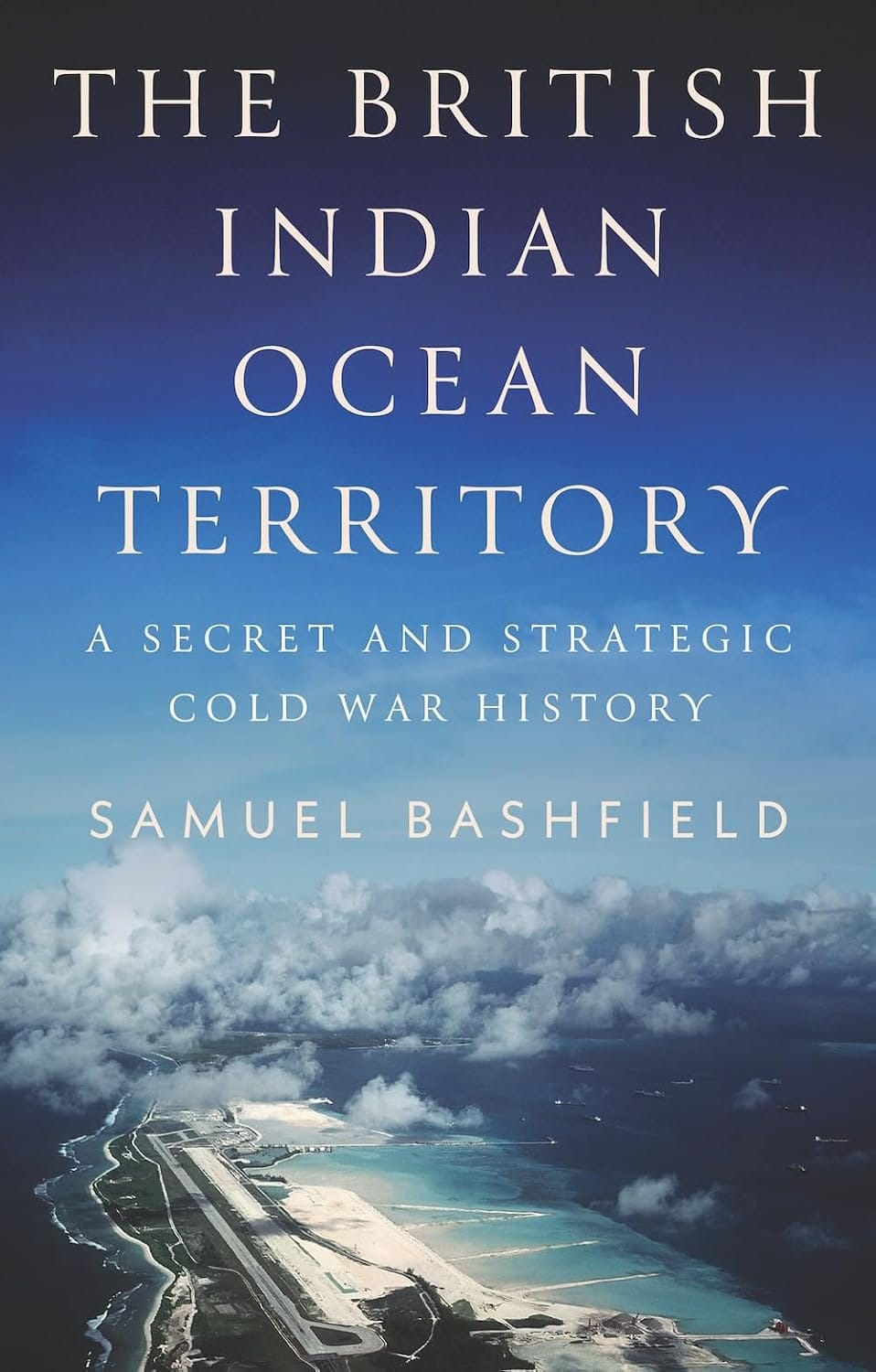
The British Indian Overseas Territory is the sort of place only a stamp-collector will have heard of. It’s more commonly and better known as Diego Garcia, in fact the largest of a group of islands (the Chagos Archipelago) smack dab in the middle of the Indian Ocean, and home to a major US military base that has recently been in the news. Samuel Bashfield’s The British Indian Ocean Territory: A Secret and Strategic Cold War History relates how this (geopolitally) came about.
Although book leads with with an evocative passage:
Every humid morning, a curious and little-recognised flag is hoisted at the Anglo-US joint military base on Diego Garcia, in the centre of the Indian Ocean. With the Union Flag in the common upper left corner position, this flag features six blue waves representing the Indian Ocean, a coconut palm illustrating the Territory’s common vegetation and, importantly, a crown symbolising British sovereignty and dependency status. Flying alongside the British Union Flag and the American Stars and Stripes each day, this third flag represents the British Indian Ocean Territory (BIOT), a secretive territory defined by geopolitical contest, historical controversy and power politics…
…it is, for the most part, a detailed blow-by-blow accounting of the (largely secret) discussions and negotiations between the Americans and British that led to the creation of a brand new colonial political structure whose main purpose was to accommodate a major US military installation on territory that was at best nominally British. It was nevertheless a good deal for Britain:
While most analysis revolves around what the United States derives from Diego Garcia, far less examines Britain’s military benefit. Many contemporary accounts fail to note that the facility on Diego Garcia is indeed a “joint” Anglo-US facility, despite the United States’ operational dominance of the base. In essence, through BIOT, Britain attained a first-rate military communications complex, airfield and protected anchorage for marginal cost…
…if not for Chagossians, who were kicked out.
Prior to 1965, Diego Garcia was administered as part of the British colony of Mauritius. The British were withdrawing from their empire and the US was worried about a strategic vacuum in the Indian Ocean. The consequent discussions and developments were for the most part insalubrious and unedifying, strong-arming colonies negotiating for independence, trading territorial access for access to nuclear weapons programmes, but not very surprising, perhaps, to anyone who has followed post-WW2 American military expansion and British imperial retreat. Bashfield wraps his account up around 1990 with the unfurling of the BIOT’s first flag in the face of American encroaching on British sovereignty.
The British Indian Ocean Territory’s origin as a PhD thesis has not been entirely disguised; it should perhaps be read alongside the broader The Last Colony by Philip Sands, who discusses the human rights of the long-suffering Chagossians in more detail as well as the minutiae of international law (as quaint as that may appear under current circumstances).
There was, initially, more to the British Indian Overseas Territory (BIOT) than just Diego Garcia and the Chagos archipelago. It was rather grander, or at least larger, with several islands—Aldabra Islands, Farquhar Group, Desroches Island—being detached from the Seychelles but were soon returned (although not with extracting military concessions) after political and environment pushback and the realisation that they were not all the useful after all. Here and elsewhere, the picture Bashfield paints is one of machinations that were as often confused and ill-thought out as strategic. The Americans were hardly better, going back and forth on whether the whole exercise was worth the money and hassle.
Diego Garcia was split off from Mauritius which has, for decades, been demanding it back. Bashfield calls these claims “irredentist”, but it was a colonial construct that included Chagos under Mauritian administration in the first place. (Diego Garcia is far closer to, for example, the Maldives than it is to Mauritius.) The archipelago’s huge EEZ has escaped no one’s notice.
The island base is back in the news and Bashfield has added an Afterword that goes up to July 2026. The dispute is unsolved despite a British-Mauritian treaty having been signed; it remains unratified. In January 2026, US President Donald Trump “called the proposed Anglo-Mauritian deal an ‘act of GREAT STUPIDITY’,” while “some Chagossian groups oppose the deal, citing insufficient community consultation.”
It is hard to see a resolution. Diego Garcia is widely deemed a “colony”, and an opportunistic, anachronistic one at that. Britain wishes to regularise the situation to bring coherence to its foreign policy to say nothing of complying with international law. An agreement to “return” it to Mauritius is on the table but the US has de facto vetoed it. The evicted Chagossians have had no say in any of this. Even if Mauritius could forego the small matter of face, sovereignty over small islands now brings massive economic benefits. And yet if one accepts US security assumptions (which one does not have to), then Diego Garcia really is of strategic importance: “Diego Garcia is currently one of the United States’ most critical overseas military facilities.”
While “BIOT is a case of imperial might versus right,” Bashfield concludes that
the Treaty would restore Mauritius’ rightful territorial integrity, would legitimise the United States’ use of Diego Garcia, and would close a troubling chapter of Britain’s colonial history while affording London continued influence over this strategic island. The military base on Diego Garcia could continue based on consent rather than colonialism.
Colonialism, unfortunately, casts a long shadow.