Old post
This post was published before January 2026. Some links, images or other content may no longer display or work as originally intended.
“May You Have Delicious Meals” by Junko Takase
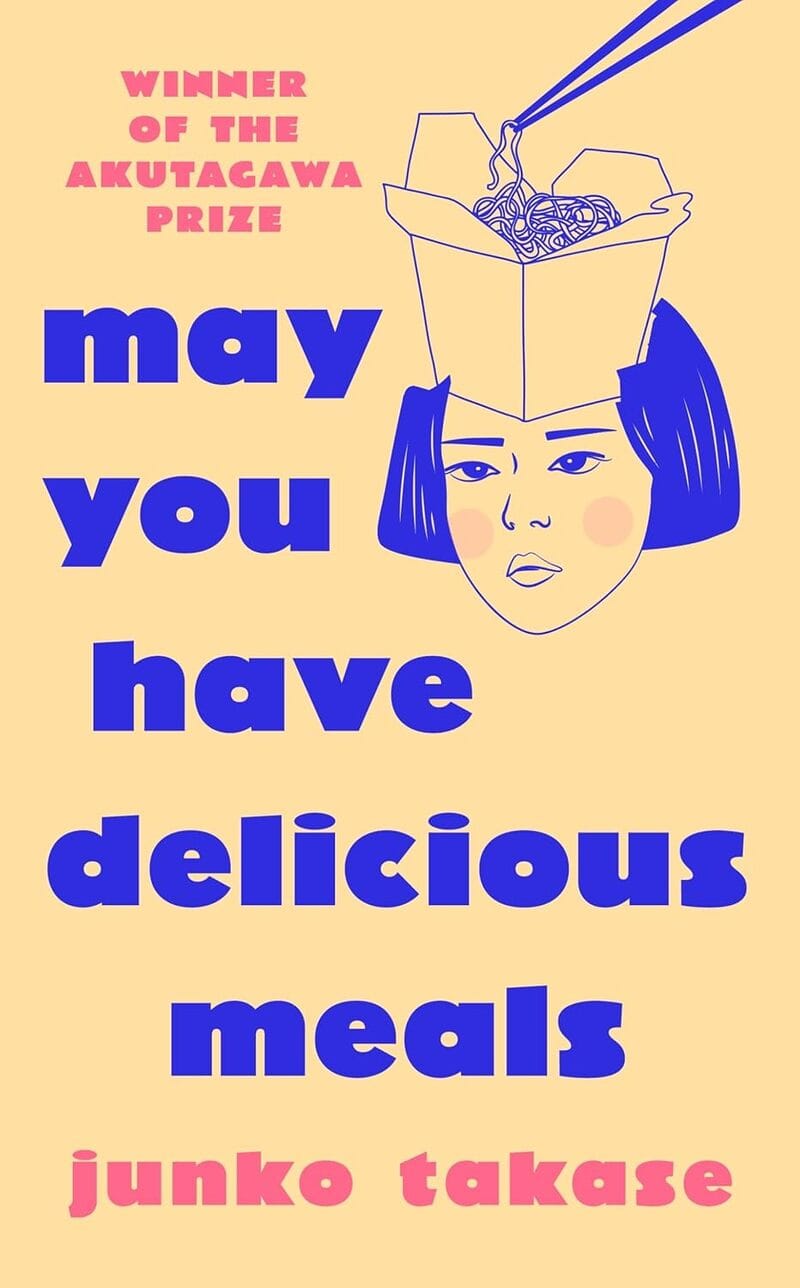
At first glance, the premise of Junko Takase’s Akutagawa-Prize-winning novel May You Have Delicious Meals seems like the set-up for a romantic comedy. Nitani, Ashikawa, and Oshio work together in the sales division of a company. Nitani normally dates timid, feminine women like Ashikawa. Nitani and Ashikawa start a relationship. Sometimes Nitani spends his evenings at his apartment with Ashikawa, where she makes him nutritious, homemade meals. He spends other evenings at dive bars with his more brusque and professionally competent female colleague, Oshio.
But a romance novel it is not. Nor is it a reasonably-straightforward critique of these Japanese office workers’ work culture a la Kikuko Tsumura’s There’s No Such Thing as an Easy Job. Instead, it’s a more open-ended study of human nature that plays with some of the norms of contemporary Japanese fiction in ways a reader might not expect.
Nitani isn’t the kind of swoon-worthy romantic lead love triangles are usually made of. He’s flawed, and he has unusual idiosyncrasies. Most notably, he hates eating—even the act of chewing. He hates “the idea of arranging [his] life around eating food” just because it’s a bodily necessity. And he doesn’t particularly like “delicious meals” either. Even when his girlfriend Ashikawa, a talented amateur chef, cooks for him, he has to finish the evening with convenient junk food, typically a reconstituted “pot noodle” made at home. High in sodium and low in almost everything else, this kind of konbini meal pops up frequently in contemporary Japanese fiction as emblematic of a life that moves too fast for anyone to slow down and enjoy good food. Takase uses the symbol a little differently; in May You Have Delicious Meals, Nitani doesn’t want to slow down or waste his precious free time meeting his body’s needs. He doesn’t know why he is vaguely dissatisfied with his life, but he knows he can no longer live without his pot noodle.
Nitani is in fact sometimes so repulsed by carefully-made or nutritious food that Takase’s prose serves as a palette cleanser for some of the almost over-rich food-writing to come out of Japan in recent years, such as in Asako Yuzuki’s deservedly-celebrated Butter (released last year in mouth-watering English translation by Polly Barton). For example, Takase’s description of an omelette is refreshingly plain:
[A co-worker] had a piece of omelette in his chopsticks—not the yellow, smooth, homogenised kind Nitani often bought pre-made from the supermarket, but one you could tell was homemade from its color, all white and yellow and speckled with brown.
Ashikawa is Nitani’s co-worker. She’s small, kind, and “mercilessly adorable”. She was harassed at her former job and “can’t really handle men yelling at her.” Her current boss now makes what seems to be perfectly reasonable accommodations, including asking Nitani to take over phone calls that might become confrontational. Her co-workers are also protective of her. Her boss encourages her leave if she isn’t feeling well, and no one expects her to work late with the rest of the staff.Nitani holds her in contempt for her professional “failures”. He has given up respecting Ashikawa “the moment he thought that she lacked a backbone came to the surface of his mind, as murky as dirty water in the bottom of a pot left unwashed.” He dates her anyway.
The novel’s voice passes back and forth between a third-person speaker relating the events of Nitani’s life and his co-worker, Oshio, narrating her own life in the first person. Oshio considers herself more professional than Ashikawa. She’s certainly more long-suffering and willing to put in overtime hours with Nitani. Sometimes her reactions to Ashikawa come across as though she thinks she’s “not like other girls”, a famous English-language cliché some women use to compare themselves to other women at the other women’s expense. Ashikawa doesn’t push herself, Oshio thinks. Ashikawa and Oshio “live by different rules.” Just like Nitani, Oshio comes to resent Ashikawa.
One night, when she and Nitani go out for drinks long after Ashikawa has gone home, Oshio asks Nitani, “Do you want to bully Ashikawa with me?”
Oshio eventually claims to be kidding, but settles on a form of bullying that’s “less bullying than just, you know, being normal.” Oshio thinks everyone else is too nice to Ashikawa; Oshio consciously chooses not to be. It is this seething resentment Nitani and Oshio feel toward Ashikawa that is really the central organizing theme of Takase’s novel.
The after-work conversations between Nitani and Oshio are some of the most notable in the novel. If any reader still believes the myth the Japanese don’t swear, Morgan Giles’s translation will certainly disabuse them of the idea, particularly in casual dialogue between the two. (While it’s true there are few Japanese words that are “taboo” the way certain English-language four-letter favorites are, the Japanese certainly know how to curse with aplomb when the occasion calls for it.) Giles’s translation is gleefully—and enjoyably—full of English swear words, usually from either Nitani or Oshio.
Through these after-work conversations, the reader learns that Nitani and Oshio have each encountered co-workers like Ashikawa before. Nitani relates the story of a man named Maki:
He was awful. “My hay fever’s too bad, I’m not coming in.” “My neck’s too stiff, I’m not coming in.” “The atmospheric pressure is low and I feel horrible so I’m going home.” One thing after another. Always the kind of thing that everyone else just puts up with. And his favorite word was “rights”. Workers’ rights. Quality of life. “The only one looking out for you is you”… I wish I could be like that too, but then, when one guy says he’s going to take care of himself and goes home early, then who’s going to do his work? Because everyone gets hay fever at the same time. So then, someone else with hay fever has to do the work of the person who went home because of their hay fever, pushing themselves, pulling themselves, pulling overtime. And yet, no one really remarks on this, and you end up stuck between a rock and a hard place, right?
Nitani is even more indignant because Maki was married, and his wife stayed at home. Since at least the 1950s, married salarymen have been expected to work whatever hours are demanded of them with the expectation their wives are capable of managing everything else on their own. Japanese women—and some Japanese men—have been fighting these expectations for generations. May You Have Delicious Meals won the Akutagawa in Japan in 2022; like many people in Japan, Nitani’s clings to gender norms that have ruled Japanese society for decades.
In many ways, the scapegoating of Ashikawa and workers like her is hard to read. From an outsider’s perspective, it’s clear that the real problem is the company’s—Japan’s… perhaps the capitalist world’s—unrealistic expectations of its workforce. When Nitani resents staying late, it’s because he could have left at seven. When a project deadline approaches, the staff works until eleven, then gives up their Saturdays, then their entire weekends. The company apparently transfers workers without consulting them or asking for their consent. One worker is transferred to an office two and a half hours away—“it [is] annoying, but he [has] no choice but to move again,” the narrator notes, because the character never considers another option.
The ultimate irony of May You Have Delicious Meals is that “weak”, “timid”, “mercilessly adorable” Ashikawa is the only character in the novel who does anything rebellious or different, with the possible exception of a small, defiant gesture Oshio makes at the end of the book. In her “weak” and “adorable” ways, she’s the only one standing up for herself. Perhaps the novel’s bleak ending is an implicit critique of work culture in Japan—and elsewhere—as it stands. If workers like Nitani and Oshio don’t change anything about the way they work, nothing about the way they are required to work will change.