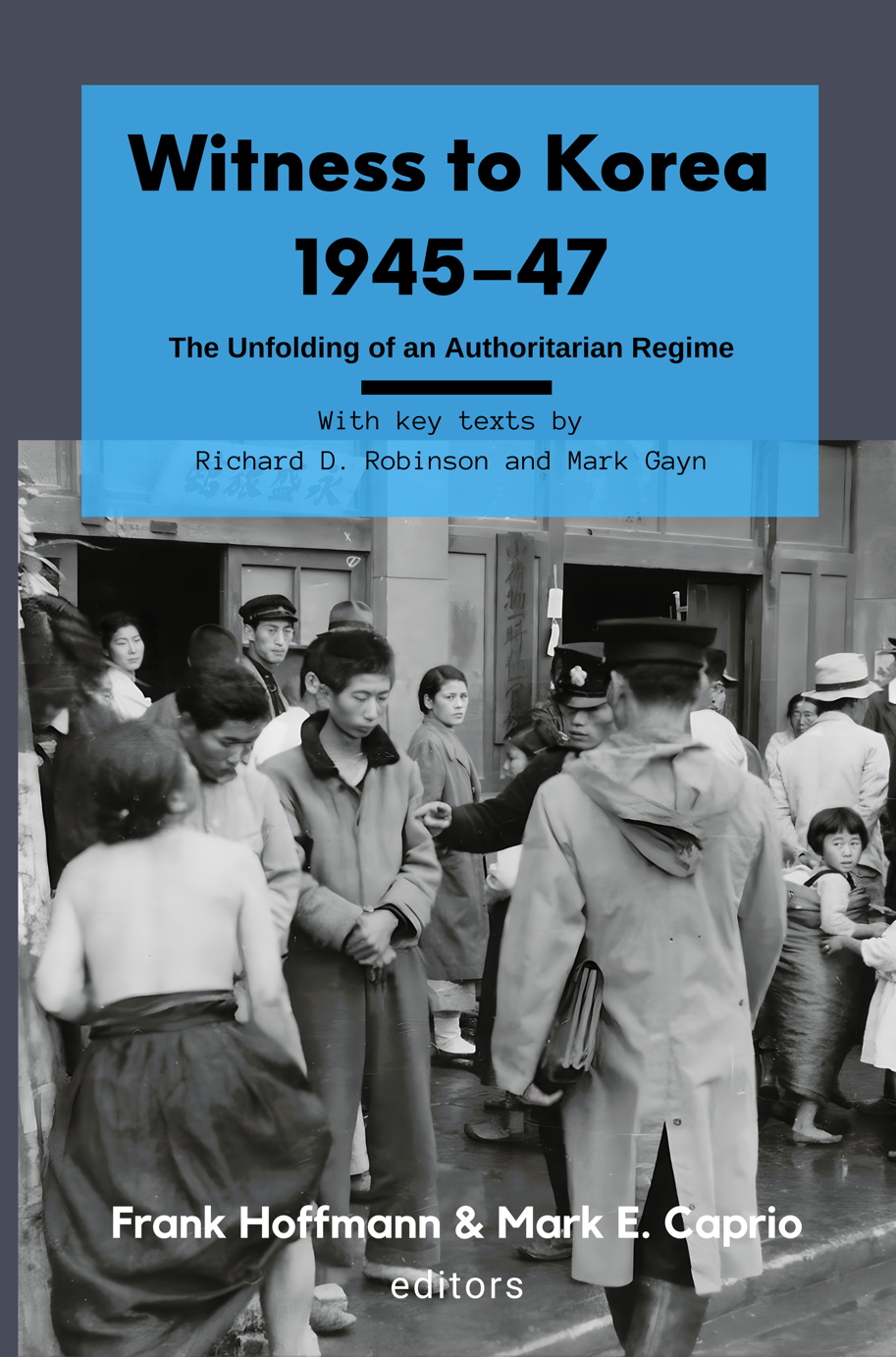
“Witness to Korea, 1945-47: The Unfolding of an Authoritarian Regime” by Frank Hoffmann and Mark E Caprio
Histories of the Korean War (1950-1953) published in the United States have been surprisingly numerous for a conflict known as America’s “forgotten war”, but few books have appeared in English on the division and occupation of Korea by the Soviet Union and the United States (1945-48). Fewer still have focused on what happened in Korea south of the 38th parallel, the US zone of military occupation, other than Bruce Cumings’s 1980s-era two-volume work, The Origins of the Korean War and Kornel Chang’s recent history, A Fractured Liberation: Korea Under US Occupation.
Filling in blanks on the history of southern Korea under the rule of the United States Army Military Government in Korea (USAMGIK) are Frank Hoffmann and Mark E Caprio, editors of the extraordinary new book under review here. The two scholars bring together writings—indeed, key texts—on Korea under US occupation by a whistleblower and a journalist: Richard D Robinson and Mark Gayn, respectively. Both Robinson’s previously unpublished “Betrayal of a Nation” and Gayn’s “Japan Diary” are eyewitness accounts.
Robinson arrived in southern Korea in November 1945 as officer-in-charge of the Office of Public Opinion in USAMGIK before going to work the following year for the military as a civilian to work on the official history of the US military occupation. Robinson watched USAMGIK officials—lacking in expertise on Korean affairs as well as in guidance from Washington—commit one fault after from the start of the occupation: imposing military rule instead of granting independence; backing right-wing extremists who returned to Korea from decades of exile in China and the United States; working with those who had remained in Korea but collaborated when their nation formed an unwilling part of the Japanese Empire; ignoring calls to distribute land to peasants who were toiling for wealthy landlords; and otherwise mismanaging economic and political affairs.
Critical of USAMGIK for partnering with extreme rightists, Robinson could still see that moderates were scarce and that the leftists were as uncompromising as their enemies. “The Communist-left believed in class warfare and revolution; the right, in a police state and force. Both would have liquidated the opposition if given the opportunity.” He named two “villains” in his history: the communist Pak Hon Yong and the rightist Syngman Rhee. Pak would leave Seoul in 1948 for communist Pyongyang. Rhee would rule South Korea from 1948, with Washington’s backing, until popular unrest drove him in 1960 back to the United States for his final American exile.
Robinson blew the whistle, denouncing the occupation in the American press and before audiences in Korea. He also started writing a book based both on what he had witnessed and on the classified documents to which he had access at work. With investigators on his trail in 1947 for an article he had published under pseudonym in the Nation, as well as other transgressions, Robinson burned his book manuscript before leaving Korea by ship for Turkey. By the time his ship landed, he had re-written a new version of the book from memory, then updated it in 1960. He could not find a publisher. Later, in the course of a career as a business professor at the Massachusetts Institute of Technology (MIT), he wrote and edited numerous books and articles.
Particularly interesting in Robinson’s book are his direct experiences. In one case, he had discovered by polling Koreans in February 1946 that only a bare majority, 52 percent, viewed the US occupation as better than the harsh Japanese rule over Korea that had ended less than half a year earlier. According to Robinson, “The outcome of that survey was that I was ordered by the Military Governor to undertake no further polls of this nature.”
Twice he faced the threat of court martial. Once Robinson had arrested Korean policemen he caught torturing a suspect with the water treatment. His superiors were outraged that he had interfered with a local police investigation. The second time, in his account, “My wife and I were threatened with court martial for joining a group of American newspapermen in a banquet in a Korean kisaeng house.”
Mark Gayn observed USAMGIK in operation during four weeks spent touring the US zone of occupation in the autumn of 1946 as the Chicago Sun’s bureau chief for Japan and Korea. Gayn recorded as journal entries his daily encounters with US officials and Korean political activists. What became something of a running joke were the repeated assertions at one stop or another in his travels that the US Army had no jeep to spare for him and the other American journalists with him, transportation provided only to those who played ball with the authorities.
Gayn showed a knack for getting memorable quotes. One was the quip of a political officer in USAMGIK that Syngman Rhee, a rightist independence activist who had spent long decades in the United States before returning to Seoul aboard a US military aircraft, was no simple fascist: “He is two centuries before fascism—a pure Bourbon.”
The journalist’s own observations were cutting. He wrote after meeting Rhee that, despite decades in the United States, after earning a Harvard degree and Princeton doctorate, the rightist leader spoke a “labored” English and only put “sentences together with an effort.” In meeting Rhee, Gayn found the elderly activist “a sinister and dangerous man, an anachronism who had strayed into this age to use the clichés and machinery of democracy for unscrupulous and undemocratic ends.”
Gayn’s “Japan Diary,” of which his four weeks of journal entries in Korea form a considerable part, became a bestseller in 1948 in the United States. Translated versions soon appeared in Japan (1951), the Soviet Union (1951), and elsewhere. A partial Korean version appeared in South Korea only in 1986, after four decades of authoritarian rule begun under USAMGIK.
Robinson’s “Betrayal of a Nation” is published here for the first time, thanks to editors Hoffmann and Caprio. Its belated appearance is a welcome one, and not only because little on the US occupation of Korea has appeared in print. As Robinson wrote in 1947 in his introduction, “I would estimate, for instance, that of all the words written on the occupation of Korea (1945-4947), at least seventy-five percent were either outright fabrication or highly inaccurate.”
We have other reasons to thank the editors. Each has included an essay of his own. Caprio gives an overview of Korea under US military occupation. Hoffman, a German scholar, in his “Sprechen Sie Deutsch? Fascism in Korea” traces the growth under USAMGIK of paramilitary Korean youth organizations modeled on the Hitler Jugend. The editors have also included a brief essay by John Merrill, Korea expert and former intelligence analyst of the US Department of State, welcoming the belated publishing of Robinson’s work.
The editors also did well in correcting the various renderings of Korean names found in the original writings of Robinson and Gayn and in adding numerous footnotes to correct errors or provide further information. They have also added numerous photographs. Most striking to me is the US Army photograph of a Japanese soldier in uniform, complete with military sword, perched atop a US Army M8 armored car bedecked with the American flag, guiding the driver into Seoul nearly a week after the Japanese surrender in Tokyo.
This book deserves a wide audience.