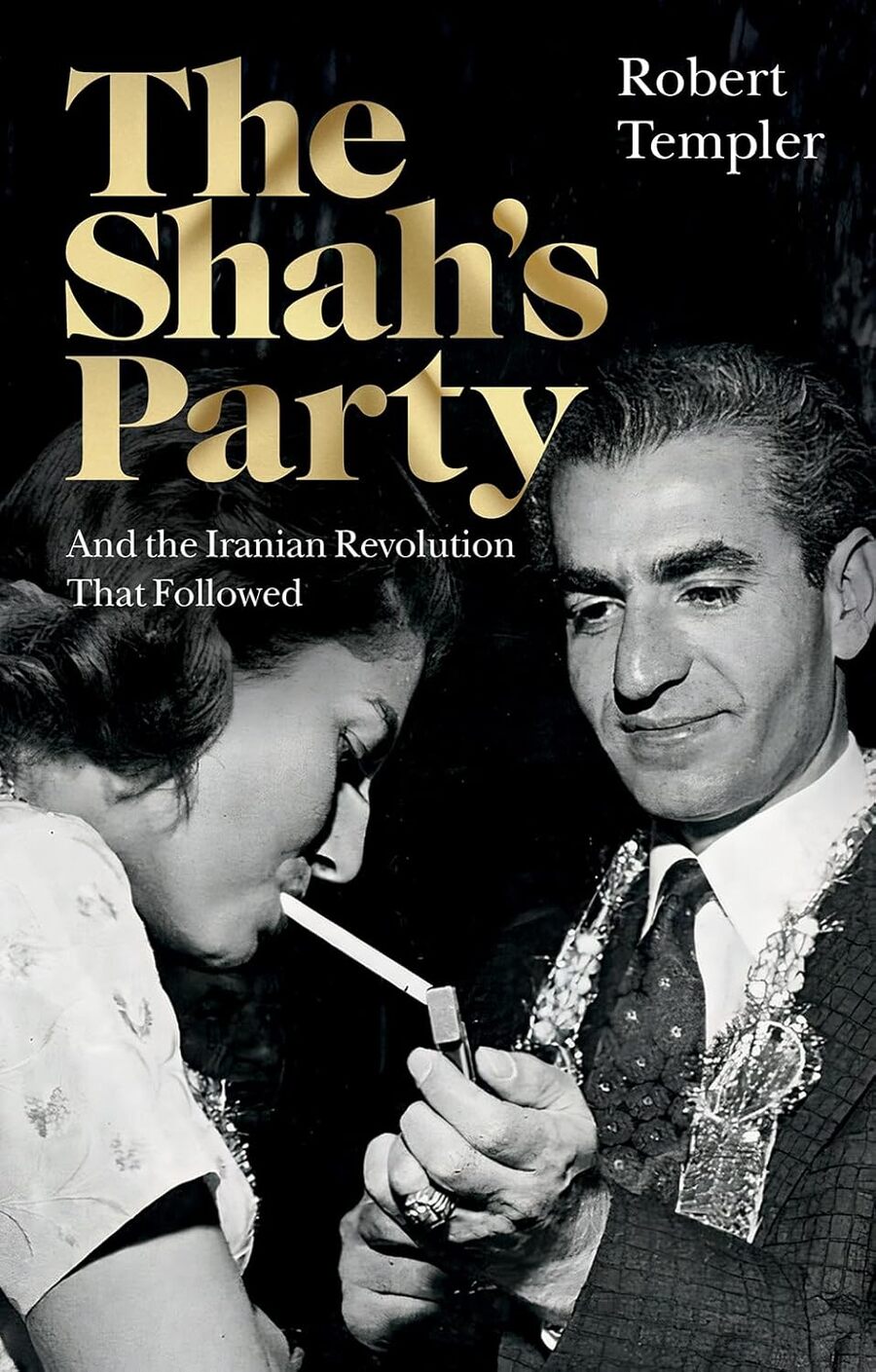
“The Shah’s Party: And the Iranian Revolution That Followed” by Robert Templer
A worldly Hungarian informed me in 1976, as I was leaving to take up a scholarship in Iran, “I was at the Shah’s 2,500 year celebration.” Astounded, I asked him what it was like. “Like something out of Buñuel”, he replied. Iran’s ruler had invited to him to the infamous coming out party because he had attended the Shah’s alma mater, Switzerland’s aristocratic Le Rosey. That already tells you a lot about the failings of the imperial regime, which today some wish to see returned to power. Readers of Robert Templer’s The Shah’s Party will be spoiled for choice to find motivations for the revolution of 1978 that drove the monarch into exile, in this Tristram Shandy-esque narrative of venality, sycophancy, ineptitude, hubris and cultural myopia. Yet as Templer makes clear, the Iranians enjoyed no monopoly on these shortcomings.
The Peacock Throne had been a rocky platform for centuries, with the number of monarchs dying in bed to be counted on the fingers of one hand. In the rough and tumble world of Iranian politics, only the most ruthless and insensitive could rule effectively. Stalin would have been well-suited to the role. Mohammad Reza Pahlavi, on the other hand, showed his unsuitability from the very beginning. A poor judge of character, an indecisive politician, easy to flatter and mislead, the shah’s only redeeming quality was his politeness and dignity, which he maintained in exile and death.The Shah’s French education did not include Machiavelli.
In the turbulence of the early 1970s, with guerilla warfare and popular liberation fronts blazing into action from Bolivia to Oman, regimes survived through pure brutality; consider Bashar al-Assad, Sadam Hussein and Omar al-Bashir. The Shah thought he was above all this. He wanted to rule by taking the high road, to be loved rather than feared. His French education did not include Machiavelli. And above all, as the son of a Cossack non-commissioned officer, he pined for global recognition of his rule and his dynasty in a world which was cynical at best about monarchy.
This led him to make the fateful mistake of throwing the “party of the century” in the shadows of Darius’s ruined capital Persepolis. Trying to rival the scale of the ancient Achaemenids, who after all ruled the world’s biggest empire at the time, was always going to be a risky business. It was a headache for the empress Farah, who only survived by binging on pain killers. “Parties can be a great source of anxiety. Guests do not turn up; people fail to RSVP and then turn up anyway; people bring friends that were not invited.” Haile Selassie turned up with a huge entourage.As Templer rather gleefully recounts, the pharaonic expenses of catering from Maxims, of furnishing the guest accommodations with the Maison Jansen, of dressing the court in uniforms by Lanvin, stood out in the age of blue-jeans and leather jackets as either deliciously désuet, laughably pretentious, or as obscenely wasteful, depending on your point of view. Only the inveterate global jetsetters found anything to approve, and they were of no use to the Shah. “It was perhaps the most cynical and corrupt crowd ever to gather in history. In subsequent years, almost all would be tarnished by scandal, be overthrown, or die in disgrace,” concludes Templer, almost ruefully.Guests from the west, and more importantly, the statesmen who declined the invitation, never understood the Shah’s geopolitical pretensions. For Washington or Moscow, Iran’s poverty and isolation meant that, no matter how many weapons the Shah procured, he could never sit at the main table. They had, after all, held a summit in Tehran in 1943 and ignored him. The Iranians, on the other hand, were and are imbued with a sense of importance, partly as heirs to Cyrus, partly out of Shiite messianism, and partly because of the centuries during which Iran was the center of a cultural world which stretched from Sarajevo to Myanmar The Shah’s grandiose recreation of Iran’s past at the Persepolis celebrations was therefore lost on many of the participants, who saw personal vainglory instead of deeply felt patriotism.Fake news did not start with the internet: as it once brought down the French Queen Marie-Antoinette, it would now bring down the Shah.
Visitors and observers also found the heavy-handed security distasteful. The secret police, the SAVAK, was becoming an object of special abhorrence in the west. Templer weighs the sins of the shah’s secret police against those of other governments in the 1970s. While finding its brutality inexcusable, he emphasizes the instrumentalization of global criticism of the SAVAK by forces supporting much more brutal regimes themselves. This is true of the regime that replaced the Shah—nowhere more in evidence than in recent months: “The regime is willing to kill a limitless number of people to stay in power, something the Shah found impossible,” he concludes.
Criticism of the Shah’s regime swelled in a period where the issue of human rights took centre-stage in international politics. Amnesty International dates back to this time. Templer deplores “the Pahlavi vision of the State and the Emperor as a leader who handed down rights to his subjects. They were not seen as intrinsic to the individual but as something that his people enjoyed because the Shah granted them.” Perhaps this only reflects Iranian wisdom that human rights are all well and good in theory but they depend on a just ruler for their effective existence, as even a certain western democracy is now learning.Influential voices came down heavily on the party. Far from cementing the shah’s role as a leader of the future, wrote the London Observer’s Patrick O’Donovan, “It was a Field of the Cloth of Gold without a purpose. It was the Congress of Vienna without any business. It was a picnic of unparalleled vulgarity.”The Shah’s perceived folly provided a field day not only for the British press but also for the monarch’s exiled opponent, the Ayatollah Khomeini. He painted the wastefulness and alien luxury as a slap in the face of pious Muslims surviving on a dollar a day. The Shah’s attempt to reshape Iranian identification away from Shiite Islam, the state religion since 1501, towards the pre-Islamic past, seemed like apostasy. This provided the wily imam material for some of his most inflammatory oratory. He claimed that the celebrations were organized by Israel, decrying the commemoration of Cyrus, whom he accused of being a Jew and a homosexual (two of his bêtes noirs.) Fake news did not start with the internet: as it once brought down the French Queen Marie-Antoinette, it would now bring down the Shah.Much of this book is devoted to context, which is important for forming judgements about events, and which in the heat of the moment we often fail to consider. For example, Templer compares the cost of security at the Shah’s party with the cost of today’s G7 gatherings and finds it was rather modest. The world has since learned that just because you’re paranoid it doesn’t mean they’re not out to get you. Security costs have accordingly ballooned. He provocatively argues that “Almost every positive aspect of life in Iran today can be traced back to the fifty-four years of Pahlavi rule,” and that “Khomeini’s Iran … has delivered little in the way of improved living standards for its people.” Readers may or may not agree with Templer’s feisty pronouncements, but they will enjoy the challenges and paradoxes that he throws at them in this fast-paced and readable work.