
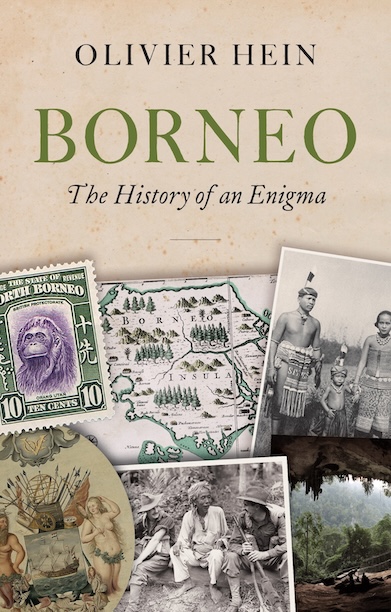
A book that attempts to tell the story of one of the world’s largest and most complex islands across vast spans of time—from deep geological history to the urgent pressures of the present—Olivier Hein’s Borneo: The History of an Enigma announces its ambition from the first pages. Such scale is risky: many books with grand reach end up flattened by their own seriousness. Hein avoids that fate. What emerges instead is a work of remarkable clarity and narrative energy, one that wears its scholarship lightly and reads with the confidence of a storyteller who knows exactly where he is taking you.
Crucially, this is not a dry academic tome. Hein writes with vividness and pace, making the book as rewarding for an inquisitive traveller as for a specialist reader. His great insight is to begin not with kings or colonies but with the rainforest itself. Borneo’s forests are among the oldest on Earth, and Hein treats them not as scenic background but as the island’s main historical actor. Rivers become routes and borders, caves become archives, and biodiversity becomes destiny.
The early chapters are rich with wonder. Hein’s descriptions of Borneo’s flora and fauna are among the most memorable in the book. Orangutans evolve in near isolation, becoming the world’s largest arboreal mammals. Sun bears and clouded leopards slip through the understory. Carnivorous pitcher plants lure insects to their deaths, while the enormous rafflesia flower erupts briefly from the forest floor, smelling of decay and vanishing almost as quickly as it appears. Ancient cave systems host millions of bats and swiftlets, layering the ground with guano over millennia. Even orchids become historical figures here—plants whose lineage stretches back to the age of dinosaurs. Hein makes the reader feel that this is a living world so dense and self-contained that it actively resists human control.
One of the book’s greatest pleasures is its exploration of Borneo’s astonishing cultural and linguistic diversity.
When humans finally enter the story, Hein resists the tired language of primitiveness. Drawing on archaeological discoveries such as the Niah Caves and the so-called “Deep Skull”, he meticulously reconstructs early human life in Borneo. The “Deep Skull” refers to an approximately 37,000-year-old human cranium from Niah Cave in Borneo, significant for rewriting Southeast Asian prehistory; once thought a teenage boy linked to Indigenous Australians, recent studies reveal it was an older female, more closely resembling modern indigenous Borneans, challenging the “two-layer” hypothesis and suggesting deep continuity in the region’s human ancestry. Archaeology offers tantalising clues, but much has been lost—quite literally drowned—by rising seas after the Ice Age, which submerged vast coastal areas and erased untold chapters of early history.
These were not societies lacking sophistication but communities perfectly adapted to their environment. Bamboo tools, blowpipes, poison darts, and botanical knowledge made heavy stone technologies unnecessary. Hein shows convincingly that simplicity here was a choice shaped by abundance, not a failure of imagination.
One of the book’s greatest pleasures is its exploration of Borneo’s astonishing cultural and linguistic diversity. The island is home to hundreds of distinct communities, often grouped under the catch-all label “Dayak”, though Hein is careful to show how misleading that term can be. Rivers, mountains, and dense forest isolated groups from one another for centuries, allowing languages, rituals, and social systems to evolve independently. Animist belief systems dominate much of this world, with spirits inhabiting landscapes, ancestors shaping daily decisions, and taboos guiding everything from farming to warfare. These are not presented as quaint traditions but as coherent systems that regulated social life and environmental balance. Hein also highlights matrifocal and matrilineal structures in several societies, gently unsettling assumptions about gender and authority in so-called traditional cultures.
Outside influences arrive slowly and unevenly. Hindu and Buddhist ideas touch the coast but rarely penetrate inland. Chinese traders appear in fragmentary records, intrigued by Borneo but never fully understanding it. Hein is particularly good at showing how Borneo remained visible yet elusive within wider Asian networks. The spread of Islam marks a more enduring shift, arriving through trade, marriage, and political pragmatism rather than conquest. Coastal sultanates such as Brunei rise to prominence, linking Borneo to the wider Muslim world while still struggling to control the interior. Hein shows how Islam layered itself over older belief systems, producing hybrid cultures rather than clean conversions.
Colonialism comes late and awkwardly. Borneo never fits neatly into European imperial designs, and the story of the Brooke dynasty in Sarawak captures this strangeness perfectly. The White Rajahs ruled through personal authority, reformist rhetoric, and violence in equal measure, creating a peculiar political experiment that was neither fully indigenous nor conventionally colonial. In contrast to the romanticised narrative of cross-cultural belonging found in William Dalrymple’s account of the White Mughals, Hein resists myth-making in his treatment of the White Rajahs, presenting it as just another historical oddity.
Borneo is no longer peripheral. Its forests matter to the global climate, and its history offers lessons about resilience, limits, and coexistence.
The pace quickens in the 20th century. Logging, plantations, mining, and global war tear through landscapes and communities alike. Hein’s account of World War II, especially the Sandakan Death Marches, is devastating precisely because it avoids melodrama. The suffering feels inescapable, and its effects linger long after the war ends. Decolonisation fractures the island politically, dividing it among Indonesia, Malaysia and Brunei, while leaving many indigenous communities marginalised within new nation-states.
The book’s final chapters are sombre but necessary. Environmental destruction is no longer abstract: forests shrink, species vanish, and ways of life erode. The disappearance of the Swiss activist Bruno Manser while defending the Penan tribe of Sarawak becomes a deadly symbol of both resistance and erasure. Hein does not sentimentalise him; instead, he uses the episode to show how easily inconvenient voices can vanish along with the forests and communities they try to protect.
The decision to relocate Indonesia’s capital to Nusantara brings the story firmly into the present. Hein treats it as a test rather than a prophecy: a moment that will reveal whether development can proceed without repeating the island’s long history of extraction. Borneo, he argues, is no longer peripheral. Its forests matter to the global climate, and its history offers lessons about resilience, limits, and coexistence.
Borneo: The History of an Enigma is a rare achievement: a sweeping history that feels intimate, a serious work that is also a genuine pleasure to read.