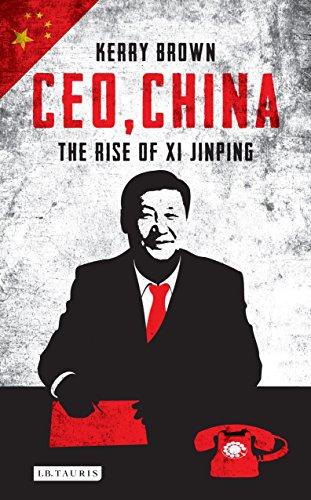
CEO, China: The Rise of Xi Jinping by Kerry Brown
Today it is China, rather more than Russia, that is — in the words of Winston Churchill — “a riddle wrapped in a mystery inside an enigma.” The Chinese leadership seems to like it that way: “We may live in an age of openness and information,” writes Kerry Brown in CEO, China: The Rise of Xi Jinping,
but the inner workings of the Chinese political system, and in particular the lives and thinking of its leaders, remain of the few bastions of opacity.
Brown goes on to note that “Chinese politics has often been treated as something remote and mysterious, best left to specialists,” but that he wishes to “encourage as wide an audience as possible to think about, and engage with, the political life of China.”
It’s perhaps worth asking “why?” Engaging with the politics of one’s own country is a civic duty; engaging with the politics of a foreign country is presumably supposed to have some practical benefits. But there is not necessarily a close correlation between business and political success in China and the ability to undertake a deep analysis of the place. But there may be one between errors and basic misunderstandings of the sort that arise from statements like “China is X” or the “the Chinese are Y”.
“Understanding” China, indeed, may be too much to ask—politics seems increasingly unpredictable even in countries far more transparent that China—but perhaps one can strive to minimize misunderstandings due to misapprehensions or simplifications. Kerry emphasises not so much the complexity of Chinese politics as its “dynamism”, that is a collection of interlocking moving parts. Indeed, he finds it useful to consider China, or rather the Communist Party of China, as a business with Xi its CEO:
it has to forge loyalty, look after its stakeholders and try to articulate and deliver its core aims.
The reasons one might want to read up on Xi Jinping are probably different than those for, say, Barack Obama. An analysis of the path to power of the sitting American President would not typically be considered essential to a functional understanding of the United States.
CEO, China is, in any event, not a political biography in the traditional sense. Xi only appears in the book’s subtitle; the book seeks to explain China as much if not more than the man himself. Brown’s summaries of (mostly) post-1949 Chinese political and economic history and both concise and clear; these might not quite suffice for those who are entirely new to the subject, but otherwise provide useful reminders as to the context and background of Xi’s life and career. And by including Xi’s family (his father and wife in particular) as well as his career, Brown succeeds in both fleshing Xi out and, somewhat surprisingly, making him intriguing.
But Brown’s main interest is “power” and Xi’s in particular: defining and describing it, whence it comes, how it is circumscribed, and how it is manifested. One measurement of Brown’s success in this volume is the extent to which his discussion ends up seeming self-evident: the reader may come out thinking it all conventional wisdom. Here the CEO/company analogy is a useful touchstone for understanding the relationship between Xi and the Party. Most notably, Brown is adept at describing the many moving parts that make up the political process, one rooted in the Party’s “belief systems”.
The problem with nuance is that it makes predictions harder. Brown lays out several scenarios for how things might play out, but concludes
We are hoping for the same thing. We want a world where Chinese and non-Chinese live sustainably, more equitably and peacefully. We want stability. For this reason, Xi’s Party becomes our best bet to get there. Very ironically, in this context, we are all supporters of Xi’s CCP.
CEO, China: The Rise of Xi Jinping is actually very readable. It is also enlightening. It easily might have been neither. So while Brown’s hope for greater outside interest in Chinese politics may be overly optimistic, potential readers at the very least can no longer argue that the material is obscure and unbearably dry.
Kerry Brown is a regular reviewer for the Asian Review of Books.