“China’s Mahan: Admiral Liu Huaqing and the Rise of the Modern Chinese Navy” by Xiaobing Li
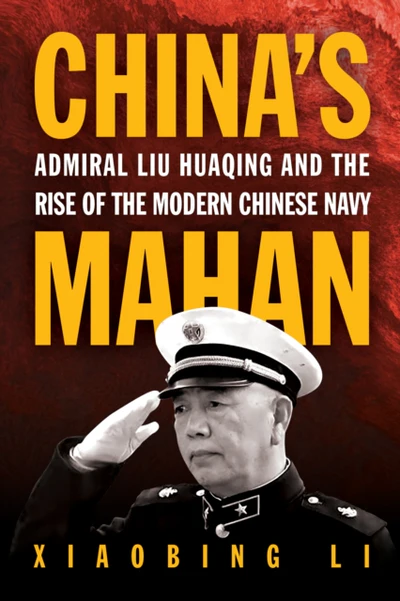
In one sense the title of Xiaobing Li’s biography of Chinese Admiral Liu Huaqing, China’s Mahan, is somewhat misleading because the author concludes that Admiral Liu has more in common with the onetime commander of the Soviet Navy Sergey Gorshkov than with the American naval historian and strategist Alfred Thayer Mahan. Admiral Liu himself stated publicly, “I am not the Chinese Mahan.” But in another sense, the title is appropriate because Liu Huaqing’s influence on the evolution of China’s modern navy and approach to sea power rivals the influence Mahan had on the US Navy throughout the 20th century and even today.
Liu Huaqing served in the People’s Republic Army Navy (PLAN) for forty-six years, including a stint as the PLAN’s commander in the 1980s and later as a member of the Chinese Communist Party Politburo’s Standing Committee. He survived the purges of Mao Zedong’s Cultural Revolution, became a favorite of Deng Xiaoping when Deng became China’s leader, and was supported in his naval theories and approach to sea power by Chinese leaders Jiang Zemin and Hu Jintao. China’s current leader Xi Jinping credits Liu Huaqing for beginning the process of modernizing the PLAN into a global maritime force.
Li is intimately familiar with the evolution of China’s military and naval history. He personally served in the PLA, studied Chinese and Asian history at Nankai University in Tianjin, and Carnegie Mellon University in Pittsburgh, taught Asian Studies at Phillips University and the University of Central Oklahoma, where he currently holds the Don Betz Chair in International Studies, and has authored several historical works on Chinese military history. Li’s primary sources for China’s Mahan include Liu Huaqing’s letters, photographs, and speeches that were published after his death in 2011, and The Selected Military Writings of Liu Huaqing that was published by the PLA Press in 2008. He credits American scholars, such as Rear Admiral Michael McDevitt, Dr. Bernard Cole, James Bussert and Bruce Elleman, and Toshi Yoshihara and James Holmes, for their pioneering writings on Chinese naval history, modernisation, and strategy.
Liu Huaqing’s naval career began when China’s navy was a coastal defense force in the period after the
Communists’ victory in the Chinese Civil War and its defense pact with the Soviet Union. Even before the formal announcement of the People’s Republic of China in October 1949, Li writes, PLA leaders sent a naval delegation to Soviet naval academies to request help with the formation of CCP naval academies. When Mao visited Moscow in late 1949-early 1950, he sought Soviet assistance in building a larger navy. Liu Huaqing worked with both Soviet advisers and former Kuomintang naval officers to develop curricula for China’s naval academies. This was a formative period in Liu Huaqing’s approach to sea power. He became a naval disciple of Soviet Admiral Sergey Gorshkov, who wanted the Soviet Union to become a global sea power. Gorshkov was an intellectual disciple of Mahan.
Liu Huaqing steadily rose through China’s naval ranks despite the purges of the Cultural Revolution and
the internal struggles for power after Mao’s death in 1976. He played a significant role in the navy’s research and development, especially the modernization of China’s shipbuilding industry. He promoted the building of aircraft carriers and nuclear submarines. Most important, as the PLAN’s commander in the 1980s, he shifted China’s naval strategy from “near seas” defense to Gorshkov’s conception of a blue-water navy. “Liu’s new strategy”, Li explains,
emphasized China’s maritime interests, sea power, oceangoing development, and global strategy by building a modern and capable navy.
This new strategy was part-Gorshkov and part-Mahan. Liu, like Mahan, had a broad view of sea power
that today we call geoeconomics. Professor Li notes that Admiral Liu’s strategic outlook is consistent with Xi Jinping’s concept of a Maritime Silk Road as part of Xi’s Belt and Road Initiative.
Liu’s strategic outlook is also consistent with what Professor Li calls Xi Jinping’s goal of establishing a “China-centric global system excluding America”. That goal could be achieved, the author writes, if the United States failed to defend Taiwan against a Chinese invasion or blockade, which “would undermine the subregional countries’ trust and confidence in the US commitments and responsibilities”.