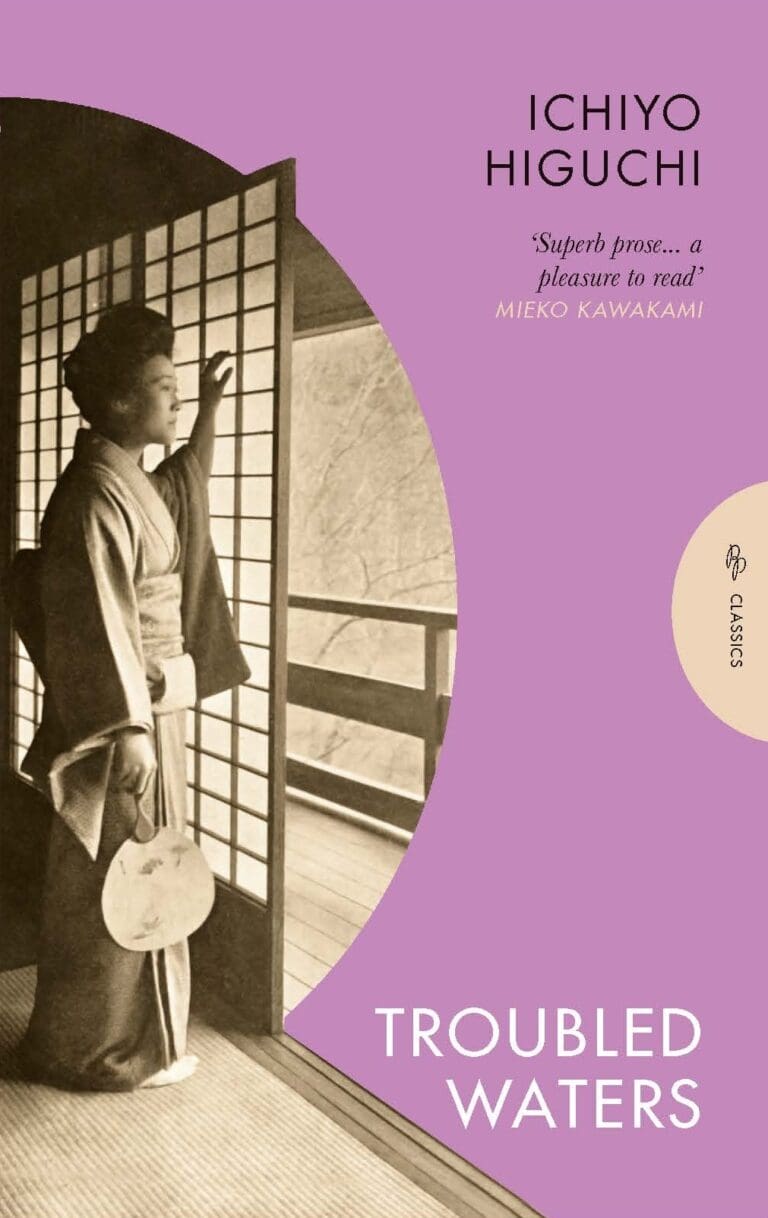
“Troubled Waters” by Ichiyo Higuchi
Ichiyo Higuchi, a contemporary of Anton Chekhov, Henry James, O Henry and Colette, may well be the most acclaimed and influential writer you have (perhaps) never heard of. Revered in Japan (she appeared in the ¥5,000 banknote for two decades this century), she is far less well-known in English than either late 19th-century European writers or her (usually somewhat later) compatriots such as Ryunosuke Akutagawa or Osamu Dazai.
Ichiyo Higuchi… may well be the most acclaimed and influential writer you have (perhaps) never heard of.
Higuchi died young from tuberculosis, aged just 24, in 1894, leaving a mere 21 short stories as her total output of fiction, contributing no doubt to her relative lack of presence in the English-speaking world, while at the same time making her ubiquity in Japan all the more remarkable. Translator Bryan Karetnyk writes of her:
Ichiyo has gone down in history as Japan’s first woman writer to earn a living from her writing, and her legacy, which redefined Japanese literature for the modern age, lives on today. Her life and works are adapted for stage and screen, and her diaries have been serialized on radio.
In Troubled Water, Karetnyk unveils five of Higuchi’s short stories, not (except for one) quite for the first time in English, but quite likely the first time one would have noticed. The feeling is one of discovery of a writer one should have known but (probably) didn’t, like the first time reading Sándor Márai or Kurban Said.
Higuchi’s own life is something out of a story itself; she was the
daughter of a man with scholarly inclinations, who as a farmer had come to the capital to seek both fortune and rank.
He managed
to send his favourite daughter in 1886 to the Haginoya, a prestigious private school, where she studied classical poetry alongside the daughters of aristocrats and noblemen.
But he made some bad investments and died from tuberculosis in 1889, whereupon
hounded by creditors and distressed by mounting debts, the remaining family had to leave their formerly genteel surroundings for the gritty, unsentimental shadows of the Yoshiwara.
Higuchu, “jilted by her fiancé”, turned to writing to make a living.
Higuchi’s stories reflect the grittiness of her life. They are set among the demimonde of courtesans and pleasure districts, and the narrow alleys of Edo’s poured districts. Her female protagonists are young (as she was), some little more than children.
In the opening story, “A Snowy Day”, a student runs off with her teacher. In the second, “New Year’s Eve”, a maid steals a couple of yen to succour her uncle and his family, who had fallen on hard times. Longer and darker, “Growing Pains” (which, of all these, is the story readers are most likely to have across before), is a coming of age story, about a girl destined to follow in her older sister’s footsteps as a courtesan and a boy destined for the priesthood. Darker still is the title story: a tragic and fatal love triangle with a courtesan and the family man who has ruined his life for her. The final story, “This Mortal Coil” (of which this is the first-ever translation), is a shorter, much more ambiguous story about a woman descending into madness, apparently as the result of a love affair gone wrong.
Karetnyk’s succinct and informative introduction allocates stories to several “stages”, from early to mature, forcing one to remember that the years of her career could be counted on the fingers of one hand: these stages had durations far shorter than, say, Picasso’s “blue period”. However accomplished she may have been, at age 23 or 24, any “maturity” must surely be relative. Karetnyk uses words like “zenith” and “peak”, yet Higuchi was still ascending. Like Keats, one is left wondering what she might have accomplished had tuberculosis not cut her down at such a young age.
What is curious, if not necessarily remarkable, is that Karetnyk has Higuchi taking inspiration from classical Japanese literature, poetry and drama:
Each of Ichiyō’s narratives is written predominantly, if not entirely, in classical Japanese: that is, a strictly literary form of the written language that even in the Meiji era had maintained, unlike the vernacular Japanese spoken in Ichiyō’s day, all the inflections and conventions handed down from the Heian period across a millennium. To draw a more meaningful comparison for readers less familiar with Japanese, it is, with all the necessary provisos, as though the writers of the late-Victorian era still wrote in the English of Chaucer.
Karetnyk has rendered Higuchi in a prose reminiscent of that “late-Victorian” era rather than either modern colloquial English, or something reflecting the classicism of the original (which has led, he notes, to many of Japan’s leading writers producing translations into modern Japanese). He has made an evident attempt to show the progress in her style. A passage from the earliest story goes
Myriad regrets I have, and each one of them in vain. What a waste—what impiety!—to have forsaken the land of my ancestors, to have disobeyed even the aunt who raised me with such tenderness. Now I have besmirched the very name my parents bestowed on me.
As English, this is overly mannered. Karetnyk calls it “rococco”. The later titular story opens with a breathless monologue
Well, look who it is! Kimura-san, Shin-san, over here! You’re always saying you’ll call, but then you never do. You were hoping to sneak past on your way to the Two Leaves again without stopping to say hello, weren’t you? Just you wait… Next time I’ll come over there and drag you back here myself! Do be sure to drop in on your way back—if you really are going to the bathhouse, that is. The two of you are such fibbers that I never quite know what to believe…
The difference (“maturity” as Karetnyk puts it) is evident.
What is also remarkable is—setting aside the minutiae of Japanese couture and grooming—that these stories seem very much of a piece with those of Higuchi’s Western contemporaries. Higuchi had not apparently read Western literature, but seems to have instead absorbed elements of style from the works of some of her contemporaries who had. One need not know, as Karetnyk notes, that a story of an unhappy love triangle “harks back to beloved themes of so many pieces composed for the kabuki stage”, to appreciate it as a story.
Higuchi, like Dostoevsky, affirms the humanity of the poor; like Colette, she writes of the limited choices that society affords women. Like Chekhov, her plots can resist resolution. One doesn’t want to push the parallels, except to note that Higuchi will likely feel familiar. And with Karetnyk’s excellent translation, she can be read along with other modern classics of the short story form.