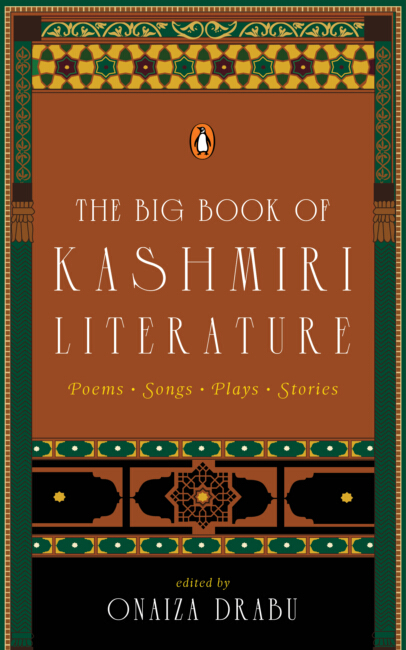
“The Big Book of Kashmiri Literature”
In 1958, a Kashmiri poet who earned his living cutting timber sat down in front of a radio microphone and stumbled over a verse from a printed edition of his own work. His name was Samad Mir, and he was one of the best-loved mystic poets of his day. His interviewers were JL Kaul, a scholar and translator, and Pushkar Bhan, a writer and broadcaster. Later in the conversation Mir wanted to recite a poem built on the order of the alphabet, so he asked them which letter came after zaal, a letter of the Perso-Arabic script. Twice he told them he was unlettered.
Onaiza Drabu, a Kashmiri anthropologist, opens her introduction to The Big Book of Kashmiri Literature with this exchange. It is a telling place to begin. In the studio sit a poet, a translator, a broadcaster and a printed book, and the poem seems to belong most securely to the man who cannot read it. Mir’s word for himself carries old religious weight. In Arabic, “unlettered” is ummi, and some Muslims use it for the Prophet Muhammad, who received revelation without being able to read. Kashmir’s poets have long described verse as something handed down from above, which the poet’s pen merely catches.
That idea runs through the whole of this enormous anthology, which gathers six centuries of Kashmiri writing into 664 pages. There are 14th-century mystics and Persian romances retold in Kashmiri, modernist lyrics and short stories, radio plays and the first Kashmiri opera. There are also forms that rarely survive the trip to print, such as lullabies, rice-planting chants and the ballads of wandering satirists. More than two dozen translators bring it into English. Nothing of this scope has appeared before.
The book has the urgency of a rescue. Kashmiri—which its approximately seven million speakers call Koshur—is the everyday language of the Valley’s Muslims and Hindus alike, but it has rarely been the language of power. Kashmir was ruled in Sanskrit, then Persian, then Urdu and English, while Kashmiri lived on in kitchens and fields. Its written forms were standardised only in 1971 and the early 2000s. The anthology opens with Rahman Rahi, the first Kashmiri writer to win the Jnanpith, India’s highest literary honor, addressing the language as a lover. In Ashaq Hussain Parray’s translation:
O Kashmiri language! I swear by you,
you are my awareness, my vision too
Without the Kashmiri language, Rahi once warned, there would be no Kashmiri, and hence no Kashmir. Drabu came to that language late. She grew up in Srinagar in the 1990s and attended an English-medium convent school, where pupils who spoke Kashmiri were mocked by classmates and fined by teachers. In the anxious early years of an armed insurgency, she writes, her parents’ choice of English seemed easy. She learned the Kashmiri alphabet only in her 20s. The literature reached her anyway, through a grandmother who is now losing her memory but not her songs. Drabu can often reach her only by playing the old melodies.
From this comes the book’s most provocative argument. The linguistically richest Koshur, Drabu contends, belongs to the people with the least schooling: grandmothers, artisans, farmers, boatmen. The educated elite, fluent in the languages of power, often speak the thinnest Koshur of all. Dictionaries are recent and scarce, so people ask an elder when they need a word. When an elder dies, the words only she remembered may die with her.
Drabu’s name for the world this literature sustains is the “life world”, a term philosophers use for the world as people actually live it. For Drabu, it means a way of seeing the world and acting in it that oral tradition has kept alive for centuries. It rests on a belief in powers greater than ourselves and beyond our control. Kashmir is imagined as a land where heaven touches earth, hidden realms hold mystical beings, and saints carry messages between those realms and the living. A Kashmiri proverb, Peer chu ne boad, yaqeen chu boad, explains what holds it together: “The saint is not great; faith is great.” Saints may dominate religious practice, the proverb suggests, but the power people feel at a shrine comes from their own belief more than from the holy figure they visit.
One enters this world through language, learned from elders who serve as living dictionaries. Because Kashmir’s Hindus and Muslims have long lived inside this world together, it is tempting to read it as proof of harmony. Drabu resists that temptation. She has little patience for the cozier story, popular in Indian living rooms, in which the two communities long ago melted into one harmonious culture.
Her pages bear out the complete picture. Kashmiris of both faiths revere the saints Lal Ded and Nund Rishi alike. Samad Mir’s alphabet poem moves from Allah and the Prophet to the forms of Shiva. Drabu points to a Muslim poet, Fazil Kashmiri, who composed songs about Krishna, and to the Pandit modernist Dina Nath Nadim, who wrote hymns in praise of the Prophet. Pandits are the Valley’s Hindu minority. Yet the same pages record what sharing did not prevent. In a confessional story by Akhtar Mohiuddin, the writer remembers how, as a boy, he tormented a classmate from the Watal community, one of the Valley’s most marginalised castes. In Bashir Akhtar’s story, a displaced Pandit mother has her son’s Muslim teacher fired out of distrust. Only later does she learn the two of them were once friends and neighbours.
The book is arranged as what Drabu calls a musical journey, in thematic sections with titles like “Where Is Your Place?” and “The Rule of Beasts”, instead of a march through the centuries. The arrangement lets old and new voices answer one another.
Its most absorbing pages are about translation, and Drabu puts the translators in plain view. Two of them carry most of the book. Ashaq Hussain Parray, who teaches Kashmiri and Urdu literature and wrote his doctorate on South Asian poetry in translation, renders much of the verse, from Rahi’s hymn to the contemporary poems of Nighat Sahiba. Rounak Bhat, a writer and editor, ranges just as widely, from a rice-planting chant to a long hymn to the goddess Sharika.
Drabu says her translators have “exercised the right to opacity where necessary,” borrowing a phrase from the Caribbean writer Édouard Glissant. A Kashmiri word need not always be glossed, nor a riddle solved. In one remarkable section she prints several English versions of the same verses by Lal Ded, the 14th-century Hindu mystic whose sayings Kashmiris of every faith still quote. In JL Kaul’s version, Lal Ded recalls her teacher’s one instruction:
My Guru gave me but one precept:
“From without withdraw your gaze within
And fix it on the Inmost Self.”
Taking to heart this one precept,
Naked I began to roam.
In Sonam Kachru’s version she dances instead of roaming, and a wanderer becomes ecstatic. Drabu borrows the scholar Yigal Bronner’s term “bitextuality” for a verse built to mean two things at once. Here you can watch translators decide which meaning to save.
Kachru, a scholar of Buddhist philosophy, calls his versions transcreations, and he breaks the English line to catch the voice’s breath. In another of his Lal Ded poems, a search gathers speed and then stops short:
I, Lalla, set out, overflowing
with love; seeking,
my day went down,
and the night.
The break after “seeking” leaves the thought suspended; day and night fall away in separate breaths.
The short stories are poignant and heartbreaking. In a story by Syed Hassina Rufai, translated by her daughter Asiya Zahoor, a woman named Hanifa spends two years secretly spinning pashmina to make her husband the shawl he cannot afford. Her mother-in-law borrows money to finish the work, and the debt delays his return. Hanifa cannot read the letter he sends and comes to fear he has left her. By the time he comes home, she is dead, and their daughter gives him the finished shawl. Its warmth has cost more than he will ever know.
The book’s long section on Kashmir’s political past is called “The Rule of Beasts”, or Waandar Raj, which takes its name from a warning by Nund Rishi, the 14th-century Sufi saint who founded Kashmir’s Rishi order. He imagines full granaries beside hungry children and a pig wearing a peacock’s crown. His Kashmiri refrain is Su hā māli āsi vāndar rāj, which Abir Bazaz translates as “It will be, dear sir, the time of the rule of the beasts.” It sets the tone for the pieces that follow. The section moves from peasants starved under the Dogra maharajas, through 1947, when British rule ended, the subcontinent was partitioned and the major part of Kashmir joined India, to the armed insurgency that began around 1990. Some militant groups were armed and trained in Pakistan, and India answered with a vast deployment of troops. Tens of thousands have died since then. Around the same time, terrorist threats and killings also drove most of the Valley’s Pandits from their homes.
In Roop Krishen Bhat’s story “Patah”, a displaced Pandit drifts between rented rooms. As a boy he was taught that his permanent address lay by the river, and he assumed the boatmen who lived on their boats had none. Now he is the one without an address.
Nund Rishi closes the section with no political answer at all. In Bazaz’s translation:
Life is empty, empty is the wind
The search is empty, empty the meaning
These verses of mine call to thinking
This burden of existence!
God, forgive my sins!
The word he repeats, otshuy, means empty or hollow. After all the rulers and uprisings that come before it, the section ends with a saint asking to be forgiven.
The book has flaws, most of them the cost of its ambition. Some translators work in rhyme, trying to carry over the music of verse that was meant to be sung, and on the English page the rhymes can sound forced. The long Persian-style romances and the plays appear only in excerpts, so to a reader they set up a story without its resolution.
Drabu gives the final page to “Saahibo”, a prayer by the early-20th-century poet Mahjoor that generations of Kashmiri schoolchildren learned by heart. He asks God for verses that might wake the dead and drive hatred from people’s hearts, with love in its place. With the grief far from over, the prayer is no easy consolation. The dead cannot be awakened. The living may yet be moved.