Our Man in China by Ming Liu
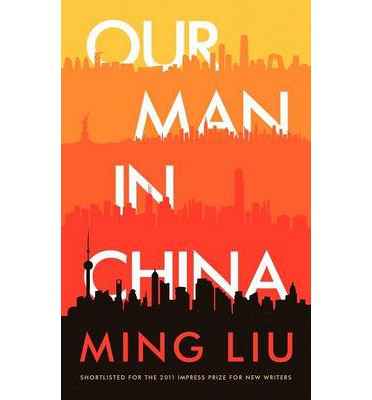
Anyone remotely related with the book business in East Asia will have come across the “expat novel”. This features a western foreigner, almost always white, almost always male, engaging, if that is the right world, the brave new worlds of Hong Kong, Manila, Bangkok or, increasingly, Shanghai. Bars usually figure prominently, as do drugs and a considerable amount of male-female relationships of various degrees of subtlety. They’re not all bad—the genre has a respectable pedigree, including Paul Theroux’s Saint Jack, for example—yet a great many are forgettable, albeit sometimes popular among other expats.
Our Man in China turns the genre on its head. The author, Ming Liu, is Chinese (by descent, at any rate) and a woman. The protagonists are expats, but aren’t Caucasian. And while bars, drinking, drugs, money and fast women figure prominently, the story is in fact a relatively subdued one about the confused identity of hyphenated bi-cultural Asians trying to work out who they really are.
Eric Chen, a newly-minted i-banker, wants to take on the world; well, if not the world, then at least China. He is Chinese, which should help, but isn’t really Chinese: he’s an ABC, or “American Born Chinese”. His Chinese is improving; everyone says so.
Eric is helping his boss work on a large Chinese tech deal; his job is mostly babysitting the client and backing up his boss (metaphorically and if he is drunk enough, physically) in the girly bars. (So that’s what an East Coast College education is now for!) The deal is landed and Eric concludes, in an understandable post hoc ergo propter hoc line of reasoning, that he had something to do with it.
His boss at Goldberg Brothers (goodness, I wonder which financial institutions the author might have had in mind) is Taiwanese, that is, really Chinese more or less, and Eric’s bete noir TK, who steals his deal out from under him, is the son of a well-connected Mainland Chinese.
Joanna Lee is a young lawyer, also ABC, also in and out of Hong Kong and Shanghai. She is falling in love with Vincent Kwok, the suave but feckless scion of a leading Hong Kong property tycoon.
Their stories, independent for the most part, intersect via mutual acquaintances and mirror each other as they bounce between Hong Kong, Shanghai and America’s East Coast.
Liu seems to have traveled close enough to these circles to have observed them. People who read the local papers will have some fun trying to work out exactly who and what she based the characters, bars and situations on. (No, the Kwoks in the book are not those Kwoks, the model Maggie is not that Maggie, but the surreptitious and explicit digital photos that find their way onto the Internet certainly recall a not-too-distant real-life episode.) Readers younger and more party-prone than I will have to judge whether Liu has got the zeitgeist right, but it seems—making allowances for some undoubted hyperbole—not beyond belief.
Liu, interestingly, does not bother to translate the Chinese phrases that some characters drop in to their conversation from time to time. That’s perhaps just as well; some of them—the words even expats quickly learn—are rather rude. The technique adds color without straining comprehension, although one suspects that Liu is herself engaging in the sort of wink-wink, nudge-nudge linguistic test with her readers that her ABC characters are themselves subjected to.
Our Man in China is nominally about the perils and temptations, moral and financial, of doing business in and with China. But underlying the story is the identity crisis faced by later-generation immigrants who feel the urge, or who feel pushed, to “make it” back in China. This is—on consideration—perhaps unique among American immigrant groups: never has a country turned from economic basket case exporter of people to global opportunity quite as abruptly as China.
This a relatively untapped vein, and Liu has made a better-than-good stab at it. The novel as a novel, however—being boringly technical about it—doesn’t entirely succeed. The two storylines remain largely independent, and Eric is a more deeply-drawn character that Joanna, whose main concern is how far to flirt with Vincent.
However, readers in the same situation as the characters in the novel—that is, young upwardly mobile professionals who move between Asia and the West—will no doubt find much that clicks, and perhaps even a few things to think about.