Crazy Rich Asians by Kevin Kwan
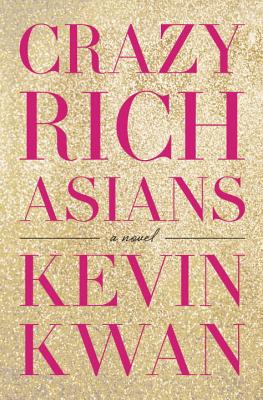
A book with a title as brash as Crazy Rich Asians is just asking to be picked up and read. The ascent of Asian money is all too real, yet at the same time, one can’t help but ask where such money came from – and who these people are. And thanks to Kevin Kwan’s debut novel, we can enter into this world of intrigue.
The story centres around girlfriend and boyfriend Rachel Chu and Nick Young, the latter heir to one of the largest billionaire fortunes in Singapore. The two have been living in rather isolated bliss in New York; Rachel, an American-born Chinese (ABC), knows nothing about Nick’s powerful family and the future expectations of him—until he brings her home for the society wedding of the year at which Nick is best man.
Naturally this female Chinese-American doctorate of economics—an outsider by all accounts because she is an ABC, who are “descended from all the peasants that were too stupid to survive in China”, and well, also because of her appalling dress sense compared to Nick’s moneyed ilk back home—becomes persona non grata among the Singaporean elite. Before long, Nick’s family and intertwined network of well-connected relatives are scheming to get rid of Rachel, the obviously “cunning, deceitful GOLD DIGGER”—and it’s a trans-continental effort that involves private investigators, devious ex-girlfriends and even a mutilated fish left in Rachel’s bag as fair warning.
One can’t help but wonder how much of Crazy Rich Asians is based on real people that Kwan knows or grew up with. He likes to brand-name drop—to the point of which fashion designer one is wearing often being a character’s only defining feature—and Kwan also packs in many of-the-moment cultural and social references, such as the following passage, when a cousin compliments Nick’s mother:
What a fabulous place, Aunt Elle!... It’s so Morris Lapidus, so Miami Modern! It makes me want to throw on a Pucci caftan and order a whiskey sour.
This is the over-the-top world that Kwan takes us into, a world where wealthy wives at Bible study will, between praying to God, phone up their brokers to frantically buy and sell stocks; where the Gurkha-guarded estate of Nick’s grandmother does not show up on any GPS system, and with the dowager herself waited on by two ladies’ maids gifted to her from the King of Thailand; a world where engaged girls and 21 friends travel to private islands for bachelorette parties, by private jet. In fact, private jets (one with a Matisse in the cabin, another with a pine floor-heated yoga studio) feature prominently in Crazy Rich Asians, but compared to the rest of the extravagance and excess, they seem rather banal.
Money and materialism drip off every page of this book, but that is exactly the point: Crazy Rich Asians is, after all, an outrageous satire. Mix together all those designer names, zeitgeist-like references, scandal, gossip and absurd social rules, and you’re looking at a comedy of manners, but one entirely about Asian wealth and the rise of it. Parodies of the rich and famous are nothing new, but one set in Asia and with an all-Asian cast, is. And clearly the Western world is taking note: the back cover of Crazy Rich Asians has endorsements from New York society writer Plum Sykes and Jackie Collins (novelist younger sister of Joan); the Guardian and Wall Street Journal are hailing it a summer beach read; Vanity Fair interviewed Kwan the day the book debuted; and, perhaps the biggest kudo of them all, media game-changer Oprah put the novel down as one of “10 Dazzling Debut Novels to Pick Up Right Now”. If the rise of Asian wealth has not yet entered the mindsets of middle-America and pop culture, it certainly will now.
All this hype bodes well for Asian fiction in general, too. In a niche sector long dominated by serious, backward-looking reads about the Cultural Revolution or colonialism—or in the U.S., about the immigrant experience—here is a modern, funny, guilty pleasure of a novel. The fact that a mainstream publisher—Doubleday, who publish Bill Bryson and Terry Pratchett—decided to back Kwan and his Singaporean satire, plus seek so much celebrity support for it, shows that publishing attitudes toward Asian fiction are changing.
Kwan’s book isn’t the first to focus on the mores of Asia’s rich and famous, but the trend of these books reaching mainstream English-language distribution is hardly a year old. Perhaps Asian-set and Asian-populated books will finally become everyday “beach reads”—a genre that is more contemporary, light-hearted and, most of all, exciting to Western audiences who are less interested in the old money at home than in the new money out East.