China Rich Girlfriend by Kevin Kwan
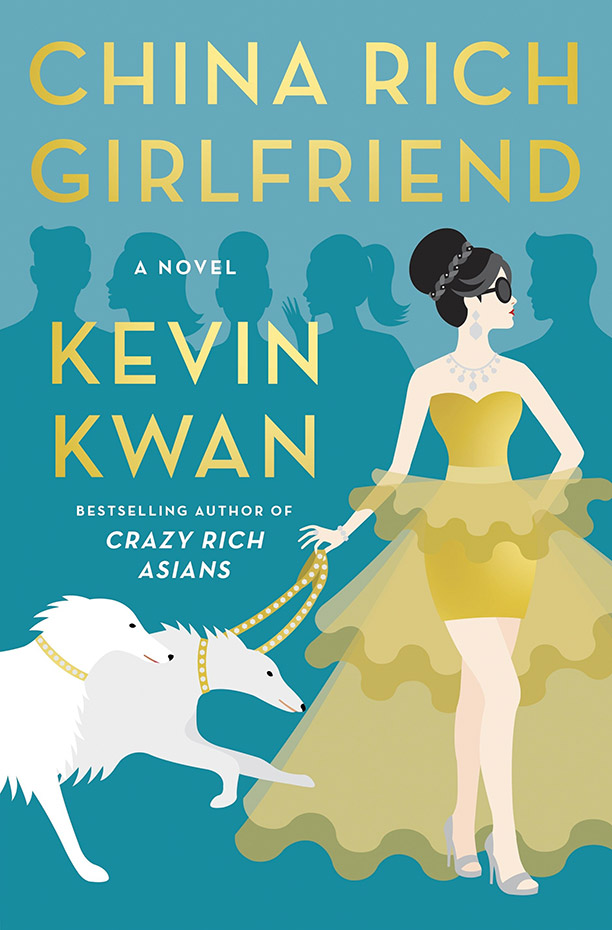
In 2013, Kevin Kwan published the international smash-hit Crazy Rich Asians. His new novel, China Rich Girlfriend, picks-up a few years after the earlier novel left off, continuing the stories of some of the same characters, and introducing new ones.
It is a novel of many plot-lines, of varying degrees of ridiculousness. The main one involves Rachel—newly-married to Nick, the heir to one of Asia’s biggest fortunes—being reunited with her long-lost father, Bao Gaoliang, who turns out to be a hot-shot Mainland politician with a pharmaceuticals empire on the side.
Bao’s son, Carlton, has just crashed a Ferrari in London, killing one girl and injuring another. Carlton fancies uber-fashionista Colette, the China rich girlfriend of the title, whose father is another billionaire—it escapes me, for the moment, how he came by his money. There are so many billionaires in the novel, it’s hard to keep them straight. Colette’s parents want her to marry Richie, who is richer even than Carlton, but she is having none of it. Carlton and Rachel forge a sibling bond, or appear to, which alarms Colette, with unpredictable, and unbelievable, results.
The blurb describes China Rich Girlfriend as an uproarious comedy of manners, but it’s more a comedy of consumerism, as is perhaps hinted in the title itself, since it uses China as a superlative — not just rich, but China rich. (Will this usage catch on in other contexts, one wonders? Will we soon be talking China polluted or China corrupt?)
In any case, the territory of greed is the one Kwan maps, sometimes so closely it’s hard to see the landscape. On page 9, we are told that a character “checked her lipstick one last time in the tiny mirror of her Jim Thompson silk lipstick case.” I’m all for the telling detail that speaks volumes about a character, but I decided that if here was a novelist who was prepared to specify that someone’s silk lipstick case was not just any old silk lipstick case, but a Jim Thompson one, it might be amusing to keep a tally of the brands he mentioned—but I gave up again soon after, because there were simply so many of them.
And it’s little exaggeration to say not a single outfit worn by any of the characters goes undescribed. We have been told that Michael is driving a 1961 red Ferrari California Spyder. His wife, Astrid,
glanced over at him now, cutting such a dashing figure in his dark gray Cesare Attolini suit, and his perfectly knotted Borrelli tie, the face of his Patek Philippe Nautilus Chronograph glinting under the flash of streetlamps as he shifted gears forcefully on his iconic automobile.
At a fashion show, the marvellously named Perrineum Wang is sporting
a Stephen Jones fascinator of glittery gold sunrays with a Sacai shredded dress.
This kind of thing is funny in small doses, but it can become somewhat wearying after a while, as can Kwan’s liberal use of footnotes, written in his own voice, or a version of it. Footnotes elucidate amongst other things, which airlines offer private cabins in their A380s; how to make a French Blonde cocktail; how a character would respond to foodie bloggers who criticized her for choosing one place to eat chicken rice over another.
Above all, Kwan uses footnotes to explain dialect terms. He explains even when no explanation is necessary. A Filipina answers the phone to her husband: “Hey swithart, how are you?” We are then solemnly told, in a footnote that swithart is Filipino slang for sweetheart. Irony is always enjoyable, and I appreciate that it can be difficult for authors to decide how much explanation to offer—do you patronize readers by spelling everything out, or do you risk that they miss something, if you don’t? And of course, I could have been missing some post-modern trick here in Kwan’s heavy-handed explanations. Perhaps Kwan intends his footnotes to make some point or other about the meta-fiction supervening on any fiction? Or something. If so, it was all too clever for me, and I found the footnotes intrusive and irritating.
Kwan has certainly been praised as a satirical writer, and China Rich Girlfriend is often very funny, but I remain deeply unsure to what extent this novel is genuinely satirical. Kwan is good on the petty savings billionaires will make: using coupons to pay for groceries; stuffing food from buffets into their bags to take home; refusing to pay for valet parking. He also has an hilarious sub-plot about a former soap star, Kitty Pong, who commissions a posh queen bee to produce a social impact assessment of her life, and then to insert her into the world of Hong Kong’s mega rich.
But although he is funny, Kwan doesn’t really skewer his characters. The sharpest, and wittiest, jab to the rich comes not from him, but from Dorothy Parker, whom he quotes at the opening of part 2: If you want to know what God thinks of money, just look at the people he gave it to. Most of Kwan’s characters are monsters, and yet he often seems to let them off the hook; he gently and affectionately teases them, rather than damning them as corrupt, and through teasing them, he flatters them.
Kwan also seems wholeheartedly in awe of the things money can buy. He is not even-handed between his characters, and he much approves of Rachel and Nick. He compliments Rachel on her good taste in wearing a simple engagement ring, which Nick explains is from Joel, in Paris. Kwan then drools, in a footnote, that Joel is:
Joel Arthur Rosenthal, aka JAR of Paris, whose precious handmade jewels are among the most coveted in the world
and that a woman of discerning eye would realise:
Rachel’s ring was a flawless oval-cut diamond held in place by ribbons of white gold almost as thin as hairs, interwoven with tiny blue sapphires.
That’s not satire. That’s fiction as fantasy wish-fulfilment.
But perhaps to worry that China Rich Girlfriend flatters where it should surely condemn, is to take the whole thing too seriously? This novel is a hoot, recommended for reading on the beach, or for whiling away a few hours on a plane.