


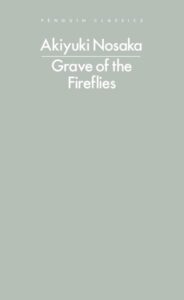
Studio Ghibli’s 1988 film Grave of the Fireflies has been described as the greatest film someone will only watch once. Deeply emotional, director Isao Takahata’s tale of two Japanese war orphans struggling and failing to survive in the closing days of World War II is almost too painful to bear. But the story isn’t Takahata’s—Grave of the Fireflies is a loosely autobiographical novella by Japanese Renaissance man Akiyuki Nosaka. Available in English-language bookstores for the first time in translation by Ginny Tapely Takemori, the novella isn’t nearly as gut-wrenching as its visual counterpart. Instead, the narrator tells the story with matter-of-fact detachment that stirs up different emotions altogether.
Akiyuki Nosaka, who died in 2015, drew on his own childhood for some of the events depicted in the novella. Like Seita, the novella’s protagonist, Nosaka, too, was a war orphan. Both were displaced by the firebombing of Kobe; Nosaka’s foster father was one of 9,000 civilians who died that night. Both were left to care for little sisters. (Takemori notes in a translator’s afterword that Seita is “an idealized character who acted more nobly and cared much better for his little sister than Nosaka himself had been capable of”; perhaps it’s worth noting that Nosaka has doubled Seita’s little sister’s age—surely a four year old might be easier to care for than a sixteen month old.)
Outside of Japan, Nosaka is best remembered for his children’s stories—or at least stories that feature children—about World War II. Takemori translated two overlapping collections of these stories (The Whale That Fell in Love with the Submarine and Cake Tree in the Ruins) about a decade ago. Nosaka places all of his stories firmly in their historical moment; each story in Cake Tree culminates on 15 August, the day Emperor Hirohito announced Japan’s unconditional surrender. Grave of the Fireflies ends instead on 22 September 1945—“the day after the ‘Protective Measures for War-Displaced Orphans and Other Persons’ had been enacted.”
There are no spoilers in Grave of the Fireflies. The story begins with the ending.
There are no spoilers in Grave of the Fireflies—either the novella or the film. The story begins with the ending. Seita, nearly starved, watches children his own age “heading off to middle school as if nothing were amiss.” Meanwhile, he and other war orphans cluster around the base of columns in the train station “as if finding in them motherly comfort” as they slowly die of hunger or illness.
And Seita does die—just three paragraphs into the story.
The rest of the novella takes place several months before and chronicles how quickly Seita’s life had spun out of control after the 5 June firebombing of Kobe. When the bombs begin to fall, Seita evacuates his ailing mother to a bomb shelter and then carries his four-year-old sister away on his back. (Nosaka’s descriptions of the night of the firebombing and its aftermath carry the heavy weight of lived experience. His descriptions of Seita’s mother, burned in the bombings, are horrifyingly vivid—“her hands resembling baseball bats… the tip of her nose like fried tempura batter…”)
The hapless Seita is left with an orphaned little sister and a series of bad options, not always making the choice an adult might find wisest, but always trying to protect his little sister, Setsuko. Seita does receive help from time to time—a boy returning from evacuation gives Seita his lunch, a guard makes sure the station master leaves Seita alone—but the real tragedy of Grave of the Fireflies is the indifference of so many of the Japanese toward Seita, Setsuko, and others like them. When an aunt steals what little they have, her neighbors do nothing; they have “already tired of war orphans.” A doctor callously explains to Seita that his sister is sick because she needs better nutrition, and recommends foods that are impossibly out of reach for the children like white fish, egg yolks, and butter. When Seita attempts to steal food to feed Setsuko, a farmer shows him no mercy. The novel almost completely lacks the film’s pathos; instead, Nosaka’s “unsentimental and unflinching” narration of these events is deeply uncomfortable to any reader who has ever looked away from someone else’s suffering.
Takemori’s translation of Grave of the Fireflies was released this fall to commemorate the 40th anniversary of the end of World War II. Its publication was timely and important, but the novella itself is perhaps an odd choice for a stand-alone publication. It runs to just 80 pages including the translator’s notes, and the font size is unusually large to achieve even that length. The translator’s notes promise “the first full English translation of Nosaka’s original collection in a few years’ time”—a volume of important work that is long overdue.
You must be logged in to post a comment.