“Kirpa Ram Vij: The Volunteer Who Launched an Army” by Ramachandran Menon
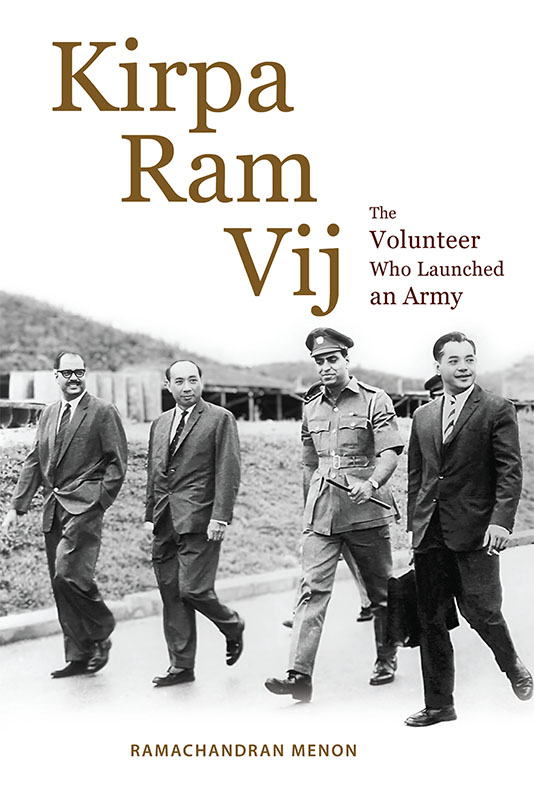
On 9 August 1965, Singapore was expelled from Malaysia, which had itself only become an independent country two years earlier. But Malaysia insisted that Malaysian troops be permitted to remain in Singapore. Singapore’s future Prime Minister Lee Kwan Yew later said that Malaysia’s insistence “stiffened our resolve” to “build up the Singapore Armed Forces”. The person primarily responsible for doing that is the subject of Ramachandran Menon’s new book Kirpa Ram Vij: The Volunteer Who Launched an Army.
Menon, a retired colonel in Singapore’s Army who had a distinguished 27-year military career (including a stint as Singapore’s defense attache to the United States) was one of the first officers commissioned at the Singapore Armed Forces Training Institute (SAFTI), which Kirpa Ram established and served as director in 1967. Menon’s book is part biography of Kirpa Ram and part detailed history of the origins and evolution of Singapore’s armed forces. Menon benefitted from access to Kirpa Ram’s personal records, exit interviews with Kirpa Ram from the Ministry of Defense (which he quotes throughout the book), an interview with Israeli Defense Force officer Ya’akov Elazari who helped organize and train the fledgling Singapore Army, and records related to Kirpa Ram’s military and civilian positions. Kirpa Ram was a soldier, civilian minister, diplomat, and business consultant during his remarkable career.Kirpa Ram was born in the Punjab in 1934, which was then still part of the British Raj. When India gained its independence in 1947, the Punjab was divided between India and the new nation of Pakistan. Kirpa Ram’s family fled the Punjab amidst the “widespread communal violence” that accompanied Indian independence, for a time stayed in India and then settled in Singapore, where other family members lived. Kirpa Ram was a good student (his strongest subject was geography) and wanted to be a teacher, but destiny had other plans. At the Raffles Institution, he joined the cadet corps and was commissioned in the Singapore Volunteer Corps, which, Menon writes, “played a defining role in his immediate future.”Singapore was then still part of the fading British empire. Japan had conquered it in World War II, but in the postwar era with the loss of India, the communist conquest of China, and a communist insurgency in Malaysia, Britain made Singapore, a strategically located naval chokepoint near the Malacca Strait, “the hub of its military operations covering Southeast Asia and the Australian-New Zealand theatre”. But by 1963, with its empire in retreat, Britain ceded Singapore to the Federation of Malaysia.Menon notes that Singapore’s expulsion from Malaysia was sudden and unexpected. As an independent city-state, Singapore needed an army. Prime Minister Lee Kwan Yew assigned that task to Dr Goh Keng Swee, the Minister for Defence and Security (later Minister for the Interior and Defence). Dr Goh selected army volunteer and one of his subordinates in the Finance Ministry, Kirpa Ram Vij, to establish the Singaporean army. And Dr Goh, after being rejected by India and Egypt, looked to Israel for military expertise to assist Kirpa Ram. In September 1965, a member of the Israeli General Staff visited Singapore and formulated detailed plans for training Singapore’s army. Later that same month, Lt. Col. Kirpa Ram and the superintendent of Singapore’s police force visited Israel “to familiarize themselves with the ethos of the Israeli Defence Forces.” Menon writes that the assistance of the Israeli Defense Force (IDF) was crucial to the development of Singapore’s armed forces. IDF officer trainers instructed Singapore army recruits on every aspect of military life under the watchful guidance of Kirpa Ram. As a quid pro quo, Israel asked Singapore to formally recognize the state of Israel. After initially explaining that such recognition would anger Muslim communities, Singapore abstained in a vote to condemn Israel after the Six Day War, and in 1969 it formally recognized Israel.Menon credits Kirpa Ram with playing a “key role in facilitating the buildup of the [army’s] artillery, armour, engineers, signals, commandos, military intelligence and medical services”. He established institutes to train officers and was the first director of the Command and Staff College. He had a hand in forming Singapore’s air force and navy. He rose to the rank of Brigadier General and served as the Director General Staff of the army.After retiring from the military, Kirpa Ram served Singapore as a diplomat as Singapore’s Ambassador to Egypt, non-resident ambassador to Yugoslavia and Lebanon, and non-resident High Commissioner to Pakistan. In those roles, he promoted Singapore’s political and commercial interests. He later served as Deputy Secretary in the Ministry of Education, General Manager for Administration for Neptune Orient Lines, a state incorporated shipping company, and finished his career as a consultant. He died in 2022 at the age of 87.Kirpa Ram once explained his philosophy of leadership: “You have to lead from the front. You cannot sit back and just order…. Explain, be transparent. Treat [people] fairly.” Menon believes that was the key to his success.