“Paving the Sea” by Rashid El-Daif
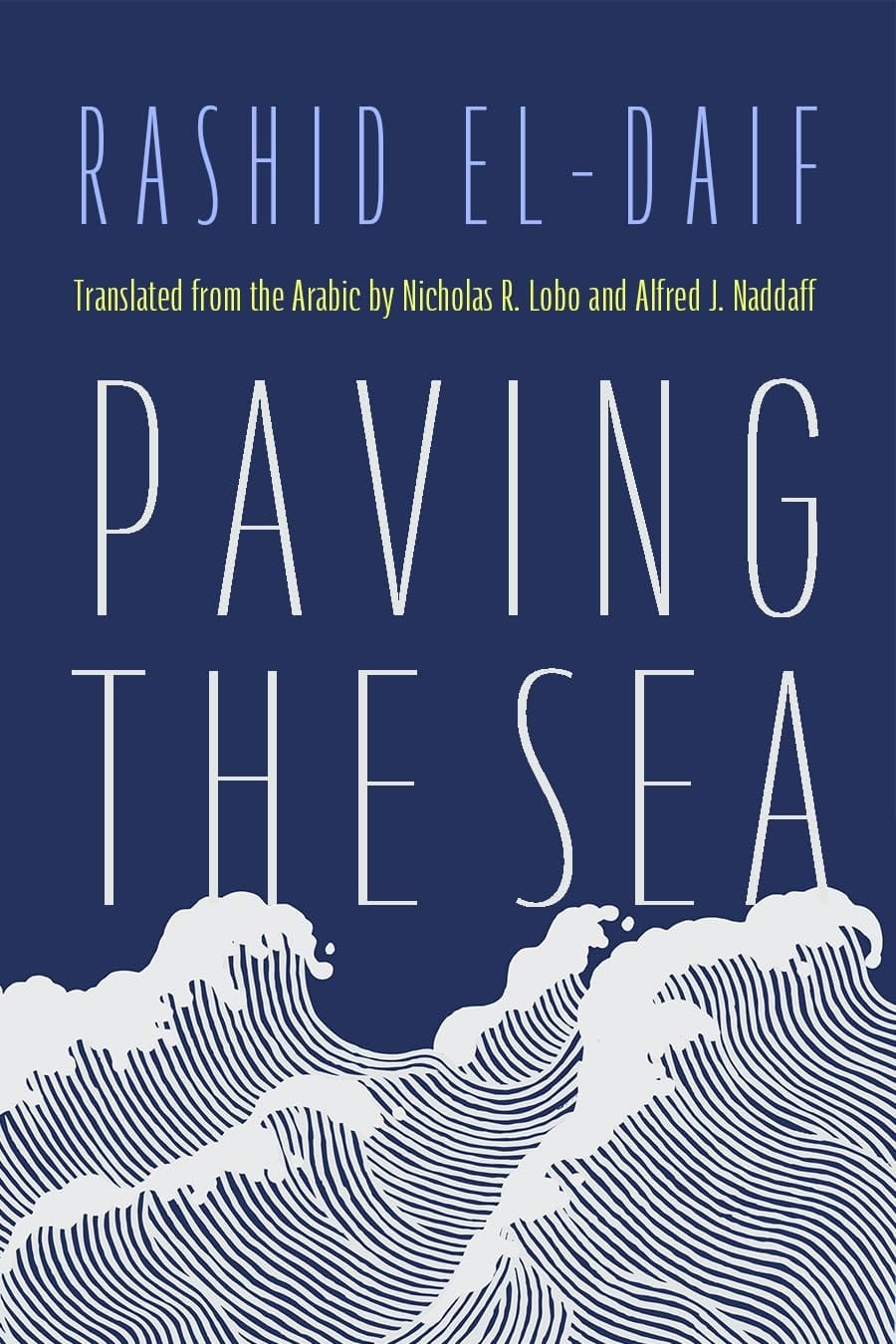
Lebanese novelist and poet Rashid El-Daif is one of the leading voices in contemporary Arabic literature, perhaps best known in English for Dear Mr Kawabata (1995) which addresses the aftermath of the Lebanese Civil War. His most recently translated work, Paving the Sea (originally written in 2011), satirizes the aspiration for Western liberalism and nationalism, as manifested in the Nahda, the initial project of Arab modernity, a 19th-century cultural and intellectual movement that sought to engage with Western ideas, while revitalizing Arabic heritage.
A foreword by Zeina G Halabi provides context for the novel, explaining that “paving the sea” is an Arabic idiom meaning “to attempt the impossible: to render the fluid solid, to impose coherence on a world structurally incapable of holding shape.”
Paving the Sea intertwines the fictional and the historical. Of its two protagonists, one, Fares Hashem, is fictional, while the other, his friend Jurji Zaidan, is based on the real Jurji Zaidan, a pioneering Lebanese novelist, journalist and historian, and a leading figure of the Nahda.
The mechanics of the plot itself focus on Fares. As a youth in the latter half of the 19th century, Fares dreams of becoming a Western-style doctor, one relying on rationality and science, not on folklore. He manages to win a place to study medicine at university in Beirut, then a city in Ottoman Greater Syria, not the capital of independent Lebanon. The university’s anatomy department cannot source cadavers for dissection, since Beirutis, mired in superstition, refuse to donate them. Fares becomes embroiled in a Dickensian plot to supply the necessary cadavers. Soon afterwards, he is expelled from university for advocating Darwin’s theory of evolution. After this calamity, he emigrates to the United States, to continue his studies, though he takes an oath to return to his homeland to bring to it modern ideas:
I swear to God Almighty … that upon my graduation, I shall return to my blessed country, that I shall take part in its rebirth in all its cities and each of its unspoiled villages.
Fares visits Paris on his way to America. Here he meets Rashid, “a young man from Northern Lebanon”, whom we’re later told is illiterate and ignorant of even celebrated Arab poets. Rashid was “planning to join his relatives and siblings in Puerto Rico, where he would later die.” Despite his illiteracy, and his early death, is Rashid El-Daif here inserting himself as a meta-fictional commentator? Certainly, though Rashid is ignorant of the greatest poets, he seems to reveal a more poetic sensibility than most of the other characters. He is visiting Paris for the first time and he
didn’t understand anything he was seeing. It was like he lived in a world of vague illusions, a world of dust. It resembled our world, just as God alone perceived it prior to its creation – but with a tint. Rashid couldn’t see or hear well. He was floating someplace without gravity to pull him in any particular direction.
In America, after a stint as a travelling salesman, Fares finally qualifies as a doctor. He then serves in the American military during the Spanish-American War and then meets a Chinese woman who becomes his wife. Eventually, Fares does manage to return to Lebanon, but not in the way he’d hoped, as the plot loops to echo the earlier one of body snatching.
Along the way, Fares has various encounters with women in which he behaves appallingly by the standards of today, or normally by the standards of his time.
If El-Daif uses Fares’s journey to parody the ideological fervour of the Nahda, and the inflated promises of Western ideals and ideas, then the characters are never simply vehicles for satire and irony: the reader will feel for poor Fares, thwarted at almost every turn, even as she laughs at his predicaments, or disapproves of his behaviour.
The translators, Nicholas R Lobo and Alfred J Naddaff, have added a dramatis personae to help readers untangle which characters are based on real people, and which are entirely fictional, and footnotes to clarify social, political, religious, literary and linguistic details. Their translation always reads smoothly and naturally.
Halabi points out that translation itself is an attempt to pave the sea. She described El-Daif’s style in his original prose as being haunted by:
the rhythms of French and English, the grandiloquent idiom of Nahda litterateurs, and the sober, pained, saccadic prose of mid-century intellectuals.
As rendered by Lobo and Naddaff in English, El-Daif’s style seemed to me mostly coolly detached and sardonic.
Though written in 2011, with its themes of migration, homesickness and the difficulties of assimilation, Paving the Sea nonetheless offers a commentary on today’s headlines. And right now, it is surely impossible to read any novel concerning Lebanon’s history without thinking of what is now happening there.
Likewise, right now, it’s surely impossible to read Paving the Sea without observing that it reads, in part, like an ironic commentary on America. When Fares is in Cuba, he asks, in Lebanese, a countryman and fellow military recruit what he is doing there. His countryman replies in stumbling, non-idiomatic English:
I come here to serve our magnificent flag … the stars and stripes… it is waving above the fortress of the freedom. I come here and contribute in the making for America her glorious history, full of progress, business, industry, and innovation. I am here to defend land of the enduring freedom, freedom that the Constitution protects her…Constitution gives to every man his right.
In her foreword, Halabi points out that Paving the Sea asks what remains of reason when belief in reason has collapsed. What about an answer? El-Daif doesn’t give one, but Halabi suggests that if any answer exists, it: “resides in persistence: in the gesture of narrating, of doubting, of translating again, and laughing throughout.”
Paving the Sea does laugh throughout, while avoiding subsiding into empty, knowing irony. It is a funny and informative parody of the grandiose illusions and delusions of modernity, a commentary on the ways lives are anchored or unmoored by historical events, and a humane and generous account of Fares’s struggles with displacement and disillusionment.