

When Clarissa FitzRoy arrives on South Australia’s Kangaroo Island in October 1836, the heiress is met with the salty spray of the ocean.
At first, it’s a fine mist with the fresh tang of the ocean meeting the shore, but it grows in weight and volume until waves are slapping me, pushing my feet along the rust-bitten deck. In the distance, I see it. The horizon line behind the white clouds, the rolling slope of land.
Clarissa soon compares the water with that of the “limpid warmth of the East Indies lagoon”. Her mind wanders to Calcutta to the Devon shoreline and then back to the Australian shores.
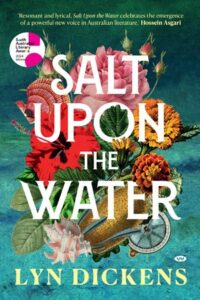
Lyn Dickens’s debut novel Salt Upon the Water tells the story of Clarissa, who has travelled to Australia from England to see Colonel William Light, the Surveyor-General of South Australia. Clarissa and William are both of mixed heritage with British fathers and Asian mothers; Clarissa has come to see William as she believes he has information on her mother that Clarissa has long sought.
Told from both Clarissa’s first-person perspective as well as William’s in the third, Dickens moves her characters around the world: South Australia, Calcutta, London, Suffolk, Bath, Venice, Rome and Penang are among the settings. She moves quickly between different locations and time periods, weaving together the lead characters’ complicated histories, alone and en deux (in her accompanying author’s note, Dickens writes that Colonel Light is “inspired” by the historical person, but Clarissa is entirely fictional).
Both characters’ mixed heritage comes into focus early.
I had thought we were well suited. Me with my Hindu mother and my Hertfordshire father, and he with his more mysterious origins. A Suffolk father and a mother that was of Siam, Chinese, Malay and perhaps Portuguese heritage. I had thought our differences unified us, but I had not counted on how much he wanted to change his skin.
Clarissa and William each contend with their own identities, struggling in different ways with decisions made by the families, the prejudice they face and, in William’s case, his role in colonial violence.
While the novel is set some 200 years ago (there are scenes from 1804 through 1836), some readers may still feel a familiarity with the tensions that William and Clarissa faced with having multiple heritages and multiple ideas of home or perhaps no home at all. In one scene, William speaks of Suffolk as “the only place” where he felt he belonged. Clarissa challenges him.
“And what of your home in Penang?”
His eyes seem to shutter. “What of it?”
As Dickens moves in and out of the past, through different time periods and different countries, there is a sense of tempo and momentum that helps propel the novel. But Dickens can also slow the pace and linger, often with what confronts Clarissa and William on the South Australian Coast.
They said this land was empty and unspoiled. But flotsam already lines the shore. Old rigging, felled trees, splintered cargo boxes. The empty rum bottles that glint to the sand like fragments of the evil eye. The seal carcasses lining the edge of the ocean on Kangaroo Island, giving up their pelts to dark-skinned women who work on them with questioning faces.
Dickens often makes use of the sensory experiences of her settings and her writing is thoughtful, detailed and lyrical. Water plays a role in the novel from Clarissa swimming to shore to William’s comfort in being at sea rather than on land. Dickens uses water and its mythology well to further illuminate the text.
Ultimately a love story, Salt Upon the Water explores the different betrayals the characters experience over their lives as well as the similarities in their stories, but also the differences that drive them apart.
You must be logged in to post a comment.