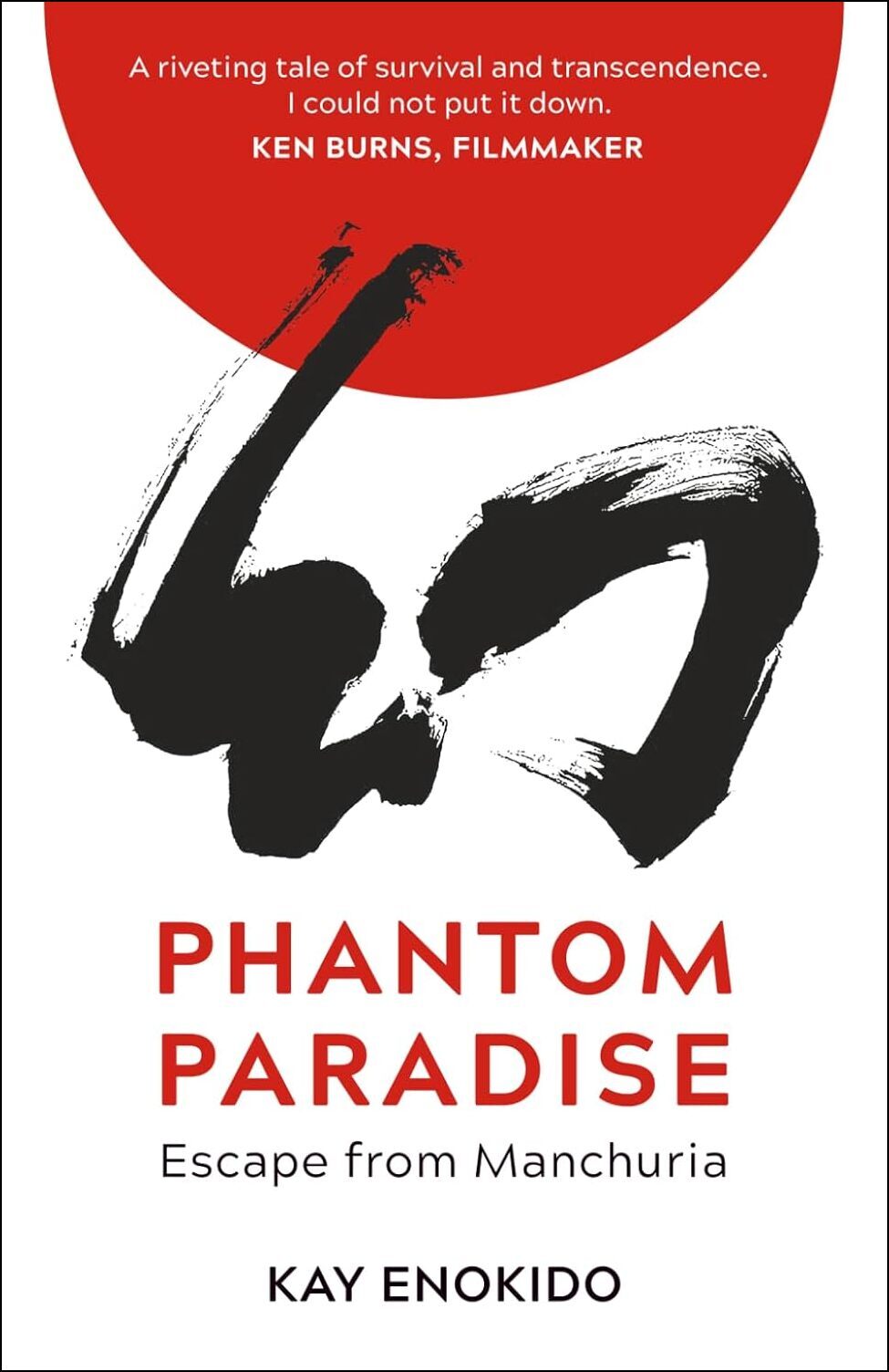
Kay Enokido was the longtime president of the stately Hays-Adams hotel in Washington, DC, hosting dignitaries like the Japanese monarchy and the Obama family before the president was sworn in. But before she was a hotelier, and before that a journalist, she had another, earlier story, one that provides the heart of her book, Phantom Paradise: Escape from Manchuria.
As the subtitle indicates, Enokido was born and partly raised in Manchukuo, the Japanese puppet state in northeast China set up in the 1930s. Enokido uses “Manchuria” instead and recognizes how fraught was this period of Japanese occupation. At the beginning of her narrative, she tries to understand the draw that brought her parents to Manchuria.
There were likely many reasons why my parents were drawn to relocate from Yokohama to Manchuria in 1939. I am quite certain that my father was strongly influenced by his older brother, Kunimitsu, whom he idolized. Uncle Kunimitsu, a telecommunications expert, had been sent to the northeast of China as an engineer before Manchukuo was established by the government. His job was to lay the groundwork for future facilities, possibly in preparation for the invasion.
Enokido’s uncle moved to Manchuria in 1928 and presented the area to his younger brother as “a utopian land”. Enokido was born a couple years after her parents arrived. She had an older brother and a younger brother, which left her mother with a lot on her plate after Enokido’s father was drafted by the Japanese army in 1945, in the dying months of the War.For much of the book, the whereabouts of Enokido’s father remain unknown, and her mother must raise her three young children alone. She doesn’t know if her husband will ever return. When Japan surrenders, the Japanese still in Manchuria worry about the encroaching Soviet army. Women and girls faced particular danger as the Soviet army raped and pillaged as they fought their way through Manchuria.Enokido was a toddler when the war ended and her mother had difficult decisions to make; Enokido only learned about this time much later as an adult. She asked her mother about the past and what she received in return was a long, written narrative of which Enokido included translated excerpts throughout her book, and into which Enokido also weaves in her own narrative.
Few English-language memoirs are set in Manchuria during World War II; even fewer are from the viewpoint of Japanese citizens, so Enokido’s story is unique. While the plight of “comfort women” in Manchuria and Korea have been covered in several books, Enokido writes about Japanese women who fled Manchuria after the war, but not before a number of them became victims of the Soviet army. At the Hataka port on Kyushu, there was a secret medical center where women could get abortions on their return to Japan. Enokido writes that 400-500 abortions took place at this center from 1945 to 1947.
It was nearly impossible for a young woman to go home with a baby whose father was a rapist from a foreign country. Not only would it be gravely difficult to raise a child financially in now war-torn Japan, but it was unthinkable that a woman would be accepted by society with such a child. It was not the women’s fault. But the women could not escape being looked down upon and feeling humiliated by the perception of having done something dishonorable and immoral.Enokido’s mother was fortunate to avoid such a fate; only through luck that she came out of the war as unscathed as she did. Not that it was easy. With her husband missing in action, she tried to find refuge with her in-laws after she returned to Japan from Manchuria, but they treated her like a stranger, despite being reunited with their young grandchildren.The Japan/Manchuria part of the book could have stood alone, but Enokido includes her own journey to the US and her eventual role at the Hays-Adams to, perhaps, round everything out. At the end of the book, she provides a wish for the future: one without war.
How many wars and military conflicts have we had after the end of World War II? How many do we still have today? In 2022 and 2023, I watched millions of Ukrainian refugees flee their homes on packed trains and on foot, carrying frightened children and meager possessions. Millions of Russians have been pressed into a war their leaders have lied about from the start. Lives are cut short in the killing fields. We must find a way to learn from the past and stop war from repeating and repeating.
Contributor
Susan Blumberg-Kason
Susan Blumberg-Kason is the author of Bernardine’s Shanghai Salon: The Story of the Doyenne of Old China, Good Chinese Wife: A Love Affair with China Gone Wrong and When Friends Come From Afar: The Remarkable Story of Bernie Wong and Chicago’s Chinese American Service League.