“Absolute Jafar” by Sarnath Banerjee
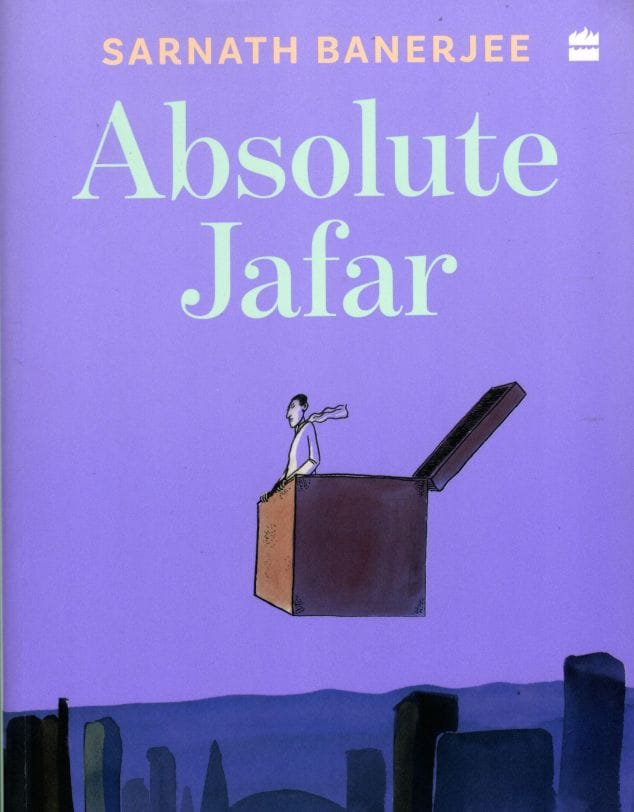
A border is usually imagined as a line on a map. In Absolute Jafar, Sarnath Banerjee shows how that line can enter a marriage, a family and even a child’s idea of home. His sixth graphic novel follows Brighu Sen, an Indian man who falls in love with a Pakistani artist, marries her, moves to Berlin and becomes a father. The marriage eventually ends, but the past continues to accompany Brighu. Through walks, memories, conversations and fragments of everyday life, Banerjee explores what happens when home is no longer a single place.
As it tells Brighu’s personal story, the graphic novel moves between Delhi, Karachi and Berlin, following Brighu’s relationship with Mahrukh Zaidi, an artist from Karachi. Eventually they move to Berlin, where their son Jafar is born. The marriage later breaks down, leaving Brighu to negotiate separation, fatherhood and the memories of a life divided between several cities.
The story unfolds through a series of episodes and vignettes, with walking as one of its central rhythms. Brighu is an “all-weather walker”, and much of the narrative develops as he moves through streets, neighbourhoods and parks. These walks are rarely about reaching a destination but a catalyst for memories. They allow memories to appear almost unexpectedly. A place in the present can lead to an episode from the past; an ordinary encounter can open into a recollection.
Banerjee approaches the political border between India and Pakistan through ordinary life rather than grand political events. The couple’s relationship has to pass through forms, permissions, visas and official procedures. One of the most memorable parts of the graphic novel concerns NORI, or No Objection on Return to India. Bureaucratic language becomes part of the story of a marriage.
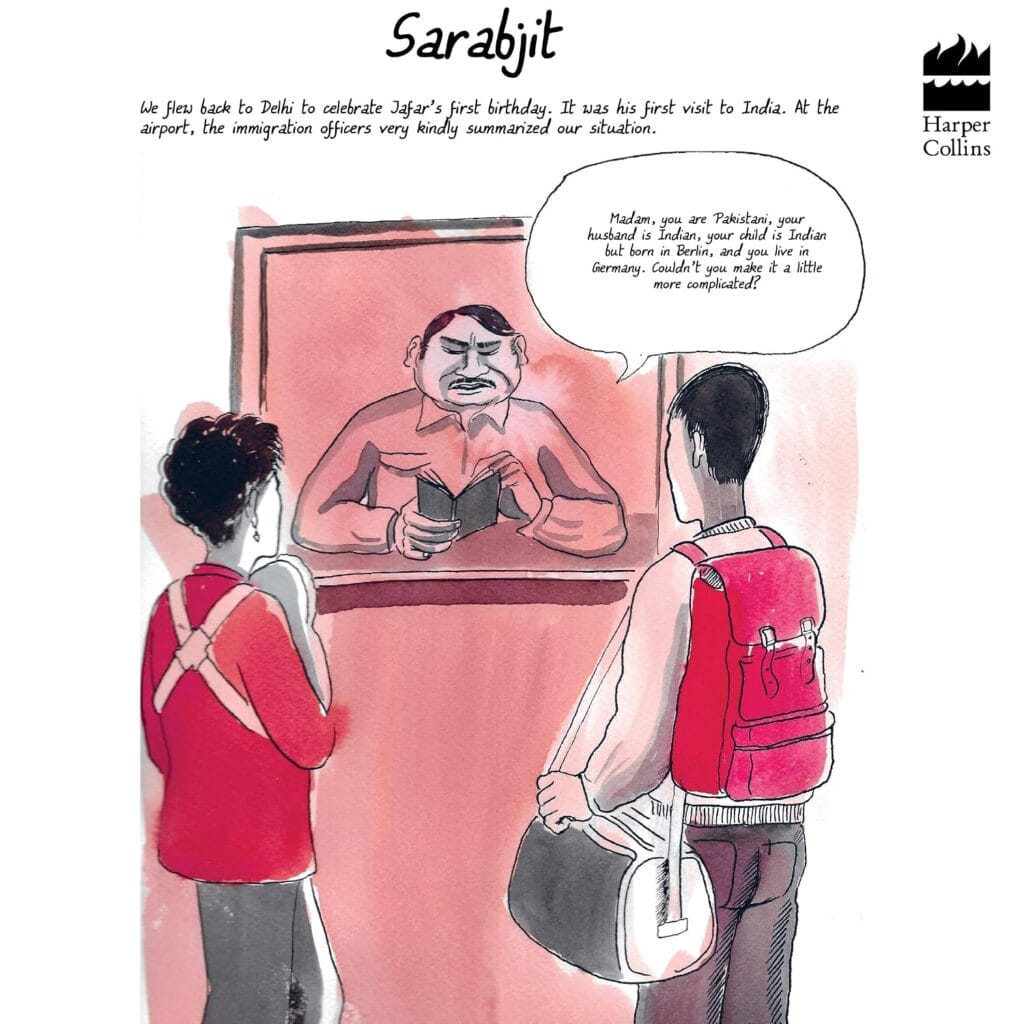
There is considerable humour in these sections. Government procedures can be absurd, especially when they are applied to intimate relationships. Rather than delivering a political lecture, Banerjee shows how large political divisions affect small decisions: where a couple can live, how they can travel and how they can maintain an ordinary family life. One of the strengths of Absolute Jafar is that it rarely turns solemn. Banerjee finds comedy in awkward situations and in the ordinary business of living. The serious and the comic sit comfortably beside each other.
Berlin introduces another kind of displacement. Brighu and Mahrukh leave the subcontinent, but Delhi and Karachi remain present through memory. Food, films, relatives, streets and stories carry the past into the new city. This becomes particularly important after Jafar is born. Brighu tells his son stories about distant lands, princes and princesses, sultans and djinns, and the places associated with his own past. These stories preserve something that is disappearing. Yet Jafar is growing up in Berlin. The places remembered by his father are not necessarily places that he can experience as home.
The title draws attention to this difference. The book is largely concerned with Brighu, yet it is called Absolute Jafar. Jafar is not always at the centre of the action, but his presence shapes the entire story. The marriage, the move to Berlin and Brighu’s relationship with the past all acquire their meaning through the child. He represents a future that cannot simply inherit the past unchanged. For Brighu, home is closely connected to Delhi. For Jafar, home is likely to be Berlin. The distinction is simple but important. Children inherit stories, memories and cultural habits from their parents, but they do not necessarily inherit the same sense of place. What is home for one generation may become family history for the next.
This makes Absolute Jafar an engaging exploration of Heimat, the German idea of homeland or belonging. The book does not treat home as something fixed by nationality. Home can be a neighbourhood, a street, a meal, a language, a family story or a set of familiar routines. A person can leave one home and slowly develop another without completely abandoning the first.
The graphic form is particularly well suited to this idea of incomplete and changing memory. Banerjee uses watercolour to create a quiet, reflective visual world. Some panels linger over streets, buildings, faces and small gestures. The pages sometimes recall the flat colours and compositions of Indian manuscript paintings. At other moments, the drawings have the loose, observational quality of urban sketches.
The shifts between black-and-white and colour are also significant. Memories do not always return with the same clarity. Some scenes seem to survive mainly as light and shadow, while others are remembered through colour. The visual changes therefore contribute to the sense that the past is not a fixed archive. Memory is selective, incomplete and constantly being reconstructed.
The pacing of the graphic novel reinforces this. Rather than pushing the reader quickly towards the next event, Banerjee often allows a scene to remain on the page. The reader has time to look at a street, a face or an apparently insignificant detail. This slowness suits a story in which remembering is as important as moving forward.
The book is also filled with references to other works of art and popular culture. Indian films such as Arvind Desai Ki Ajeeb Dastaan, Katha and Noorie appear alongside JM Coetzee’s Life & Times of Michael K. These references form part of Brighu’s way of understanding his world. His memories are not made only of personal experiences; they are also made of the books, films and stories that have accompanied him.
The opening and closing images provide another visual thread. The reference to Project Cheetah—the translocation of African cheetahs to Kuno National Park in India—echoes the book’s concern with displacement and the making of home elsewhere. The cheetah’s rapid physical relocation across borders contrasts with Brighu’s slow, reflective process of emotionally making home in Berlin. The contrast suggests that while crossing a border may take only hours, becoming at home somewhere else can take years.
The metaphor is not entirely neat, and neither is Brighu. Although the story is largely told from his perspective, he remains difficult to understand completely. Mahrukh is even more distant. Her inner life receives much less attention, and the end of the marriage comes abruptly. Readers looking for a fuller account of the emotional reasons behind the separation may find this part of the story less developed.
Yet Brighu’s distance also belongs to the character. He is an observer, a walker and a collector of impressions. He often seems more comfortable watching life than explaining it. His inability to settle into a single place or a simple understanding of himself mirrors the larger uncertainty surrounding home in the book.
Absolute Jafar is therefore not simply a story about an Indo-Pakistani marriage or a migrant living in Berlin. It is about what remains after people leave places behind. The answer is not simply memory, because memory itself changes. Delhi changes, Karachi changes, Berlin changes, and the people who remember them change too.
The book’s politics are found in forms and borders; its emotional life is found in food, films, family stories, walks and silences. Its most affecting moments occur when these two worlds meet: when a geopolitical division enters a household, when a bureaucratic rule affects a marriage, or when a father tries to give his child a homeland through stories.
The cheetah that returns at the end captures this unsettled condition. Like Brighu, it has been moved across a vast distance and placed in a new landscape. But Brighu carries several landscapes within him. He continues walking through the present while carrying fragments of the past.
Absolute Jafar finally suggests that home may not be a place waiting to be recovered. It may be something continually made from memory, family and everyday experience. Brighu cannot return to exactly the world he remembers, while Jafar will grow up with a different sense of where he belongs. Between those two generations lies the quiet, often funny and sometimes melancholy space that Banerjee’s graphic novel explores: the long journey from having a home to remembering one, and from remembering one to making another.

You must be logged in to post a comment.