Lost Colony: The Untold Story of China’s First Great Victory over the West by Tonio Andrade
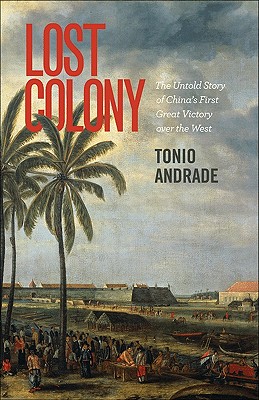
It was in the mid-17th century that a Chinese army captured Taiwan from the Dutch. At the head of this army was Koxinga, the fierce, legendary, pirate leader’s son who is still venerated in modern times. Far from being a little-known but vital part of Taiwanese history, this was a seminal event in world history, Tonio Andrade argues in Lost Colony: The Untold Story of China’s First Great Victory over the West.
What was so earth-shattering about Koxinga’s victory over a heavily outnumbered foe on a small, sparsely inhabited island? Andrade uses the incident to illustrate and discuss the on-going discussion—in both academic circles and more generally—about whether Western expansion from the 15th century onwards was due the superiority, intrinsic or otherwise, of Western civilization over the rest of the world, including Asia or whether—in the revisionist view—Asia in fact held its own until the nineteenth century.
Lost Colony starts off with the compelling stories of Koxinga’s father, a feared pirate who became a wealthy official, and Koxinga himself. The son of a Chinese pirate father and a Japanese woman, Koxinga or Zheng Chenggong, is worshipped as a god in parts of mainland China and Taiwan. In Taiwan, there is an entire class of naval frigates and even a major university named after him.
Born in Japan, the young Koxinga came of age in a China whose ruling Ming dynasty was in its death throes after over 250 years in power. By the time Koxinga was a youth, the Manchus had overthrown the Ming regime, and were then putting down rebellions. Koxinga decided to take on the Qing forces and restore the Ming, against the wishes of his own father, a turncoat who had gone over to the Qing. Andrade provides an exhilarating account of this, starting from Koxinga’s early struggles to amass an army and gain territory, starting from his father’s native Fujian province (then called the Land of Min). He finally undertook a great campaign against the Qing, capturing numerous cities and fighting his way up the Yangtze River to Nanjing, where he settled in to besiege the great former capital. He took too much time and within a month, the Qing had regrouped and defeated Koxinga. Forced to flee back to his stronghold, the Fujian city Xiamen, Koxinga turned his sights on Taiwan.
When Koxinga moves on to Taiwan, the narrative begins to slows down. What it loses in pacing, it makes up with detail. Koxinga saw the Dutch in Taiwan as easy pickings. With a fighting force numbering a little over one thousand, the Dutch were concentrated in two forts in the Tainan area, Fort Provintia on the mainland and Fort Zeelandia on an island in the bay. Koxinga forced Provintia to surrender quickly, then moved to capture Zeelandia. With a numerical advantage in soldiers of about 20 to 1 and an even greater advantage in ships, it seemed improbable that the Chinese would have failed to force the Dutch to capitulate. Yet, over time, Koxinga suffered delays and defeats, even coming close to calling off his siege due to his forces almost running out of food.
Andrade thus provides a detailed and analytical account of Koxinga’s 9-month siege of the Dutch based on extensive research, and referencing a range of Chinese and Western sources, even the personal correspondence of people who were present during the campaign. We get riveting accounts of the desperation, the deprivations and barbarities, including the torture of prisoners and the live vivisection of a Chinese prisoner. In particular, infighting among the Dutch leaders is shown to be terribly detrimental to their resistance efforts. The Dutch governor Frederick Coyet would come out of the campaign with a damaged reputation and in turn, attempt to deflect his failings onto other countrymen.
There are a few shortcomings despite the author’s intensive research. First, it is debatable to perceive Taiwan as a “colony”, when the Dutch did not actually control much of Taiwan, including most of the northern, central and eastern areas. Andrade does not go into any detail about the Dutch presence in the rest of the island outside of Tainan. Later on, when describing a Dutch captain being given a mission to leave Provintia and evacuate Dutch residents from two forts in the north, the names of these forts are not even given.
But what of the major debate over Western and Chinese technological prowess in the 17th century? In the end, Andrade establishes that Koxinga’s victory rested not on sheer numbers or logistics, but on factors such as superior leadership and tactics. In terms of land fortifications and naval ships, the Dutch were superior, which runs counter to the basic revisionist argument, Andrade admits. Yet it isn’t surprising that Koxinga would prevail, given his immense territorial and naval numerical superiority and control of the land surrounding the besieged Dutch. That the only pitched land battle involved fewer than two thousand troops in total and that there was only one naval ship battle meant the campaign was more like a fierce series of skirmishes than a war.
On the other hand, Andrade points out that this campaign does dispel conventional notions of Western progressiveness and Asian stagnation in the 17th century. Koxinga’s use of tactics and cannons and the firm discipline of his troops even under heavy fire, Andrade says, demonstrate that the Chinese had no problem with improving on military tactics and adapting foreign concepts.
This victory over the Dutch would be Koxinga’s ultimate triumph, earning him control of Taiwan and deity status, though he wouldn’t live long to enjoy his victory. His triumph would ensure the end of European rule over Taiwan and the start of over 200 years of Chinese rule, a significant event in Taiwan’s history and one which still has ramifications to this day. In this aspect, this was truly a “great victory” over the West, as the book’s lofty subtitle states though, Koxinga, as a loyalist of the fallen Ming regime, was a rebel and his defeat of the Dutch can’t really be said to be a victory for China.
Lost Colony proves to be a good read as Andrade turns what would seem like a minor footnote in history into a stirring and insightful account of military campaigns, pirates, sieges, treachery, and naval battles. But he doesn’t truly succeed in presenting a case for Koxinga’s victory over the Dutch as a monumental event that is a counter-example for a perceived major historical paradigm shift. This is a pity, because the presenting of major historical debates in a condensed form and the lack of decisive arguments generated by the Chinese-Dutch conflict overshadow the fact this was a momentous event in its own right, for the Chinese and for Taiwan.