The Blood Telegram: Nixon, Kissinger and a Forgotten Genocide by Gary J. Bass
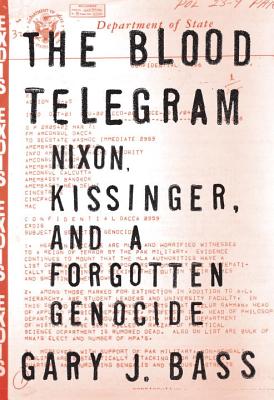
The “blood” in the title of this excellent account of Bangladeshi independence refers to Archer Blood, American Consul General in Dacca as the events unfolded in 1971. The telegram (a “cable” back to the U.S. State Department) was one he titled “Selective Genocide” to describe the clampdown by Pakistani forces—armed by the United States as an important Cold War ally—on political unrest. The “blood” of the title is a macabre double-entendre.
This and subsequent cables had little noticeable effect. Soon after
Blood and almost his entire consulate sent in a telegram formally declaring their “strong dissent” — a total repudiation of the policy that they were there to carry out. That cable—perhaps the most radical rejection of U.S.policy ever sent by its diplomats—blasted the United States for silence in the face of atrocities, for not denouncing the quashing of democracy, for showing “moral bankruptcy” in the face of what they bluntly called genocide.
Whether what happened in those very dark days was strictly, morally or even descriptively “genocide” is something I must leave to others, but the “forgotten” in the book’s title is certainly apt. “There is a gulf,” writes Princeton professor and former journalist Gary Bass, “between what Americans remember of the Cold War and what its victims remember of it.”
The Blood Telegram will no doubt be read and commented on by those that have an interest in South Asia and in the history of American foreign policy. For others, a 500-page book on what may seem to many to be by now an obscure incident in an obscure corner of the world might seem daunting. Such reticence would be misplaced: the book is not just illuminating but also very well-written. The pages almost turn themselves.
Pakistan—it helps to remember—was originally two unconnected pieces: West Pakistan (now Pakistan) and East Pakistan (now Bangladesh). The two pieces were separated not by a narrow channel or strip of land but by a 1600km expanse of India; West and East Pakistan were also almost entirely linguistically and culturally distinct. The capital was in Islamabad, a world away from Bengali East Pakistan. It seems bizarre in retrospect. Bass writes:
It would have been hard to make a united Pakistan function even if it had the best government in the world. It did not.
Pakistan was ruled by Agha Muhammad Yahya Khan, a general from West Pakistan who had taken power in 1969; he planned elections for late December 1970. This doesn’t seem to have been entirely well-thought out, for East Pakistan was more populous that West Pakistan. The Bengali Sheikh Mujib-ur-Rahman’s Awami League swept all but two of East Pakistan’s seats, giving him an outright majority. But Mujib as Prime Minister and implementation of his platform of autonomy (or more) for East Pakistan was not what the West Pakistan military and civilian leadership had in mind. What happened next is, sadly, predictable.
On the night of March 25, 1971, the Pakistan army had begun a relentless crackdown on Bengalis, all across what was then East Pakistan and is today an independent Bangladesh. Untold thousands of people were shot, bombed, or burned to death in Dacca alone...
Pakistan’s crackdown on the Bengalis was not routine or small-scale killing, not something that could be dismissed as business as usual, but a colossal and systematic onslaught. Midway through the bloodshed, both the Central Intelligence Agency and the State Department conservatively estimated that about two hundred thousand people had lost their lives. Many more would perish, cut down by Pakistani forces or dying in droves in miserable refugee camps.
There are several threads to the rest of the story, one being that once the crackdown began, the break-up of Pakistan was inevitable. But the process was almost inconceivably bloody. This thread is sad, but not particularly surprising. Bass, making use of evident journalistic experience and expertise, is unsparing in his descriptions.
The U.S. consulate gave detailed accounts of the killings at Dacca University, ordinarily a leafy, handsome enclave. At the wrecked campus, professors had been hauled from their homes to be gunned down. The provost of the Hindu dormitory, a respected scholar of English,was dragged out of his residence and shot in the neck. Blood listed six other faculty members “reliably reported killed by troops,” with several more possibly dead. One American who had visited the campus said that students had been “mowed down” in their rooms or as they fled, with a residence hall in flames and youths being machine-gunned. “At least two mass graves on campus,” Blood cabled. “Stench terrible.”
But what stands out in The Blood Telegram are the “What the hell?” moments, such as Kissinger encouraging Zhou Enlai to move troops to the India border and the American Government arguing that third-parties should not get involved because, regardless of how many people were being killed, it would be interference in Pakistan’s internal affairs. Ironies abound: the White House worrying that China might think it unreliable if it ditched Pakistan and the Soviet Union vetoing U.N. resolutions requiring democratic India to refrain from intervening to prevent the autocratic Pakistan regime massacring its own people.
Bass makes extensive use of White House tapes which allow us to hear Kissinger and Nixon musing and discussing strategy, geopolitics and their personal opinion of Indians, Indira Gandhi, reporters, Ted Kennedy, diplomats and democrats in real-time. It often reads like a movie script.
There have been revisionist attempts to rehabilitate Nixon and Kissinger since they left office. Bass shows how misguided these attempts are. The portraits painted of Nixon and Kissinger or, rather, those they paint of themselves, are—while not surprising; there already being a lot of evidence about what sort of men these were—unflattering in the extreme.
The words still have the power to shock. “Let the Indians squeal... I want a public relations program developed to piss on the Indians,” Nixon is reported as saying. Although private, the exchanges don’t show the sort of level-headed consideration one would like to think senior officials employ when making important decisions.
Nixon and Henry Kissinger, the brilliant White House national security advisor, were driven not just by such Cold War calculations, but a starkly personal and emotional dislike of India and Indians.
Bass is withering, almost mocking, when it comes to Kissinger. Undeniably intelligent, Kissinger comes across as obsequious and almost obtuse, betting on the wrong people, jumping to conclusions and denying reality when it didn’t correspond to his world view.
And Archer Blood? For blowing the whistle, he was sidelined and his promising career stalled.
Bass isn’t much given to speculation as to what might have been, had America come down on the other side. But the book almost invites readers to draw parallels to later events from Iraq and Syria to the more recent hounding of others, like Blood, who have stood up to tell the truth.