The Ballad of a Small Player by Lawrence Osborne
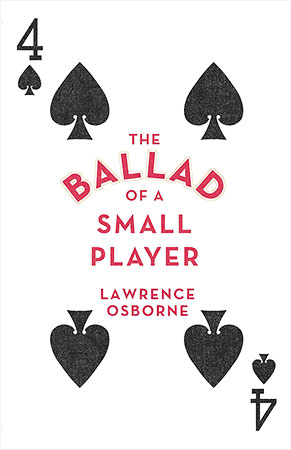
There is nothing in the title or on the stylish cover of (at least the British edition of) Lawrence Osborne’s slim new novel to indicate that the book is set entirely in Macau and Hong Kong. While an admirable breach of marketing convention, this means it may also slip unnoticed by many potential readers in what must surely be a key market.
That would be a great shame, for The Ballad of a Small Player is one of the best, and quite possibly the best, East Asian “expat novel” of the past decade. I realize with concern that this may come across as damning with faint praise.
The often pejorative “expat fiction”—applied to novels written by, in the main, white visitors to Asia—needn’t necessarily be a term of disdain, for the genre includes such writers as Somerset Maugham, Shirley Hazzard, Graham Greene, Paul Theroux and J.G. Ballard. There is no reason why Hong Kong and its sister city of Macau should not make for as great English-language fiction as such other foreign locales as Berlin or Paris, but despite—or perhaps because of—the Asian cities’ obvious attractions, lightning of the literary kind rarely seems to strike. The results are usually dreary and formulaic processions of bar girls, fast money, deadbeat caucasian males, drugs and crooks.
These elements form the basis of The Ballad of a Small Player too, but Osborne—against the odds, one has to say—pulls off a virtuoso performance that isn’t, in the end, about any of those things.
The phoney Lord Doyle, in actuality a crooked lawyer who embezzled a suitcaseful of money and scarpered to Asia, is gambling his way through his ill-gotten fortune in the casinos of Macau. His game of choice is baccarat punto blanco—“the slutty dirty queen of card games”—governed by pure luck. A score of nine, a “natural”, is the highest possible score.
Doyle has ups and downs, more downs than ups, and along with girls, drink and fancy meals, the money is dwindling. Doyle, in spite of his yellow kid gloves and smart suits, seems to be playing himself into deliberate oblivion. Doyle isn’t very likeable, even when he is.
Then he meets Dao-Ming, one of the girls that frequent such places, and his luck changes. Dao-Ming, of course, is not quite what she appears to be.
To say more, would spoil the plot. But suffice it to say that The Ballad of a Small Player is much more La Pique Dame—at least the Tchaikovsky version I know if not the Pushkin I don’t—than Suzie Wong and as such, the setting adds color and verisimilitude without becoming the point of the book.
What sets the novel apart is not so much the plotting or characterization, but the writing: the elegant prose, the changes of pace, the crisp dialogue and the descriptions that transport the reader into the scene.
She perched at the far end of the table with a vulgar little handbag of the kind you can buy in Shenzhen, badly made Fendi with gilt metal that flakes away a week, and her left hand rested protectively on a small pile of lower-denomination red chips...
She was saying thank you or some such thing, and her lips moved like two parallel fingers playing a game of rock-paper-scissors.
Chips come “in a great salacious pile”, “glass screens are frosted with images of Confucius and naked girls” and as Doyle sees himself through another’s eyes, having “the look of an New England literature professor out on town without permission from his wife”. When he drinks, it is not generically red but “Lello Douro”, the buffet sports oeufs savoyards, he frequents the very real Fernando’s, Robuchon and Pasteleria Koi Kei.
Those who don’t live in East Asia might read The Ballad of a Small Player for the exoticism of its locales and the descriptions of the extravagant seediness of the Macau casinos.
Those who live here know all this, of course. Some will read it voyeuristically no doubt, but others will be transfixed by the way Osborne has turned our corner of the world, and all those things that make it what it is, from humidity to egg tarts and gaudy statues in casino lobbies, into a story that reaches well beyond it.
Any “old China hand” thinking of turning his (or these days, her) hand to semi-autobiographical fiction would do well to read this first.
Anyone else would do well to read it too.