“The Craft of Indo-Arabic Numerals: How Practical Arithmetic Shaped Commerce and Mathematics in Western Europe, 1200-1600” by Raffaele Danna
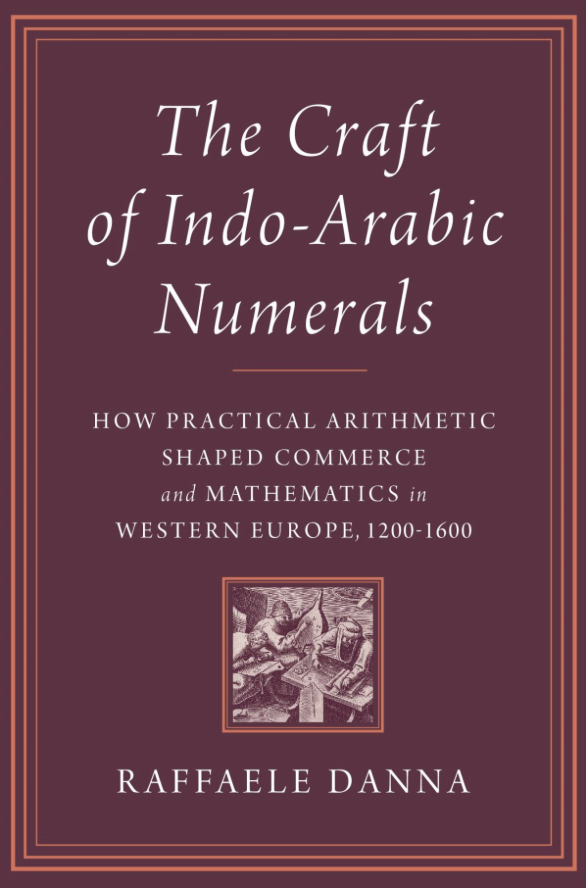
There is, despite the title, very little that is Asian in Raffaele Danna’s new The Craft of Indo-Arabic Numerals. The subtitle—How Practical Arithmetic Shaped Commerce and Mathematics in Western Europe, 1200-1600—tells it all. However, the numerals themselves—concepts of great intellectual depth and practical value—came to the West from the Arabs, and originated in India (hence Danna’s careful use of the term “Indo-Arabic”).
These numbers remained unknown to western Europe for a surprisingly long time: introduced in ancient India, they reached the Mediterranean only in the late Middle Ages… Before the introduction of the ten figures, … western Europeans did not have a sign—nor a fully-fledged mathematical concept—for the number zero. Without Indo-Arabic numerals, moreover, it was not possible to write fractions …
Although it is not his focus, Danna gives a good overview of several dozen pages on how these numerals reached Europe, via (as so much at that time) Iberia. For many decades, they were something of a niche academic interest; somewhat surprisingly, they made it to England relatively early. By the early 13th century, Indo-Arabic numerals were used to number sections of text in English Biblical sources.
Danna is however more interested in the how and the why of the more general take-up. He points to Fibonacci’s statement that “he became familiar with Arabic mathematics in the custom houses of the Maghreb, and that his work gathered mathematical knowledge he had consolidated during his commercial travels across the shores of the Mediterranean.” The first real customers (not Danna’s word but, as we shall see, an appropriate one) were found in the business world rather than universities. He starts by noting that the uptake was not obvious, for a…
base-ten structure was not neatly compatible with the array of units and measures of medieval Europe… European weights and measures were anything but standardized, and were almost universally nondecimal. The Carolingian monetary reform of the late eighth century strove to provide a common standard, but its division of the monetary unit into libra / solidus / denarius (£ / s / d) was not uniform: a solidus was made of twelve denarii, but a libra was made of twenty solidi. Moreover, while the subdivision into twentieths and twelves provided a unified standard, in time this standard was applied to a multitude of local currencies whose values diverged.
Indeed, commerce had been going on in Europe for a very long without (to use the current shorthand) Arabic numerals—the Romans managed without it, using instead their now eponymous system of I, V, X, C, etc. Danna’s convincing explanation for their uptake in the 13th and 14th centuries is the multitudes of currencies and coinage in simultaneous in the politically-fragmented northern Italy:
As a consequence of the increasing scale of trade, merchants had to deal with a growing number of currencies, weights, and measures. Especially in the Italian case, the highly fragmentated political landscape hampered standardization, with virtually every city using different units… This meant not only that Italian merchants had to deal with conversions and exchange rates for every interregional venture but also that, as a consequence of trade, several different monetary denominations circulated in parallel in the same marketplace… Furthermore, with the introduction of gold coins in the middle of the thirteenth century, the Italian monetary system became bimetallic. The value of both silver and gold coins, which was based on their content of precious metal, depended on the quotation of gold and silver. Their relative value changed frequently depending on the supply and demand of precious metal…
Arabic numerals made all of this more manageable. Danna notes that England, which had a unified silver coinage, had therefore less need of the new-fangled means of keeping accounts; general take-up of Arabic numerals happened there well after Italy.
The rest (by far the bulk of the book) is a fascinating account of both how the numerals were used, how arithmetic and mathematics were taught, where and how books were published and who used them. The Craft of Indo-Arabic Numerals is a multi-disciplinary work, covering history of science, mathematical history, economic history, social history and delves in everything from double-entry book-keeping to the technology of book printing.
It is hard to escape the conclusion that it was the introduction of Indo-Arabic numerals and their catalysing effect on trade and commerce and ultimately capitalism that led to the Industrial Revolution taking place in Europe rather than, say China. One need not invoke religion, politics, warfare or guilds: it was all caused by an intellectual development from India by way of the Arabs.