“The Competition of Unfinished Stories” by Sener Ozmen
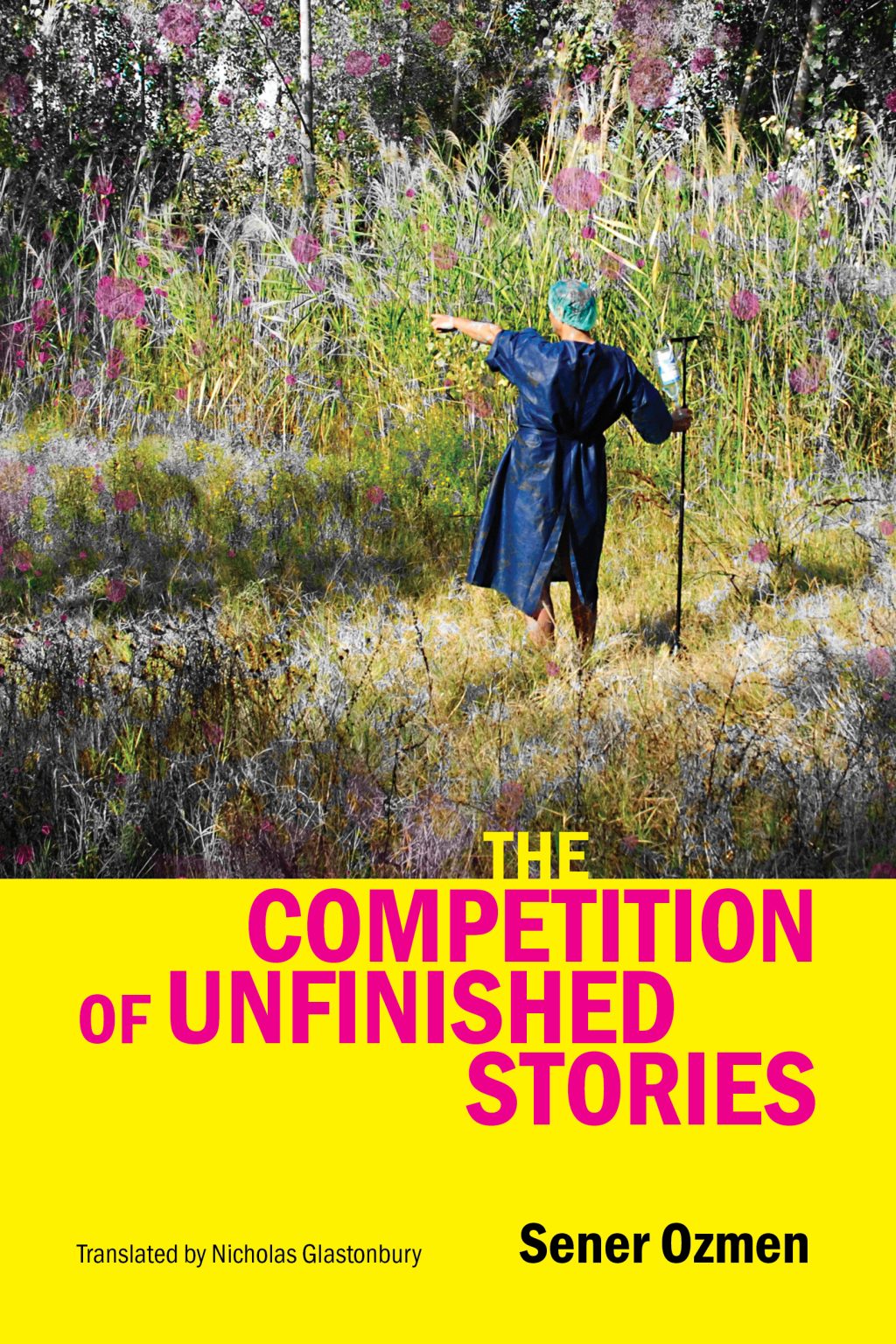
Sertac Karan, a Turkish-Kurd and the protagonist of this absurdist black comedy, is a would-be writer who is alienated from society and much given to procrastination. From childhood, his exorbitant imagination shines at creating outlandish characters, which, when he is an adult, will become actual delusions, as his fantasies invade and undermine conventional reality. First written in 2010, the novel is set between 1969 and about 2000, at the height of the vicious conflict between the Kurdish PKK and the Turkish army (during which perhaps 40,000 Kurdish civilians were killed). As the novel shows, in this period, both the use of the Kurdish language and public discussion of Kurdish cultural identity were illegal. The situation has mercifully eased since 2000, as shown by the novel’s publication in Kurdish and, even more so, by its translation into Turkish in 2015 as Kifayetsiz Hikâyeler Müsabakası.
Sertac’s descent into an underworld of ever-increasing mental disintegration and his accompanying destructive marriage to Merasîm provide the main impetus for the narrative. However, Sertac’s frequently peculiar story also serves to explore the plight of those Kurds, second-class citizens at best, living under what Sertac sees as the Turkish state’s obsessive desire for their “wholesale erasure, no matter violent or nonviolent”.
Sertac (born on 20 July 1969, the day Neil Armstrong walked on the moon) is from the Kurdish-speaking underclass (not all Kurds belong to the underclass), born in the Lower Quarter of the fictional town of Zerdav (“Zerdav” means “bile” in Kurdish). He grew up extremely poor, deprived and unloved. His family (his father, “Fethî the Postman”, his unnamed mother and his older brother, Nizam) all live and sleep in the same room and cannot afford a sofa. His mother loathes him (but dotes on Nizam) and beats Sertac incessantly for minor disobedience. As a child, a hungry Sertac, caught putting cooking oil and sugar on his bread, causes his mother to appear with, “slipper in hand, what do you think you’re eating, and beat him till kingdom come.” Sertac’s maternal uncle, Mihemed, loves him, but visits infrequently as he’s a Maoist peshmerga (guerrilla) and “hopeless romantic” who ends up “killed by some traitor, for freedom and future, on one luckless winter day.” Sertac’s childhood teaches him that his only power and pleasure lie in his creativity and skill at falsehood:
Lying and happiness; he increasingly did not know which came first, which was cause and which was consequence; he … would not stop lying.
Growing up, Sertac’s only other friend who cares about him is an imaginary one; an Islamized version of Neil Armstrong, who frequently visits the insomniac Sertac to offer consolation.
Sertac poured his heart out to Neil, hoping the astronaut would bring him to the Moon and find him a mother who wouldn’t beat him with her slipper. A mother who would love him, who would feed him meat and bananas.
His school life is equally violent, as his Turkish teachers practice both ideological assimilation and old-fashioned repression of those Kurdish children who refuse to shed tears on Atatürk’s birthday:
Members of the Teachers’ Council would raid the classroom, one of them guarding the door while the others wandered the room like wolves through a flock of sheep, beating the living daylights out of the Lower Quarter kids with canes and metal rulers until they finally did shed those tears… then make them recite those national anthems of this most modern civilization.
As an adult, Sertac aspires to be an art teacher and writer, but can only find work, reluctantly, as a confirmed atheist teaching Husn-î Xet (Arabic calligraphy), in the private “Imam Hatip School for training imams and clerics”. He is distrustful of the fact that his fellow teachers, in what he calls the Community of Believers, appear fond of him, a sign of his growing paranoia. Merasîm, a half-Kurdish, half-Turkish young woman, marries Sertac mostly out of unbridled lust, but quickly starts to regard him as a hopeless, abject failure. The infuriated, frustrated Merasîm often resorts to physical violence.
Though he hadn’t said a word about Merasîm hitting him upside the head to his “unmanly” friends, they knew as soon as they saw him that Merasîm had gotten hold of him and had, as usual, knocked his lights out. They even had a bet going among them about “how” or “with what” Merasîm had hit Sertac.
“It was an ashtray!”
“It was a pitcher!”
“No, a vase, it was a vase!”
As might be expected from Ozmen, a poet and also a prominent artist, the narrative features strong imagery. Taken on a school visit to see dead Kurdish peshmerga, strung up by the Turkish army, the officer warns the children against “join[ing] these terrorists, these Armenians, these Bolsheviks, these hoodlums, these cum stains.” For Sertac, “all he saw was yellow … a filthy … repulsive … yellow of death!”
Sertac drowned in that whole jaundiced autumn. The worst part of it all was how everything everywhere looked yellow as an egg yolk. Any person, any place, anything he turned his eyes upon, all he saw was yellow… He never so much as touched his spoon to the yellow rice they served every day at lunchtime. The yellow tea they gave him at breakfast never passed his lips.
After the paranoiac Sertac decides “not to leave the house because of fear of being tortured by the secret police”, his “unfinished stories” increasingly run out of his control, becoming more incredible and full-blown delusions, which gradually become schizophrenic hallucinations. As his descent into madness grows, these characters represent bizarre, multiple identities of Sertac, as a Turkish-Kurd, that challenge Sertac’s real identity.
One story features “Sertac, Codename Revolution”, the bravest, toughest, most masculine of peshmerga. He has a sister, Canan, who tragically and inexplicably commits suicide by rat poison while in the shower. Another story is the narrative of “Sertac Karan aka Beyond-hope Sertac”, a patient of glamorous Armenian-Turkish female psychiatrist, Dr Sarîn Zavaryan, who becomes the object of Sertac’s erotomania, except she too turns out to be another of Sertac’s fantasies. A third relates the tale of “Sertac Karan aka Three-days-earlier Sertac”, a former revolutionary returned from exile, who visits the city of Amed (the Kurdish name for Diyarbakir, Turkey) after the successful revolution, only to find everyone now walks backwards and he is living with a violent domestic cat, who unaccountably goes berserk when she hears the word “Revolution”: His housemates consider Sertac mad when he decides to “tear up a copy of Das Kapital and eat every last page”.
The Competition presents a subaltern, marginalised perspective where grotesque humour, emphatic bawdiness, clashing languages (Turkish and Kurdish in this case) and narrative chaos transgress and subvert dominant hierarchies and authority. This is an unusual, wildly inventive novel, written with gusto and lashings of Kurdish gallows humour, whose portrayal of the absurdity implicit in the predicament of Turkey’s Kurdish minority is explored via the bizarre, larger-than-life Sertac and his picaresque fantasies. Nicholas Glastonbury’s translation is vivid and evocative. Readers may well find themself undecided about whether they should laugh or cry at Sertac’s story, as well as his hopeless struggle to try to author his own narrative, but they will likely remember this novel for a long time.