Mirage, anonymous, translated from Chinese by Patrick Hanan
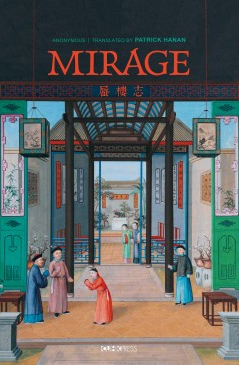
Set in the prosperous merchant city of Guangzhou towards the end of the Ming Dynasty though first published in 1804, this little-known novel takes as its primary subject the journey from (relative) innocence to experience of Jishi, the teenage son of a Hong merchant—the Guangzhou traders licensed to conduct business with foreigners in the port. However, the domestic concerns of Jishi’s adolescence are set in counterpoint to the story of a dramatic and bloody rebellion in rural Guangdong which periodically interrupts the main narrative, and sits in distinct stylistic contrast to it.
These two narrative modes pay obvious homage to two of the four classical Chinese masterpieces, the aristocratic bildungsroman Hong Lou Meng (Dream of the Red Chamber), published 22 years before Mirage in 1792, and the much earlier swashbuckling epic Shui Hu Zhuan (Water Margin). Providing further literary interest to Mirage are the novel’s notorious sex scenes, which allude directly to the racy sixteenth-century novel Jin Ping Mei (The Plum in the Golden Vase), often considered the unofficial fifth great Chinese novel.
However, Mirage is more than simply the sum of its allusions. The anonymous author of Mirage fuses the tropes of its literary forebears to create a compelling portrait of a society on the cusp of a destabilising modernity, with the structures—bureaucratic, military and social—which have held the Empire in place becoming corrupted and weakened by avarice and moral decrepitude.
The young Jishi emerges as a relative pillar of virtue in this dissolute world. When his father dies, the teenage Jishi must take responsibility for both his financial affairs, and the wellbeing of his mother and sisters. Turning his back (at least partially) on the pleasures of the flesh which had previously distracted him from his responsibilities, Jishi becomes a model of a young aristocrat, writing off the debts of the poor farmers who work his land, and providing support to those around him who become victims of the avarice of those less benevolent members of the ruling elite. Chief among them is Superintendent Heh, “thirty years old and six feet tall, with a great love of money and an equal appetite for wine and women,” who embodies the moral corruption of the age, and becomes the chief villain of the piece.
As Jishi negotiates quotidian dramas in Guangzhou, Yao Huowu, an itinerant whose brother has been wrongly imprisoned and executed, initiates a rebellion in Huizhou prefecture, gathering together a band of brothers who have suffered at the hands of corrupt officials. Part Robin Hood, part Bruce Lee, the picaresque Yao Huowu descends from a long line of male heroes in Chinese literature characterized by their exceptional physical strength, their prodigious capacity for drinking and their unsparing loyalty to their fellow soldiers. These disparate storylines are united by the figure of Jishi’s tutor, Li Jiangshan, who becomes Huowu’s benefactor, and who represents the Confucian ideals to which the author would have his heroes and readers aspire.
These central narrative strands emerge over the course of twenty-four episodic chapters, which also deal in turn with a range of more minor romantic and personal dramas. As with other such early Chinese “novels”, to offer a synopsis of Mirage is both to somewhat sell short the richness of the world it depicts, and also to force it to conform with Western notions of the novelistic narrative arc. Though shorter and somewhat easier to navigate than epics such as Dream of the Red Chamber or The Plum in the Golden Vase, characters still number into the hundreds (a character index akin to that David Tod Roy so usefully assembled for The Plum in the Golden Vase should, in this reviewer’s opinion, be mandatory for such translations), and narrative threads are often left hanging for many chapters—or, indeed, altogether. For this first English translation, however, the late Harvard scholar Patrick Hanan has rendered the novel into a clear, vernacular English, and has avoided weighing the edition down with lengthy footnotes or commentaries; this is very much a translation to be read and enjoyed, rather than simply subjected to academic study.
Though set at the end of the Ming dynasty, the novel’s key dramas echo events contemporary to its writing, in particular the rebellions by the secret society of the Tiandihui in Huizhou. The anonymous author thus adopts the politically pragmatic approach of commenting on events of the day by locating them in the era of an earlier dynasty.
It would be easy to overstate the prescience of Mirage’s anonymous author in his accounting of a society in decline, but it is also impossible to treat the novel as simply a redemptive fable. “Rise and fall in the world—they’re both impossible to predict,” says Jiangshan in final paragraphs of Mirage, yet one cannot help but reading in the fates of the novel’s characters some suggestion of the dramas the trading port of Guangzhou, and the empire more generally, were to experience in the ensuing decades of the nineteenth century.