“Trading at the Edge of Empires Francesco Carletti’s World, c. 1600”
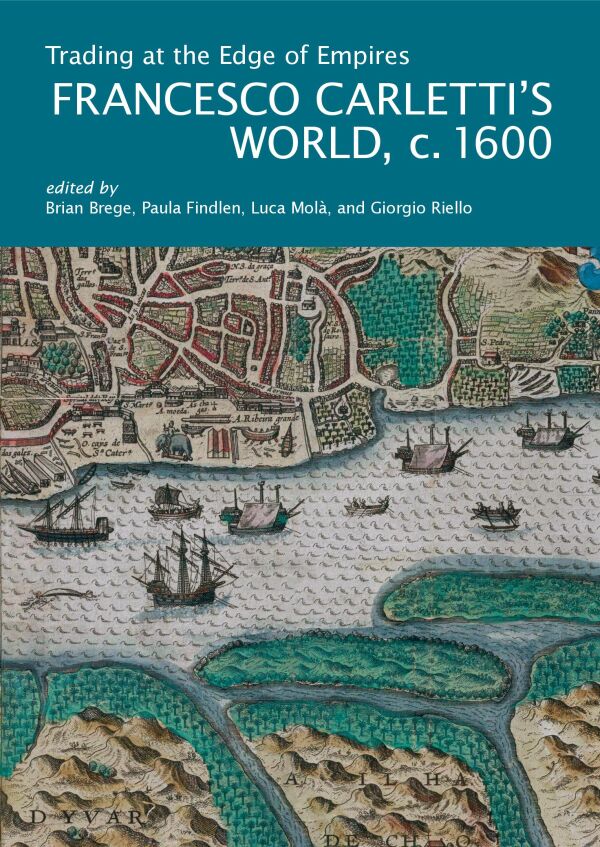
At the turn of the 17th century, Florentine Francesco Carletti left from Seville with his father Antonio for Cape Verde, where they were planning to buy slaves for resale in the Caribbean. He ended up in an almost decade-long circumnavigation of the world, the first private citizen to do so. His travels took him to Cartagena on the Caribbean coast, across to Panama, down to Lima, up to Mexico City and Acapulco to the Pacific to the Philippines on the Manila Galleon, up to Nagasaki, down to Macau, then Malacca, over to Cochin and finally Goa in Portuguese India. On his way back home, he was captured by the Dutch on St Helena; it took him years to negotiate his way back to Florence. On his return, he wrote the Ragionamenti, an episodic account of his travels and adventures, which he addressed to his patron Grand Duke Ferdinando I of Florence.
It seems inexplicable that Trading at the Edge of Empires—a project of Harvard’s Villa I Tattii—is (apparently) the first volume in English (other than translations of the work itself) on this fascinating story. This book, reflecting its origins as seminars and workshops, is a collection of some two dozen scholarly essays on Carletti and his “world”: commentary on commentary, in other words, rather than an integrated narrative biography or history. In absence of the latter or the TV docutainment series Carletti eminently deserves, it (and the editors’ introduction which goes some way to providing a narrative) is a start.
The first part of the Introduction’s summary of the voyage gives the flavour of the story.
After buying enslaved people in Cape Verde, the Carletti sold them in Cartagena de Indias, where Francesco was arrested. Securing release and permission to travel and trade in the Spanish Americas with the help of some timely Medici support, the Carletti crossed the Isthmus of Panama and arrived in Lima in January 1595 to recover their losses from selling enslaved people in the Caribbean. After buying Peruvian silver, they traveled to New Spain via the port of Acapulco, spending June 1595 to March 1596 in Mexico City. Having made a deal with the captain of one of the ships of the Manila galleon, the Carletti were then falsely registered as ship’s officers and loaded their silver for Manila, arriving there in June 1596.
Due to various political constraints between the Spanish and Portuguese parts of the Habsburg empire, the way to Macau lay through Nagasaki, so they sailed north. They arrived in Nagasaki, where their observation of the 1597 crucifixions didn’t stop them from conducting business in silver, goods and slaves and setting off to Macau, where they were promptly arrested. The father died not long after, but the son seems to have been let off, proclaiming himself Florentine and hence outside any imperial restrictions and apparently pulling strings with the Jesuits and again invoking the Medici.
Francesco Carletti spent “a profitable year and a half in Macao” and in December 1599 continued west, stopping off in Malacca and Cochin before proceeding to Portuguese Goa, where he stayed through the end of 1601. He boarded the São Tiago of the Carreira da Índia but never made it back to Lisbon, being intercepted by the Dutch.
So, quite some story. But for better (if one is a scholar) or worse (if one is looking for a rousing yarn), the story itself is not really what interests the various commentators.
There are several discussions of Carletti’s involvement in the slave trade. The misgiving he expresses about it in the Ragionamenti (“this always seems to me an inhuman traffic and unworthy of our Christian vocation and piety”) didn’t seem, as the commentators note more than once, to stop him from engaging it. One of these slaves, a Korean who was renamed Antonio, was freed by Carletti in Goa and continued with him back to Europe, ending up in Rome. However, the residents of the small Italian town of Albi, where “Corea” was a not uncommon surname, came to believe in more recent times that they were his descendants.
In the autumn of 1992, two female Italian university students, Rosa Corea and Teresa Corea, from the small town of Albi, visited the Biblioteca Angelica in Rome. Their purpose was to check the most well-known manuscript of Carletti’s Ragionamenti before their journey to the presumed homeland of their distant ancestor.
It’s a nice story, if “implausible” (in the words of Inha Park, the author of the piece), and resulted in delegations, a monument, books and musicals.
Another area of interest is Carletti’s interest in women and sex aids. Chapter titles like “Of Cocks and Commerce: Sex, Money, and Value in Carletti” and “Carletti and the World of Sex: Global Bodies and Colonial Desire” leave little doubt to their contents. Carletti seems to have been rather a gourmand when it came to women. The Indo-Portuguese women of Goa were, he thought, the most attractive; he thought the rose apple the perfect example of “what a woman’s flesh ought to be.” Those interested in early-modern sex aids should buy the book.
More edifying, perhaps, was the Chinese atlas Carletti seems to have brought with him and which is still in Florence. Jorge Flores takes up “Carletti’s Experience of Portuguese Asia”. Carletti wrote extensively about food, cultural practices and language; there is much here to be learned on the nature of global trade at the turn of the 17th century.
There are some areas one wishes that authors had covered in more detail. One has to go to the original to find out what Carletti wrote about his voyage on the Manila galleon. Indeed, the contributors to Trading at the Edge of Empires might have profited from quoting and including more details of what Carletti actually wrote. That, one hopes, is food for another book.
Trading at the Edge of Empires is a reminder of how many different nationalities were in Asia just three decades into the start of the annual voyages between Acapulco and Manila and how knitted together the world already was. Once globalisation started, it proceeded rapidly.