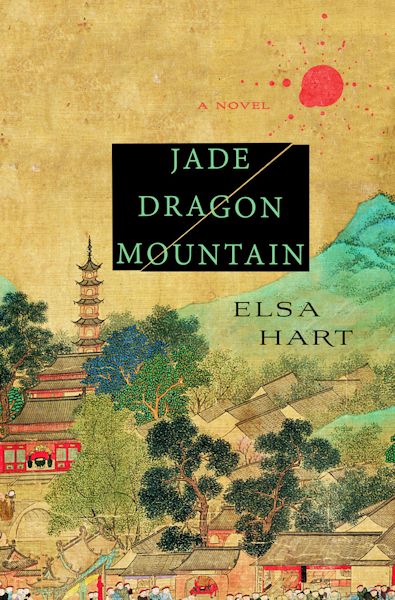
Jade Dragon Mountain by Elsa Hart
Over the last decade or so, Yunnan—China’s most south-westerly province—has become something of a playground for young Chinese urbanites looking to escape the crowds and the smog of the major cities along the eastern and southern coasts of the country. Yunnan’s temperate climate, romantic associations (James Hilton’s invented Shangri-La is often said to have been inspired by the landscape of northern Yunnan) and cultural and ecological diversity have driven its development as a tourist destination. The town of Lijiang—known historically as Dayan, and now a UNESCO World Heritage Site—has become a focal point for this development, drawing millions of visitors each year to its cobbled and commercialised streets.
Historically, however, Yunnan was seen by the Chinese ruling classes as hostile territory: remote, topographically unforgiving and tricky to keep in order. It was (and remains) the very periphery of the middle kingdom, where the gravitational pull of the capital is at its weakest.
Such liminal spaces are fertile ground for fiction, and in her debut novel, Jade Dragon Mountain, Elsa Hart exploits her remote setting to good effect. Set in 1708, Hart’s novel begins with the arrival at Dayan of the exiled mandarin Li Du, who wishes to discreetly and quickly register his arrival in this new prefecture before continuing on his travels. Li Du’s arrival coincides, however, with the preparations for a festival commemorating the visit of the Kangxi emperor, who will be present in Dayan for an unprecedented display: a total eclipse of the sun commanded by the emperor himself.
These preparations are led by the magistrate of the prefecture: Li Du’s cousin, Tulishen. During Li Du’s brief stay at Tulishen’s mansion, an elderly Jesuit monk and fellow guest of the magistrate named Brother Pieter is found murdered in his room. Despite Tulishen’s insistence that any fuss must be minimised in advance of the emperor’s arrival, Li Du’s suspicions, coupled with the evidence he uncovers, leads his cousin to authorize Li to attempt to track down the killer in advance of the emperor’s arrival just three days later.
From this point onwards, Jade Dragon Mountain becomes a fairly conventional whodunnit, with a diverse cast of characters, each with motivation and opportunity, and the magistrate’s mansion standing in for an English country house. As such, it delivers the conventional pleasures of the genre effectively, compelling the reader onward through the narrative towards an elegant solution.
Jade Dragon Mountain is also, however, a commentary on the limitations of political control. Initial blame for Brother Pieter’s murder is placed upon the Tibetan bandits who roam the mountains around Dayan, and the magistrate is constantly aware that though “surrounded by peasants barely aware of Qing rule”, his political fate will be determined by his success in imposing that rule. There is a sense throughout the novel that the fragile hold on authority claimed by those in positions of power is at the mercy of forces, both political and cosmological, outside their control. As such, Jade Dragon Mountain achieves an allegorical resonance which enables it to transcend the superficialities of its genre.